![[Visual] Stock behavioral targeting](http://images.ctfassets.net/gwbpo1m641r7/2M3546AIPufdkh1GubCWEx/fad2c28b3461b586842dee5322002a92/BLOG-ux-analytics-tools-3182742.jpeg?w=946&q=85&fit=scale&fm=avif)
When it comes to customer service, many organizations think fewer calls equal lower costs. But this isn’t always true—in fact, many call reduction strategies rack up long-term costs due to poor experiences and missed opportunities.
The goal isn’t to deflect as many calls as possible. It's to solve the underlying issues behind calls that could have been prevented, freeing up more time for the ones that close sales, drive expansion, and build long-term loyalty and retention.
To do this, you need to understand why people are reaching out in the first place instead of just pushing them away to meet deflection KPIs. Connecting conversation insights to experience data makes the cost of every call clear, revealing which ones can be prevented, which ones are worth protecting, and how to tell the difference. In this article, we cover:
The real cost of customer calls
Why blanket call deflection isn’t the answer
How to identify avoidable calls using conversation intelligence
How to pinpoint the root cause of avoidable calls
Key insights
An avoidable call is one that a better digital experience could have prevented, for example, calls caused by a technical error, confusing navigation, or missing information. A valuable call is one that presents an opportunity to convert, retain, or deepen your relationship with a user.
An AI agent that deflects contacts but quietly suppresses conversions saves money on support while costing more in revenue. Don’t just measure containment rate; use sentiment and conversion data to get the full picture of AI agent performance.
It’s impossible to tell which conversations are avoidable and which ones lead to long-term impact when channels are siloed. AI-powered conversation intelligence tools analyze 100% of customer calls and interactions across support, marketing, sales, and product, so every team can align around customer needs, prioritize effectively, and ship fixes faster.
How much does a customer call actually cost?
Many businesses think of customer service in terms of cost per contact: the total operational cost to handle a call or conversation from beginning to end. This is calculated by dividing the total support costs (including agent salaries, software licences, equipment costs, and office rent) by the total number of contacts in the same period.
For example, if your monthly support cost was $10,000 and you handled 1,000 contacts, your cost per contact would be $10.
But this formula doesn’t capture the true cost of negative customer experiences or avoidable calls, which often have a much greater impact. Research shows that many customers reduce or completely cease spending on brands after a poor experience, costing businesses approximately $3 trillion per year globally, according to Qualtrics XM Institute’s 2025 Global Consumer Study.
Every avoidable contact also represents:
Wasted acquisition spend: you paid for someone to land on a broken experience or confusing page, reducing the ROI of your marketing budget
A missed conversion: opportunities fall through when users don’t get fast, clear answers to inquiries during the consideration stage, resulting in lost revenue
A lost customer: poor experiences and bad service lead to customer churn, forcing businesses to focus on acquiring new customers instead of retaining the ones they have
Reputational damage: customers share negative experiences online or with friends, leading others to avoid your brand
Pro tip: understand why users are reaching out—and what to do about it—with Contentsquare’s Conversation Intelligence. It automatically analyzes 100% of voice, chat, and email interactions to reveal which contacts are driven by avoidable friction and which ones lead to conversion or expansion, so you can take action to improve the customer experience.
INSERT VIDEO
What is call deflection and why it doesn’t work
Deflection is the practice of reducing customer calls or contacts by guiding them to other, less expensive channels, like self-service knowledge bases, community forums, or AI agents and chatbots.
It’s a classic call center cost reduction technique. On paper, it saves money by lowering cost-per-contact, reducing the inbound volume your human support team—your most valuable customer service resource—has to deal with.
But avoiding talking to your customers isn’t always what’s best for their experience—or your business:
Deflecting all contact indiscriminately doesn’t solve the underlying problems driving it, like on-site errors, which will continue to frustrate users
Many customer calls are actually opportunities to convert, retain, or delight your customers, which blanket deflection misses
Deflection shuts down one of your most vital feedback and improvement channels: what your customers are telling you
For example:
You deflect calls about a technical issue to a help article → but the problem is with your website, not user behavior, and the issue continues to drive contacts and lose sales
You route calls about account cancellation to a self-serve user guide → but a conversation with your team could retain them with a cheaper plan
Your AI agent lowers the cost-per-contact → but increases customer frustration, causing more customers to churn
Deflection can still be a helpful strategy, but it needs to be used carefully. The strongest results come from combining deflection with human judgement where needed to provide the right support at the right time. Contentsquare’s 2026 Benchmarks Report found that conversations that combine bots and humans resolve at nearly double the rate of bot-only interactions (57% versus 29%).
To apply it correctly, you must understand all of your conversations and their impact. This way, you can deflect unnecessary and low-value conversations and reallocate resources for the most important ones, without damaging the customer experience or business outcomes.
How to identify which calls are avoidable vs. valuable
The goal isn’t fewer contacts. It’s fewer avoidable contacts. But how do you know which is which?
This is where contact drivers come in. Contact drivers are the categorized reasons customers reach out, such as order issues, technical problems, or product questions. But when you’re dealing with hundreds or thousands of customer interactions every day, dispersed across email, chat, and phone, it’s impossible to manually review them all to find the common threads.
Modern conversation intelligence software uses AI to automatically analyze all customer interactions across text and voice channels, uncovering the exact trigger behind each call or message for faster routing and resolution—no manual tagging necessary.
![[Visual] conversation-intelligence-contact-driver](http://images.ctfassets.net/gwbpo1m641r7/2tHMu1S8P79JZ2xJcvzLkI/94c64cd61b9e116f837353d2a979921e/conversation-intelligence-contact-driver.webp?w=1280&q=85&fit=scale&fm=avif)
The contact driver hierarchy in Contentsquare’s Conversation Intelligence
With this information, you can explore contact drivers by
Volume: the number of contacts about a specific topic
Sentiment: how customers feel about specific topics
Conversion impact: which contact drivers influence conversions and revenue
This lets you separate the noise from the signal, so you can see which calls and contacts are avoidable, which ones are low priority, and which ones are the most valuable to your business.
For example, volume doesn’t always correlate with importance. A high-volume contact driver with a low impact on sentiment and conversion is less urgent than a low-volume one with an outsized effect on both—but when your phone lines and inbox are overrun with the same issues, it can be hard to tell. Once you can see the difference, you know what to focus on and how to allocate your resources to improve customer experience ROI.
How to trace an avoidable call back to its digital root cause in 4 simple steps
Once you identify which calls are avoidable, use customer experience analytics tools to investigate, contextualize, and quantify the root cause behind the contact.
1. Explore contact drivers
Use conversation intelligence software to surface contact drivers, emerging issues, and common questions. Analyze conversations at scale to spot patterns across all channels—not just support sources—that you might otherwise miss.
For example, Contentsquare’s Conversation Intelligence capability highlights a spike in ‘checkout error’ calls from users who tried to make a purchase but aren’t sure if their order was confirmed or payment processed—and are anxious about whether they’ve been charged or not.
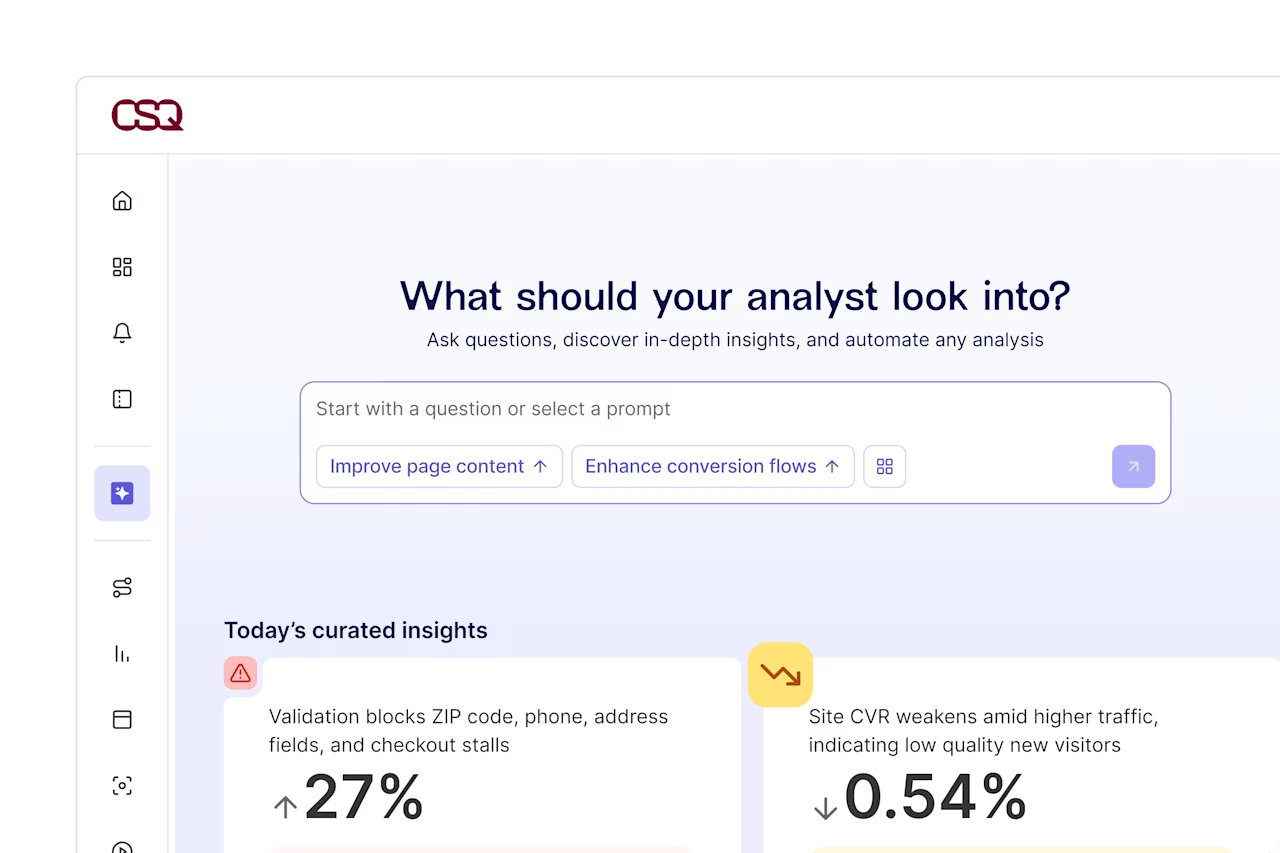
Pro tip: query conversation insights using Sense Analyst, Contentsquare’s built-in AI agent capable of complex, multi-step analyses. Ask Sense Analyst questions like
Which contact drivers have increased this week?
Which issues have the most negative sentiment?
What are the top contact drivers for users on each pricing tier?
Sense Analyst delivers immediate, data-backed answers based on your conversation data, so you can quickly home in on the most important issues and get recommended next steps.
2. Identify where the friction happens
Once you’ve identified a pattern, analyze the customer journey to pinpoint where the issue occurs. This lets you investigate exactly which pages users visit before and after contacting support, connecting the conversation topic to a specific moment in the digital journey and providing deeper context.
For example, using Contentsquare’s Journey Analysis tool may reveal that users who experienced the checkout error refreshed the payment page multiple times, returned to the cart, or looked for support articles in your help center before getting in touch with your team. Comparing these journeys with those of users who successfully completed transactions shows you where the friction actually happens.
![[Visual] advanced-journey-analysis](http://images.ctfassets.net/gwbpo1m641r7/7CgyI9hKeh4DseAVNABK1s/3b7a109c25bc371386321918fa4b4d8f/advanced-journey-analysis.png?w=1280&q=85&fit=scale&fm=avif)
3. See what users experienced
Contextualize the issue with session replays, playbacks of individual users navigating your site from beginning to end, to see the experience through affected users’ eyes and verify exactly what happened.
For example, use Contentsquare’s Session Replay capability to watch user checkout journeys with a high frustration score. These replays may show you that the ‘checkout’ button doesn’t change color when users interact with it, leading them to click repeatedly because they’re unsure whether the action went through.
![[Visual] CSQ-Frustration-Score](http://images.ctfassets.net/gwbpo1m641r7/42XUbRA4QZNcWpukMpln1m/44c3ab68cd5de383e3811680e94bd8a5/CSQ-Frustration-Score.png?w=1280&q=85&fit=scale&fm=avif)
4. Quantify the revenue cost
Now that you’ve traced the contact driver back to its source, assess its impact. Measure the revenue or conversion cost of the issue to understand what needs urgent attention and make a clear business case for prioritizing the fix over other roadmap issues competing for the same resources.
Use Contentsquare’s Impact Quantification capability to assign a dollar value to the problem. For example, Impact Quantification might show that the ‘checkout error’ issue is affecting an estimated 100,000 users with a projected revenue loss of $5M. Use these projections to get stakeholder buy-in and align teams around solving the problem quickly, before it affects your bottom line.
![[Visual] Impact Quantification](http://images.ctfassets.net/gwbpo1m641r7/4IJqJ0oQjeIPQarJo5Penh/7b50e86a64798268f7ce9bf84184815a/Impact_Quantification__1_.svg?w=655&q=85&fit=scale)
Fix the digital experience, reduce call volume
Once you understand what’s driving avoidable customer calls and contacts, you can proactively address it, saving time and effort for both your customers and your team.
When you fix the root cause of avoidable calls, that issue’s contact volume drops to zero—not because you deflected customers, but because the reason they were reaching out ceased to exist. For example, you add a confirmation message and enhance the color of the confusing checkout button to reassure customers that their order went through, eliminating the need for them to get in touch in the first place.
This reduces overall call volume, streamlines the user journey, and gives your team more time to focus on increasing conversation resolution rates for high-value topics.
This is the metric shift you should be tracking. Instead of blanket deflection rate KPIs, teams need to identify which avoidable calls are driving the highest contact volume, fix the underlying digital experience issue, and monitor whether the volume drops—to validate that the problem is resolved.
Rather than cost per contact, teams should measure time saved, revenue recovered, and new opportunities found.
We have actually shaved a little over three minutes of AHT [Average Handle Time] now that we don’t have the agent tag tickets anymore. That has reduced our cost per case by 23%.
FAQs about customer call costs
Many organizations focus solely on cost-per-contact, which is the total operational cost of handling a call. But the real cost of avoidable calls—and the poor customer experiences that come with them—is much greater, including
Wasted acquisition spend
Missed conversions
Customer churn
Reputational damage

Anna is a freelance content writer and strategist specializing in B2B SaaS. She's written for industry-leading companies like Contentsquare, Hotjar, Intercom, DocuSign, HubSpot, and more. When she's not writing, she spends her time reading, drawing, and hanging out with her cat.
![[Blog] [Visual] Perceived performance optimization](http://images.ctfassets.net/gwbpo1m641r7/1IVk6m2Z4Nrxievl7vXGIy/8cf2dc036eb47d62b4636a0eb59fbcbb/Copy_of_pexels-diva-plavalaguna-6147020.jpg?w=624&q=85&fit=scale&fm=avif)