![[Visual] Website software - stock](http://images.ctfassets.net/gwbpo1m641r7/2kYw6mr9AELodQ2vTQBsvQ/b327161ce5bf0dc830fcb03d7b58e2c6/AdobeStock_567047837.jpeg?w=1280&q=85&fit=scale&fm=avif)
When it comes to implementing customer interaction technology, many teams get stuck on specifics: traditional chatbots or conversational AI?
The truth is that it isn’t either/or. Both can work—what really matters is how you use them. Data-driven, strategic teams analyze conversations—regardless of the technology they deploy—to make targeted customer experience (CX) improvements, transforming their investment into a competitive differentiator.
In this chapter, we cover the key differences between chatbots and conversational AI, how to evaluate which is right for your business, and—most importantly—what to do with the data to get maximum ROI.
Key insights
Customer interaction technology is no longer just for support tickets. Today, businesses use these tools to guide customers throughout the entire journey, from initial evaluation to long-term success, and unlock insights that enhance customer experiences, inform product and campaign decisions, and drive business growth.
Technology isn’t a replacement for processes; it should complement them. Before you add a chatbot or conversational AI to your tech stack, ensure you have a solid foundation in place, like clear workflows, defined escalation paths, and up-to-date knowledge bases.
Regardless of technology, human oversight and guardrails are essential to ensuring a positive end-user experience. Regularly review customer conversations to identify pain points and opportunities, and stay empathetic and customer-centric even as you scale.
What is a chatbot?
A chatbot is a computer program that people communicate with via text or speech. Traditional rule-based chatbots use scripted logic and decision trees to respond to questions or keywords with pre-written answers. For example, if a user sends a message with the word ‘refund’, it triggers a response outlining your business’s refund policy.
Some chatbots provide multiple choices for users to select from, limiting open-ended inputs and guiding users through specific flows to provide the right information (like “Why are you getting in touch?” → “I have a problem with my order” → “My order is late” → “Here’s what to do if your order hasn’t arrived yet”).
Rule-based chatbots are commonly used for predictable, deterministic processes like
Answering frequently asked questions
Routing queries to the right team (like support or sales)
Capturing leads and collecting qualifying information
Booking appointments or scheduling reservations
![[Visual] HubSpot-chatbot-builder-transparent](http://images.ctfassets.net/gwbpo1m641r7/qltST5eoaxu7aDDPcaUsw/8df04681ff1c35f6226932cbba411825/HubSpot-chatbot-builder-transparent.jpg?w=1280&q=85&fit=scale&fm=avif)
Source: hubspot.com
However, because they’re fully pre-programmed, this type of chatbot has limitations that can cause user frustration:
They lack contextual awareness and don't retain information for future queries
They struggle to handle unexpected inputs and can break easily
They require resources to update and maintain, even when using code-free or low-code builders
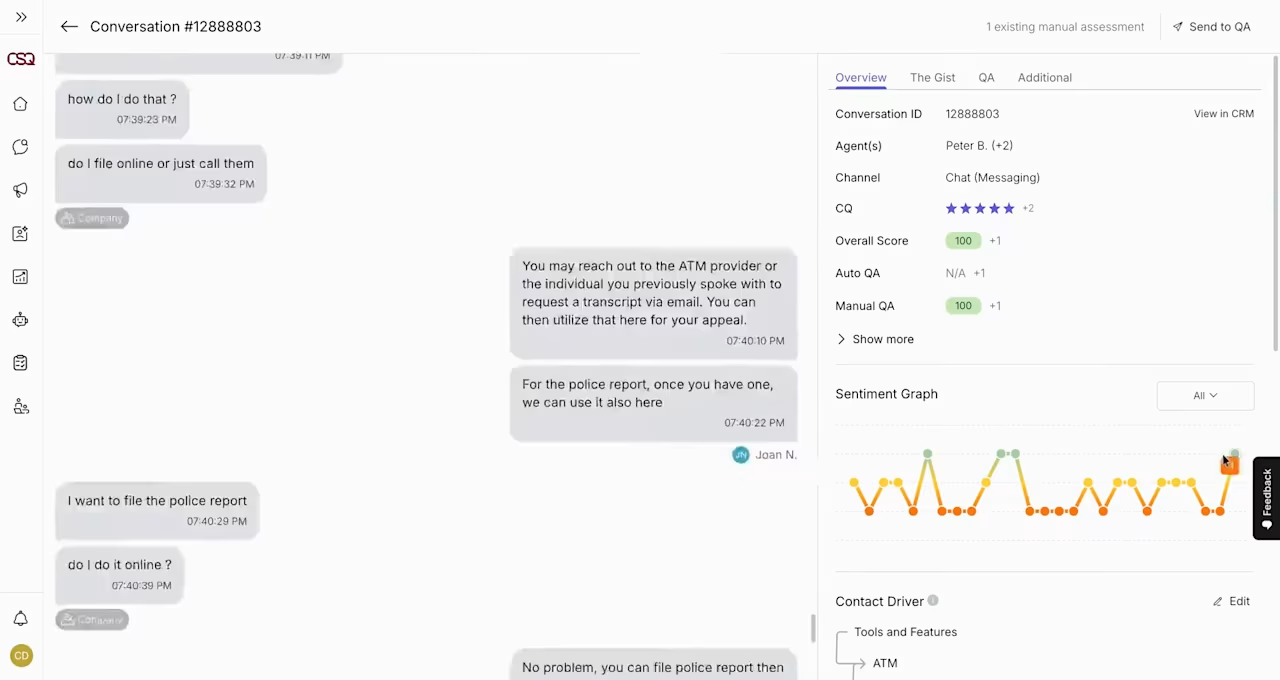
Pro tip: Contentsquare’s Conversation Intelligence helps you analyze and improve both chatbot and conversational AI flows at scale, so you can see what’s working—and where you need to improve.
Use Conversation Intelligence to explore your existing chatbot conversations and discover:
What customers are actually asking compared to what your bot currently covers
Topics or user flows that frequently end in drop-offs instead of resolutions
Which bot conversations lead to frustration and negative sentiment
Recurring themes and topics you could automate to save time and reduce cost per contact
Then, make data-driven optimizations to your scripts and decision trees to deliver better user experiences.
What is conversational AI?
Conversational AI is technology that conducts human-like conversations, understands the user intent behind queries, and responds dynamically using generative AI. It draws on:
Artificial intelligence
Large language models (LLMs)
Natural language processing (NLP)
Natural language understanding (NLU)
This enables context-aware, multi-turn, intent-driven conversations. Unlike rule-based chatbots, conversational AI can handle ambiguity by inferring meaning and retaining context. AI models also learn and adapt over time, with each interaction fuelling future responses.
Conversational AI appears in many forms, including
AI-powered chatbots (like Intercom’s Fin and Zendesk’s AI agents)
Virtual assistants built into operating systems and devices (like Apple’s Siri and Amazon’s Alexa)
AI assistants (like ChatGPT, Gemini, and Claude)
In-platform AI assistants (like Contentsquare’s Sense Analyst) that let you ask questions about your data in natural language
![[Visual] 360 experience](http://images.ctfassets.net/gwbpo1m641r7/3USnare8ZNuuBBXsWF1lZo/925613fe1be1a83834ce46b2f9eb6623/360_experience.jpg?w=623&q=85&fit=scale&fm=avif)
However, there are some considerations to be aware of:
AI models can have hallucinations, presenting false information as factual
Conversational AI is only as good as the knowledge bases it’s trained on, relying on clear, structured, and up-to-date information to work effectively
Conversational AI still requires guardrails and human judgement to ensure responses are consistent and accurate
Today, many modern platforms combine chatbots and conversational AI, blending rule-based and AI-powered logic to provide the right experience at the right time based on user (and business) requirements.
Pro tip: Contentsquare’s Conversation Intelligence automatically evaluates every conversation—both AI and human—to ensure they meet your standards, enabling you to maintain quality even as you scale.
The tool’s AI Agent Analytics feature tracks the number of conversations your chatbot or conversational AI handles, the rate of automated resolution, how often conversations are transferred to a human, and the abandonment rate. See where it succeeds or struggles (such as topics that frequently result in transfers or customer abandonment) to pinpoint how to improve responses, guardrails, and escalation paths.
![[Visual] Contentsquare-Conversation-Intelligence-AI-Agent-Analytics](http://images.ctfassets.net/gwbpo1m641r7/6tHHk2GowvcMzAkb1WbLps/f2f0ee171e95e0aabec284390c0d26a1/Contentsquare-Conversation-Intelligence-AI-Agent-Analytics.png?w=1280&q=85&fit=scale&fm=avif)
The key differences between chatbots and conversational AI
Some of the most significant differences between chatbots and conversational AI include:
Capabilities: chatbots provide basic, rule-based interactions, while conversational AI understands intent, retains context, and personalizes responses using previous interactions and integrated business data
Investment: chatbots may be cheaper initially but require ongoing maintenance as you scale, while conversational AI has a higher upfront cost but is capable of learning and adapting to new use cases
Use cases: chatbots are best suited to predictable, repetitive tasks, like answering FAQs and scheduling, while conversational AI is better for complex, multi-step interactions
| Rule-based chatbot | Conversational AI |
|---|---|---|
Technology stack | If/then rules engine, decision trees, keyword matching | NLP, LLMs, machine learning, AI models, integrations |
Setup complexity | Requires manual setup using coding or visual builders for each conversation flow | Draws on existing knowledge sources, but requires prompt engineering, testing, and integrations with business systems (e.g. CRM) |
Scalability | Limited: requires manual updates and maintenance as use cases grow or change | Highly scalable: learns and adapts with each conversation |
Contextual understanding | Limited: follows predefined paths, struggles with ambiguity, and doesn’t retain conversational context | High: infers user intent, understands natural language, and retains conversational context |
Personalization | Limited: uses provided responses and basic customer data | Extensive: draws on previous conversations, user history, and integrated data from other business systems |
Use cases | Pre-defined and deterministic processes: FAQs, basic customer support, lead qualification, scheduling | Complex, multi-step interactions: tailored customer support, sales, marketing, customer engagement |
Cost | Lower implementation cost, requires additional resources to scale and maintain | High upfront cost |
When to use a chatbot vs. conversational AI: 4 factors to consider
Whether you should choose a rule-based chatbot or conversational AI depends on several factors:
1. Business maturity
Business maturity isn’t just about how long your business has been operating. Brand-new startups may have solid processes that long-running companies never formally established (or documented). Ask yourself:
What volume of conversations are you currently dealing with?
Do you have defined processes for conversations already in place?
Do you have an accurate, up-to-date knowledge base?
What resources are available, including team capacity and budget?
If you’re dealing with a low volume of simple conversations, a basic rule-based chatbot to handle repetitive tasks may be all you need. On the other hand, if you’re looking to scale your customer experience, conversational AI may be worth the investment, allowing you to provide personalized CX without requiring additional headcount.
2. Use case complexity
What kind of conversations are customers currently having? Ask yourself:
Do most conversations follow similar paths and have predictable outcomes?
Could the majority of conversations be resolved with an FAQ?
Are customers asking complex questions that require context and information from multiple business systems (like in-depth questions about their subscription history)?
If your team members are spending a long time switching between tools to gather information and effectively respond to conversations, conversational AI may free up time for higher-value tasks.
3. CX goals
What are your big-picture CX goals and how will your chosen tool help you achieve them? Ask yourself:
Are you primarily looking to reduce response times and handle high volumes of routine queries more efficiently?
Is personalization a priority—do customers expect tailored interactions based on their history or preferences?
Are you focused on reducing customer effort and friction at key points in the journey?
Do you have targets around customer satisfaction (CSAT) or Net Promoter Score® (NPS®) that you need to move the needle on?
If your goals are largely operational—handling volume, reducing costs, and resolving repetitive queries—a rule-based chatbot may be sufficient. But if you're aiming to meaningfully improve satisfaction, reduce friction across complex journeys, or deliver personalized experiences at scale, conversational AI gives you the flexibility and intelligence to get there.
4. Total cost of ownership
It’s not a simple binary between cheap (rule-based chatbots) and expensive (conversational AI). In addition to the initial investment and implementation fees, remember that both technologies require ongoing resources, like
Team time to manage chatbot design, update AI knowledge bases and prompts, and test end-user flows
Monitoring and quality assurance (QA) to ensure responses are accurate and on-brand
Technical maintenance and operational costs, such as integrations and upgrades as you scale
In addition, consider the long-term return on investment as well as the immediate price tag. A cheaper tool that requires significant team resources to maintain and update may ultimately be less cost-effective than a more expensive solution that requires less maintenance and can handle a greater volume and complexity of customer conversations.
Use case | Chatbots | Conversational AI |
|---|---|---|
Low volume of simple conversations | ✅ | |
Conversations that follow predictable paths | ✅ | |
Frequently asked questions | ✅ | |
Complex conversations |
| ✅ |
Multi-step processes |
| ✅ |
Highly personalized conversations |
| ✅ |
Gathering context across multiple business systems |
| ✅ |
Scaling CX without adding headcount |
| ✅ |
How to measure and improve chatbot and conversational AI performance
Whether you use a chatbot or conversational AI—or a mix of both—what really matters is how you use it. The greatest ROI comes when you learn from every conversation and make data-driven improvements that enhance experiences and help you reach your CX goals.
This is where conversation intelligence comes in: with the right software, you can consolidate data from 100% of customer conversations across all channels (including chat, email, and voice) to uncover powerful insights and optimize your CX strategy.
Here’s how to use conversation intelligence to measure and improve performance across chatbot and conversational AI.
1. Track key metrics
Start by defining your KPIs. These may include
Containment rate: the percentage of conversations fully resolved by your chatbot or AI without requiring human intervention (also known as the rate of automated resolution or ROAR)
Escalation rate: the percentage of conversations escalated to a human because your chatbot or AI was unable to resolve them
Resolution rate: the percentage of conversations successfully resolved overall
Sentiment analysis: how users feel during the conversation
Customer satisfaction (CSAT): how satisfied customers were with the interaction overall
Time to resolve (TTR): how long it took to fully resolve the conversation from first contact
Conversion rate: the percentage of chatbot or AI-assisted conversations that result in customers completing a desired outcome (like booking a demo or signing up)
Consider these metrics together to get a full understanding of performance. For example, a high containment rate is only valuable if those conversations also have a high CSAT score. Similarly, a longer time to resolve may not be a sign of inefficiency or poor experiences. With AI or chatbots handling more straightforward conversations, teams are left with more complex, high-value queries that may naturally drive up TTR.
Pro tip: when it comes to resolving conversations on their own, bots are better suited to certain topics over others. According to Contentsquare’s 2026 Digital Experience Benchmarks report, the topics with the highest bot-only resolution rates are:
Account management (37%)
Orders (29%)
Billing and payments (25%)
Explore your own metrics by topic to understand where automation excels—and which areas still need a human touch.
2. Analyze conversation data to find issues and opportunities
Next, look at your conversations to find common patterns, understand customer needs, and identify improvement opportunities.
Use Contentsquare’s Conversation Intelligence to
Uncover why users really reach out: the Conversation Insights feature lets you analyze every customer interaction at scale and explore how sentiment shifts over time. The Contact Drivers feature reveals the intent behind each conversation to surface common topics and which area of the business they relate to (like billing or account management), Emerging Issues spots spikes in conversation volumes so you can take proactive action, and Root Cause connects contact to underlying policies or product issues, helping you work quickly to prioritize fixes based on impact.
Connect what users say with what they do: Contentsquare’s all-in-one platform uniquely enables teams to combine user behavior data from Product Analytics with insights from customer interactions. Reveal how conversations impact conversion, identify friction points in the user journey, quantify the impact on revenue, and reach out to users who didn’t convert to close the loop. Accelerate analysis with Contentsquare’s built-in AI agent, Sense Analyst, to connect the dots across your entire experience dataset and deliver targeted, comprehensive insights.
Validate performance: many conversational AI platforms charge per resolution, but can you verify those resolutions actually solve customer problems? Using an independent CI platform gives you deeper analytics with independent objectivity, so you can confidently verify what’s working—and ensure you’re getting the best ROI from your investment.
3. Make improvements and monitor results
Based on your findings, make improvements like
Creating additional chatbot answers or knowledge base content for your conversational AI to draw on to fill in gaps or automate more use cases
Fixing common contact drivers, like technical issues or confusing navigation, to reduce user friction
Adjusting escalation policies to ensure high-stakes conversations, like ones that show early signs of churn, are flagged early and routed to the right people
Then, measure the impact on the metrics you identified earlier to validate your changes. Use built-in reporting, like Conversation Intelligence’s Briefing Room, to get exec-ready summaries of your top issues and opportunities, simplifying continuous improvement and monitoring.
![[Visual] conversation-intelligence-briefing-room](http://images.ctfassets.net/gwbpo1m641r7/66AutCU0JsjHTRiftM8qRT/b4a88a30260faec2735da54df5c0531c/conversation-intelligence-briefing-room.jpg?w=1280&q=85&fit=scale&fm=avif)
It’s not about the tool. It’s how you use it.
Whether you choose a chatbot or a conversational AI platform, it’s how you use the resulting data that will make or break your strategy.
Conversational intelligence is the missing layer that turns customer interactions into actionable insights, giving you valuable feedback that doesn’t just unlock better ROI from your technology investment—it helps you enhance the entire customer journey.
FAQs about chatbots and conversational AI
A chatbot is a computer program that human users have conversations with via text or speech. Traditional rule-based chatbots follow scripted logic or decision trees.