
The information on this page is correct as at 31/08/2026 to the best of Contentsquare's understanding.
On paper, Contentsquare and Amplitude overlap more than they used to: they both combine product analytics, session replay, conversation intelligence, and AI analysis.
But in practice, Contentsquare and Amplitude are suited to completely different use cases, industries, and teams.
Amplitude is popular with technical product and engineering teams, typically at SaaS companies, with the engineering time and resources to plan tracking and keep it running.
Contentsquare (that’s us, hello! 👋) delivers results to every team, from product to marketing to ecommerce, with self-serve answers and expert-level next steps built on the best automatic web and mobile data capture in the market.
In this comparison, we look at Contentsquare and Amplitude side by side to show you which platform delivers the insights and outcomes your team really needs.
TL;DR
Amplitude is primarily a product analytics platform for product teams testing features, tracking rollouts, and running experiments. Amplitude requires teams to plan the business-critical events they want to track in advance and manage manual updates. It’s popular with engineering-heavy, product-led SaaS companies that have the dedicated technical resources needed to build and maintain their data setups
Contentsquare is a complete experience intelligence platform that automatically captures all web and mobile behavior, feedback, and conversations without manual tagging. AI analyzes every touchpoint and prioritizes fixes and opportunities by business impact, giving all digital teams (including product, ecommerce, marketing, and UX) data-backed next steps to prove their impact and drive growth
According to a Forrester Total Economic Impact™ study, Contentsquare delivers 602% ROI, almost 3x more than Amplitude’s 217%
Amplitude’s AI analysis is only as complete as your tracking plan. Contentsquare’s Sense AI proactively surfaces insights across your autocaptured dataset and gives every digital team self-serve insights
Amplitude includes native A/B testing. Contentsquare enhances your favorite testing tool by showing why variants perform differently through side-by-side visual analysis and conversion impact
Amplitude focuses on product metrics. Contentsquare is built to drive holistic growth across the entire customer experience, from finding errors with Synthetic Monitoring to visualizing cross-device engagement with web and mobile Heatmaps and Zoning
Choose Contentsquare to start fast, automatically capture complete data to search retroactively anytime, and give every digital team prioritized, expert-level next steps to drive growth
Choose Amplitude if you want product analytics, feature flags, and experimentation in one tool, and you have the engineering resources and budget to plan and maintain the tracking behind it
What are the main differences between Contentsquare vs. Amplitude?
Instead of jumping into a tool comparison, start from your business goals. What are your biggest business challenges? Choose the platform that’s designed to help you achieve your OKRs.
Here’s an overview of the main use case differences between Contentsquare vs. Amplitude from our perspective
| Make confident product decisions, fast | Answer a question you hadn’t planned for | Visualize mobile behavior | Prioritize what to work on next | Catch errors before customers do | Combine what users do with what they say | Run A/B tests and manage features | Increase ecommerce sales | Self-serve data across teams | Prove ROI |
|---|---|---|---|---|---|---|---|---|---|---|
Contentsquare | Complete Product Analytics (formerly Heap), Smart Capture automatically tracks every web and mobile interaction from day one | All data is automatically captured, ready for analysis anytime | Complete visual analytics including Session Replay, Heatmaps, Zoning and Journeys, across web and mobile apps | 1-click Impact Quantification automatically shows the revenue and conversion cost (and opportunity) of any behaviour, error, or dropoff | Complete Error Analysis includes Synthetic Monitoring to proactively find issues | Surveys and Conversation Intelligence connects every customer response, review, chat, and email with behavior | Integrates with popular testing tools. Designed to identify new test opportunities and show why variants win
| Merchandising Analytics to track SKUs and optimize catalog performance | Complete autocapture plus Sense AI gives every team fast, expert-level next steps without needing technical knowledge | Contentsquare delivers 602% ROI over three years (source) |
Amplitude | Deep product analysis, but requires some manual planning, instrumentation, and maintenance | Autocapture only collects basic web events (like pageviews and clicks) | No mobile heatmaps, all mobile capture requires heavy tagging | Can measure impact based on AOV or LTV with extra setup | No way to proactively monitor for issues | In-app guides and surveys to help users navigate the product, plus conversation analysis | Run native product experiments and control feature flags. Acquired Statsig in May 2026 | Requires manual data arrays to link UX clicks to SKU-level performance | AI agents work from whatever your tracking plan covers | Amplitude gives a 217% ROI over three years (source) |
Use cases that both Contentsquare and Amplitude do well
Both Contentsquare and Amplitude are strong in product analytics and support teams focused on user adoption, feature engagement, and growth. But they take very different approaches to get you there.
Here’s what you need to know.
How do we create better products and drive user adoption and growth?
Since acquiring Heap in 2023, Contentsquare is now a comparable Amplitude alternative, with full product analytics capabilities plus additional tools for retention analysis and user segmentation.
Both Contentsquare and Amplitude are popular alternatives to product analytics competitors like Mixpanel, and Pendo. Use either to
Report on sign-ups and product usage
Measure onboarding and feature engagement
Stitch user behaviors across sessions and devices
Track retention and run cohort analysis
Create custom product analytics dashboards for different teams with templates for common use cases
Measure the success of SaaS products and ecommerce stores
Key difference: complete vs. limited autocapture
One of the biggest differences between Contentsquare Product Analytics and Amplitude is how they capture data.
While Amplitude recently added limited autocapture for a predefined set of website events (like pageviews, clicks, and file downloads), it still requires manual tracking for business-critical events. This adds blockers to non-technical and cross-functional teams who have to rely (and wait) on engineering to set up tracking and keep it maintained with every product update.
In contrast, Contentsquare Product Analytics has the best mobile and web autocapture on the market (we call it Smart Capture), refined over 10+ years.
![[Visual] sense onboarding](http://images.ctfassets.net/gwbpo1m641r7/2nVEnSpBllHRgoEpq6I2bl/ad7fd3c07b7d962fa9e3269851d27bc2/sense_onbaording.png?w=624&q=85&fit=scale&fm=avif)
Contentsquare Product Analytics captures every web and mobile interaction automatically
Unlike Amplitude, Contentsquare is built for comprehensive, retroactive, ‘always-on’ product analysis. Every team self-serves retroactive insights without extensive planning or back-and-forth with engineering.
Plus, Smart Capture works across the platform (from Product Analytics to Heatmaps) on all plans with no event limits, even on our free tier. 🥳
For teams looking to go even further with their data, Contentsquare’s Data Connect automatically exports experience, product, and error data straight to your warehouse of choice.
The sticking point with Amplitude is the never-ending battle between product and engineering. With Contentsquare, it’s just a half-day for an engineer to install, and then I can answer my questions from that point by myself.
How do you facilitate experimentation?
Experimentation gives your team a low-risk way of finding what works best, backed by data.
Amplitude provides a native experimentation tool called Amplitude Experiment. You can use it to
Launch product feature and web tests, and target any segment
Track A/B test success based on metrics you already track (like completed sign-ups or average order value)
See how long it will take to reach your chosen goal using the duration estimator
Measure success based on various algorithms and confidence levels
Amplitude is strong if you want to run and manage experiments and feature flags inside one tool. They also acquired the Statsig platform, brand, and customer base in May 2026, adding warehouse-native experimentation and feature management.
Contentsquare does not provide a native A/B testing tool, but we integrate with all leading testing platforms, including AB Tasty, Optimizely, and VWO.
Contentsquare complements any experimentation stack by showing you where to test, what to change, and why one variant outperformed another.
Contentsquare improves your A/B tests in 3 main ways:
Use Contentsquare’s AI-powered insights to identify new opportunities for experimentation
See exactly what impacts conversions and revenue during the tests using side-by-side Zoning Analysis
Understand exactly why variants won (and lost) to iterate more effectively on future tests and design changes
![[Visual] ab test heatmaps](http://images.ctfassets.net/gwbpo1m641r7/71Feljv3nwR0ng3PEiPGEG/c5c4f991ef679e660e08970edb2a894a/ab_test_heatmaps.png?w=1280&q=85&fit=scale&fm=avif)
Visualize the outcome of A/B test variants with side-by-side Zone-Based Heatmaps in Contentsquare
What Contentsquare does better than Amplitude (and why it matters)
If you’re scrolling through homepages, Contentsquare and Amplitude could look pretty similar—collect data, put it in charts, analyze it with AI, rinse and repeat. But there are several use cases where Contentsquare provides tools that are not a focus for Amplitude’s product suite.
Here are the main differences you need to know.
How does Contentsquare use AI to scale insights?
Even with limited web autocapture, Amplitude’s AI features depend on predefined, tagged events. If it wasn’t tracked, it can’t be analyzed. Contentsquare’s AI works on your full behavior dataset, automatically captured across your site and app, so you can uncover what matters without gaps or delays.
Contentsquare’s AI is built into the entire platform to reduce time-to-insight across every use case.
Our autonomous AI agent, Sense Analyst, continuously analyzes behavior patterns in the background and surfaces the most important changes, anomalies, and opportunities.
Sense Chat lets teams ask questions in everyday language and instantly explore the data, and our MCP puts answers right into your LLM of choice, no dashboards required.
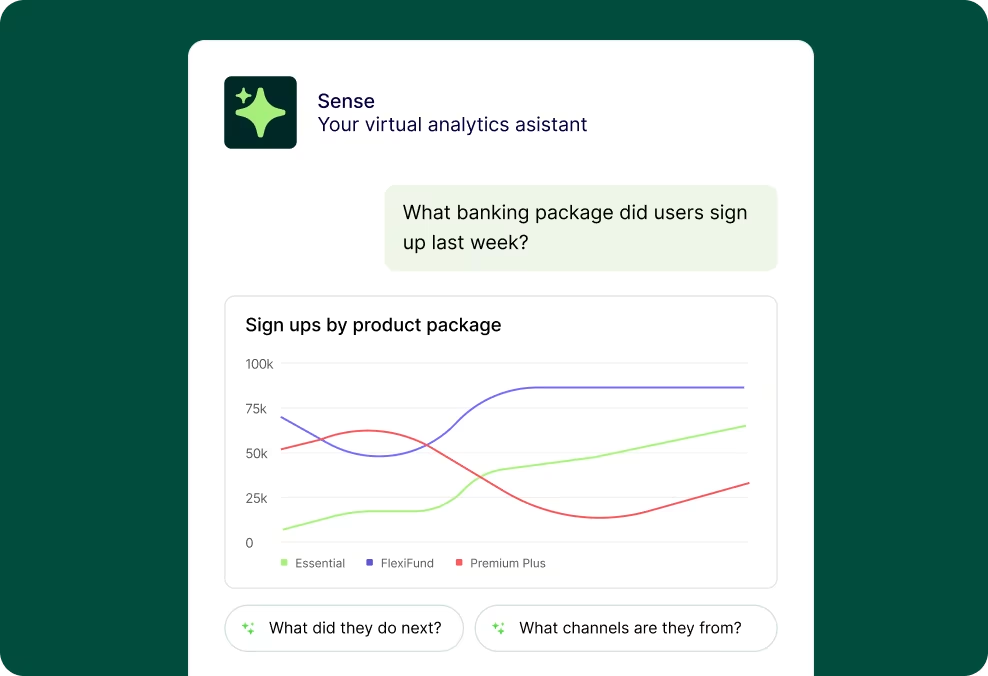
Let Sense Analyst do the hard work for you
With our acquisition of Loris AI, we’ve brought Conversational Intelligence into our AI layer as well. You can analyze support conversations, chat transcripts, reviews, and ticket data at scale, detect sentiment and intent, and connect what people say to what they actually did on your site or in your app.
How does Contentsquare tie insights to business outcomes?
Amplitude, and many of its competitors, make it difficult to go beyond surface-level behavior. They show you what happens, but don’t make it easy to quickly visualize what it means to your business-critical metrics (like conversions and revenue).
Contentsquare connects every interaction to business impact. Every team can easily quantify the revenue impact of UX issues, content performance, technical errors, and journey dropoffs directly from tools like Heatmaps, Journeys, or Session Replays.
![[Visual] API Error](http://images.ctfassets.net/gwbpo1m641r7/4fpTzbSPxtQvud8Fy3lRVR/8671529d1e6dcbddfe68f779b8dffbc2/Screenshot_2024-11-04_at_22.18.53.png?w=1280&q=85&fit=scale&fm=avif)
Use Contentsquare to prioritize by impact instead of guesswork
Built-in Frustration Scoring and 1-click Impact Quantification automatically prioritize what you need to fix based on real business results over gut instinct or volume.
How does Contentsquare improve marketing acquisition?
For marketers working on acquisition challenges, both Amplitude and Contentsquare provide metrics on campaign traffic and conversion. Amplitude enables users to bucket UTMs and referrers into channels to organize acquisition traffic, use multi-touch attribution to evaluate which acquisition strategies shine, and track return on ad spend metrics with Google and Meta integrations or warehouse data.
Meanwhile, Contentsquare’s Product Analytics capabilities aren’t limited to analyzing product or ecommerce metrics—they also let you gain deep insight into your customer acquisition channels, for example, traffic and conversion metrics by campaign. We also have dedicated Attribution Analysis to give every user an easier way to analyze traffic as an alternative to GA4.
Visual analytics
With Contentsquare’s added to your eco-system, you also get comprehensive visual analytics for improving marketing ROI:
The Zoning Heatmaps tool shows exactly which elements are driving conversions and revenue, for example on campaign landing pages—use them to make a case for changes, demonstrate the success of an experiment, and compare segment behavior
Live Zoning overlays metrics directly onto your website—use the CS Live Chrome extension to visualize how people interact within your website pages in real-time
Sunburst journey maps visualize customer journeys to help you discover unexpected behaviors. It displays the entire user flow through the entire website or app at one glance. Similar pages are grouped into page types to reduce the noise. You can compare user journeys side by side to see how marketing-acquired users who convert behave differently from those who drop off
By combining visual analytics and traditional charts, Contentsquare gives everyone on the marketing team self-serve insights into why traffic is bouncing and what changes you should be A/B testing to improve results.
![[Guides] [Mobile Analytics] [Mobile Heatmaps] Compare Journeys](http://images.ctfassets.net/gwbpo1m641r7/7CcbpQsDieNoOOSkvT6SsJ/740f749f0c91a9fdd263f2029a7c43ef/comparejourneys.webp?w=654&q=85&fit=scale&fm=avif)
Visualize segment differences with side-by-side journey maps in Contentsquare
Contentsquare’s Google Audiences integration
Many of your digital marketing investments will be through Google’s advertising products. That’s where an integration with Google products makes it easier to improve your ROI on Google ad campaigns.
Contentsquare lets you import GA4 audiences directly into Experience Analytics. You can see how each audience behaves after they click your ads, which content they engage with, where they drop off, and how their journeys differ.
With GA4 Audiences in Contentsquare, you can:
Filter heatmaps, journeys, and session replays by audience segment
See which campaigns and audiences drive engagement and conversions
Identify drop-off patterns and content issues for specific groups
Feed those learnings back into Google Ads and the broader Google Marketing Platform
How do we surface obstacles and prioritize what to fix based on revenue impact?
No company can afford to lose customers and users because of frustration on their sites and apps. Session Replay lets you step into users’ shoes and see what they’re experiencing.
While Amplitude has session replay, it doesn't provide native error tracking or full experience monitoring. Many teams end up stitching it together with other tools for errors, performance, and UX diagnostics.
Contentsquare goes beyond Amplitude’s features to identify all points of friction, their root causes, and (more importantly) their business impact.
Technical error analytics and resolution
Using Contentsquare you can
Combine Heatmaps + Session Replay for websites and mobile apps—automatically detect errors, then view relevant session replays to see exactly what users experienced before, during, and after the error occurred, like. JS errors, API errors, app crashes, console logged errors, and custom defined errors such as form validations
Save time with Frustration Scoring + Session Replay + AI summaries by skipping straight to the most important sessions
Enable support teams to resolve escalated issues by replaying the exact sessions related to customer service tickets, understanding root causes of issues down to errors, granular network details, request/response headers, and bodies
Ensure security by enabling only authorized personnel to decrypt customer data needed for handling the customer’s service tickets
Enable engineers to see the full waterfall of network details behind every replay so they can understand what leads up to bugs and fix them quickly
Get customizable real-time error alerts and dashboards that rally your team around critical issues
Make it easy to file tickets via Jira or rally teams to action via Slack and Microsoft Teams
Error tracking
Perhaps the two most popular capabilities in Contentsquare for technical teams tasked with ensuring friction-free experiences are text search and 1-click Impact Quantification.
Contentsquare provides retroactive text search, which enables teams to
Surface and quantify all occurrences where site users encountered unexpected error messages of any kind, for example “Oops, something went wrong”
Visualize how users experience these messages,
Learn things that technical teams didn’t already know from their APM tools like Dynatrace and Datadog
Contentsquare enables 1-click Impact Quantification of behaviors and errors directly from session replay
Spot any issue or error? Simply select the issue or behaviors leading up to it and quantify with one click to see how many others experience the same problems
Contentsquare automatically compares the segment of customers that experience the issue vs. those that don’t experience it at that point to calculate the true impact of the problem
This enables teams to go from one to many and prioritize the issues that will actually move the needle for the business and customers
![[Visual] Rage clicks](http://images.ctfassets.net/gwbpo1m641r7/4Pq9iLl1o4oFPFyqUdrCed/a38f3e461ca77264c698318b54c869ab/Screenshot_2024-12-04_at_13.30.20.png?w=1280&q=85&fit=scale&fm=avif)
Rage clicks ranked by missed revenue in Contentsquare
Performance and synthetic monitoring
Errors aren't the only reason users abandon. Slow site speeds are just as costly. Contentsquare pinpoints where performance lags are causing drop-offs, so you can fix them before they impact revenue.
Contentsquare provides speed analysis based on real user monitoring (RUM) to identify performance issues affecting conversion. Most importantly, this lets you quantify the conversion impact of slow speeds.
Contentsquare also provides additional analysis based on synthetic monitoring. Teams use this to
Speed test new product releases before launch
Automatically speed test production experiences to get alerted if performance degrades
Get automated tips for what is hurting performance and how to speed it up
UX problems
Even when a website or app works as designed, users can (and often) still get confused or frustrated. These issues often go unnoticed without behavioral data that goes beyond standard click tracking.
Contentsquare makes it simple for everyone to see not just what users clicked, but how they interacted with the page and where the experience broke down.
With Contentsquare, you easily spot:
Clicks on unclickable elements where users expected interactivity
Rage clicks and repetitive taps that signal confusion or error
Multiple failed form interactions and high drop-off points
Automated form field analysis, including drop rates, blank fields, and refills
Sessions where users left negative feedback, replayed with full context
Behavioral patterns behind 1-star vs. 5-star experiences, using side-by-side journey comparison
This level of insight helps product, UX, and support teams not only detect frustration, but also understand why it happened and how to fix it.
It’s also why technical teams rely on Contentsquare to monitor experience health in real time—whether they use it alongside Amplitude or as their primary product analytics solution.
How does Contentsquare create happier customers by collecting feedback and listening better?
Surveys and Conversation Intelligence give you direct access to what’s going on in the minds of your most important business asset—your customers.
VoC tools empower teams across the organization to make data-driven decisions:
Marketers refine campaigns based on customer sentiment
Product teams prioritize features that resonate with users
Customer support address common pain points
Executives gauge overall satisfaction and loyalty
All this leads to improved customer experiences and increased business growth.
With Contentsquare, you have the option to integrate or use built-in feedback and Conversation Intelligence tools, including
Surveys: AI-powered for any use-case like exit-intent surveys and Net Promoter Score® (NPS®) surveys
Intelligent analysis: transform qualitative data into actionable metrics with AI survey results and sentiment analysis
Contentsquare also gives you the ability to make sense of feedback at scale with the help of
Session Replay: 1-click to replay experiences leading up to feedback
Segmentation: to compare behaviors of users that rated experiences highly vs. poorly
Root cause analysis: combine feedback responses with Error Analysis to reveal why users are getting frustrated
Impact Quantification: quantify how many other users ran into the same frustrations even if they didn’t leave feedback, and calculate the impact on conversion and revenue
Complete Conversation Intelligence: leverage qualitative insights by analyzing every customer chat, call, email, and review at scale to drive LTV and retention
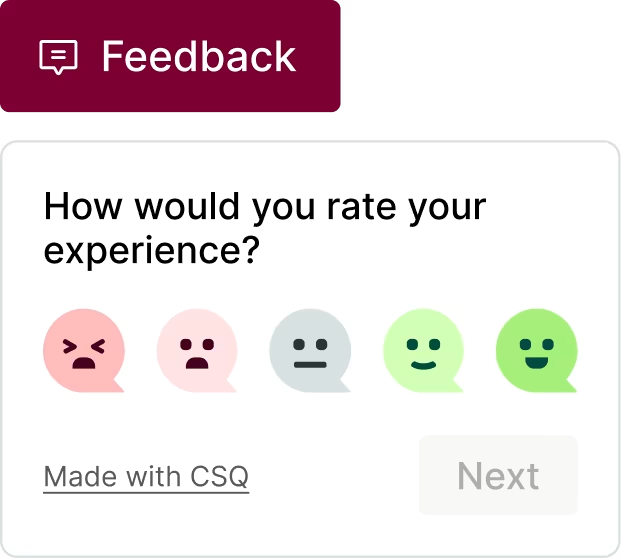
Contentsquare gives you more ways to collect and analyze feedback
Is Contentsquare vs. Amplitude better for your team?
What’s your primary reason for using a platform like Contentsquare, Amplitude, or alternatives?
If you only need event-based product analytics and are comfortable with manual tagging, Amplitude could be a good fit.
If you need whole-business growth driven by deeper experience insights, faster time to insight, and less engineering overhead, Contentsquare is the best choice.
That’s why Contentsquare delivers 602% ROI in just 6 months, almost 3x more than Amplitude does in 3 years (217%), according to Forrester Total Economic Impact™.
Ready to see how we do it? Take a product tour or request a demo today.
FAQs about Contentsquare vs. Amplitude
Amplitude is a product analytics and event-tracking platform founded in San Francisco in 2012 by Spencer Skates and Curtis Liu. Today, Amplitude is used by around 5,000 companies and managed by 700+ employees spread across offices in the US, Europe, and Asia.
Net Promoter®, NPS®, NPS Prism®, and the NPS-related emoticons are registered trademarks of Bain & Company, Inc., NICE Systems, Inc., and Fred Reichheld. Net Promoter ScoreSM and Net Promoter SystemSM are service marks of Bain & Company, Inc., NICE Systems, Inc., and Fred Reichheld.
![[Visual] Contentsquare's Content Team](http://images.ctfassets.net/gwbpo1m641r7/3IVEUbRzFIoC9mf5EJ2qHY/f25ccd2131dfd63f5c63b5b92cc4ba20/Copy_of_Copy_of_BLOG-icp-8117438.jpeg?w=946&q=85&fit=scale&fm=avif)
We’re an international team of content experts and writers with a passion for all things customer experience (CX). From best practices to the hottest trends in digital, we’ve got it covered. Explore our guides to learn everything you need to know to create experiences that your customers will love. Happy reading!

![[Visual] Content feedback - stock image](http://images.ctfassets.net/gwbpo1m641r7/3VIxae9gYdfHTaMYr25eph/96af0a02a3248b25f83d10b360591acc/Magic_Oil_-_Photo_4.jpg?w=624&q=85&fit=scale&fm=avif)