Your customers reveal what they need through their behavior long before they say it in a survey.
They hesitate on a form. Search for help more than once. Abandon a basket and return the next day. These signals show where a customer is struggling, but they become far more useful when teams can measure their business impact.
That’s where the Contentsquare and Snowflake partnership comes in:
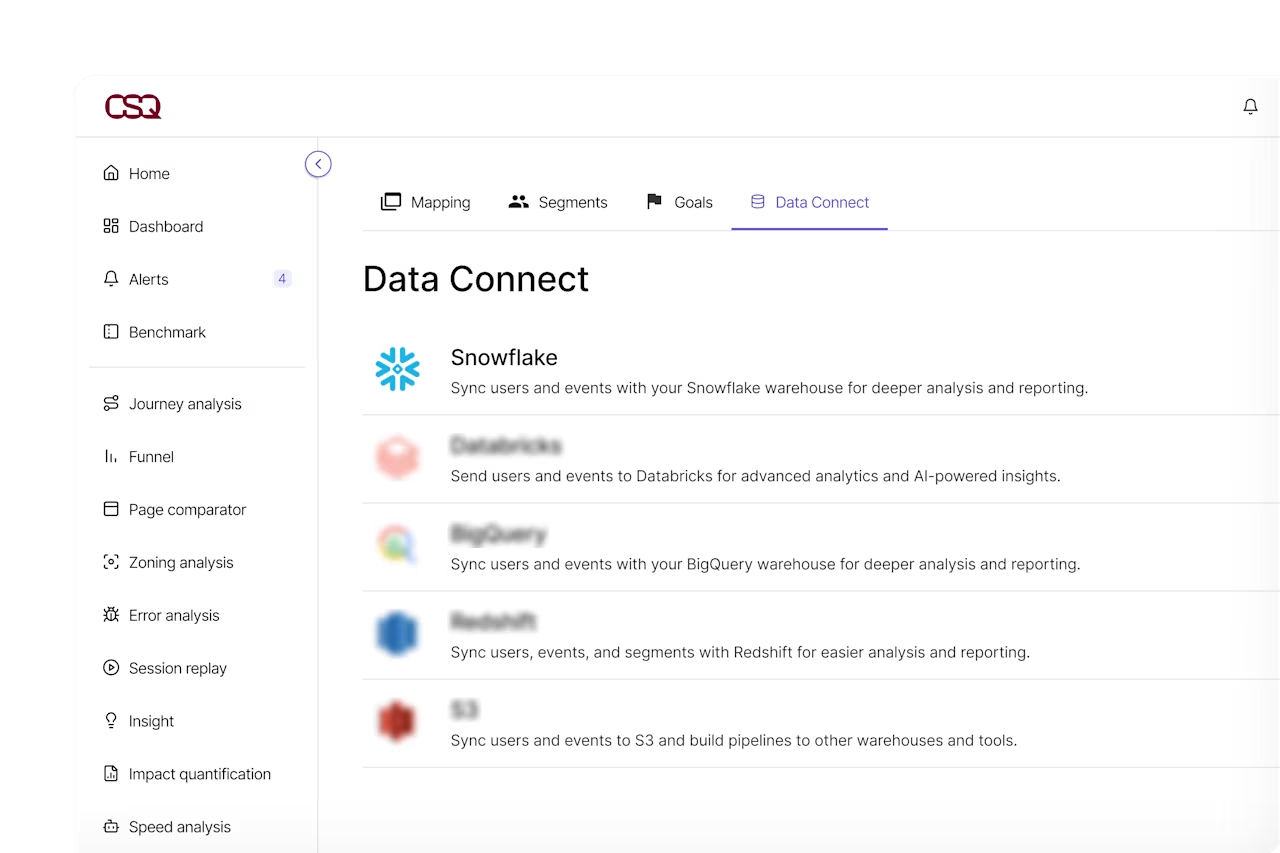
Contentsquare Data Connect brings behavioral data from web, mobile apps, and conversation analytics into Snowflake, where teams can explore it alongside enterprise data using Snowflake Intelligence and natural-language questions.
Together, the platforms help teams understand not just what's happening in the customer journey, but why—and what to do about it.
The value of connecting experience and enterprise data
Contentsquare and Snowflake bring different layers of information together:
Contentsquare is an AI-first experience platform that reveals where customers struggle, what they search for, which journeys lead to conversion, and where friction causes them to drop off
Snowflake connects that experience data to the wider business. Teams can analyze it alongside data from POS systems, loyalty programs, inventory, call centers, finance, and other enterprise sources.
Snowflake Intelligence makes that context easier to use. Business users can ask questions in natural language, while configured AI agents support recurring analysis and defined downstream actions
Together, the platforms connect the customer signal with the business context behind it.
For example, a product page with high engagement and low conversion could indicate strong demand, a pricing issue, an out-of-stock product, a broken checkout step, or a customer service problem.
Behavioral data identifies what’s happening. Enterprise data explains why and determines what to do next.
Contentsquare is an incredible asset that provides context to personalize experiences and make them more relevant.

How Contentsquare and Snowflake work together
The partnership connects four stages of the decision-making process:
Capture. Contentsquare captures behavioral signals across web, mobile app, and conversations, including friction, searches, journeys, and outcomes.
Connect. Contentsquare’s Data Connect capability brings that data into the customer’s Snowflake environment, where it sits alongside point-of-sale, inventory, loyalty, service, and financial data.
Ask. With Snowflake Intelligence, teams can explore structured and unstructured data using natural-language questions rather than relying on a prebuilt dashboard or a SQL request for every analysis.
Act. Teams can configure AI agents around recurring use cases and, where supported by their implementation, connect insights to downstream workflows.
The data remains in the customer’s Snowflake environment, under its existing governance, security, and access controls.
💡 See it in action: how Bloom & Wild unifies behavioral and business data in Snowflake
With Contentsquare Data Connect, UK gifting brand Bloom & Wild exports behavioral data straight into its Snowflake warehouse—refreshing critical events like confirmed orders every two hours. Teams join that data with stock, order, and Braze email insights via dbt to break down silos, give leadership a single source of truth in Tableau, and cross-reference funnel drop-offs with customer tiers to find exactly the right users to interview during a new product launch.
5 ways to unlock deeper insights in Snowflake's AI platform with Contentsquare data
Combining behavioral and enterprise data opens up new ways to understand customers and make better business decisions.
Below, we explore 5 practical use cases and share example questions teams can ask in Snowflake Cortext to uncover deeper insights, identify opportunities, and turn what they learn into action.
1. Find the friction that affects revenue
What to ask: “Which checkout errors this month correlate with the largest drop in basket value, and what was the estimated revenue impact?”
Contentsquare identifies where frustration and errors occur. Snowflake then adds sales and financial context to help teams estimate the commercial impact and prioritize the right fix.
2. Measure campaign quality, not just campaign volume
What to ask: “How do visitors from our paid social campaigns compare with loyalty members in conversion and repeat visits?”
Combining acquisition, behavioral, conversion, and loyalty data helps marketers understand which audiences are creating lasting value—not just which campaigns are generating traffic.
3. Connect digital demand to product availability
What to ask: “Which product pages have high engagement, low conversion, and low stock?”
This question helps teams spot where customers are showing interest in products they cannot easily purchase. It also reveals demand signals that inventory and merchandising teams may not yet have identified.
Merchandising teams can now get pre-built reports automatically, and when they connect their merchandising data to Snowflake, they also get the underlying SQL exported to run custom queries directly. What’s really exciting is that Snowflake lets you describe what you want in plain language and writes the SQL for you—fundamentally changing who can access data and how fast they can move.

4. Identify which customers need help before they churn
What to ask: “Which high-value customer segments have experienced repeated friction and also have open service cases?”
Bringing behavioral and service data together gives marketing, customer experience, and support teams a shared view of the problem. Instead of sending customers a generic offer, they can resolve the issue first and decide when (and whether) to re-engage.
5. Turn recurring questions into workflows
Teams can also configure an AI agent to monitor a combination of signals, such as high customer value, recurring friction, and unresolved service issues.
Depending on the customer’s setup, that insight could support an alert to a service team, suppress an inappropriate promotion, or add an audience to a re-engagement workflow.
The important point is that the action is based on a combination of signals—not a single data point viewed in isolation.
Better questions lead to better business decisions
The next big opportunity for teams isn't necessarily collecting more data. It's making better use of what they already have.
When behavioral insights sit alongside the wider business picture, teams can challenge assumptions, spot opportunities they might otherwise miss, and make decisions with a clearer understanding of their consequences.
That's what makes the partnership exciting: giving more people the context to investigate, question, and act—not just access another set of reports.
FAQs about the Contentsquare-Snowflake partnership
Snowflake is a cloud data platform that helps organizations centralize, govern, share, and analyze data at scale. Snowflake Intelligence adds natural-language access to governed enterprise data and supports AI-powered analysis and agents.