![[Visual] Stock 2 people in office](http://images.ctfassets.net/gwbpo1m641r7/3E6Xcnz962m21VwKbUtyw7/2fb57f4ada18792c86aa38b93e6e0932/5294329.jpg?w=1280&q=85&fit=scale&fm=avif)
How do you uncover what truly matters to your users? Simple: ask them.
Customer surveys aren't just a feedback form; they're a direct line to the people who experience your product every day. They reveal hidden pain points, unexpected delights, and opportunities you might never have considered.
This guide will walk you through 31 customer feedback questions and five expert tips to help you design effective customer satisfaction surveys and get the insights you need.
Key takeaways
Ask questions that match your goal, whether you're trying to understand customers, improve products, or measure satisfaction
Include at least one standard metric question (Net Promoter Score® (NPS®), Customer Satisfaction (CSAT), or Customer Effort Score (CES)) to benchmark performance over time
Keep surveys short and focused; prioritize open-ended questions for qualitative insights
Use on-page surveys for real-time feedback and longer surveys for in-depth research
Stop guessing. Start asking.
Use the right questions to turn customer feedback into actionable insights and your sharpest competitive advantage.
31 customer feedback questions
Here's a list of 31 customer feedback questions you can ask to get closer to your customers and their needs. Keep reading past the list to learn more about why or when you should ask each type of question.
How would you describe yourself in one sentence?
What is your main goal for using this [website/product]?
What, if anything, is preventing you from achieving that goal?
What is your greatest concern about [product/brand]?
What changed for you after you started using our [product/service]?
Where did you first hear about us?
Have you used our [product/service] before?
Why did you choose to use our [product/service] over other options?
Have you used a similar [product/service] before?
How do you use our [product/service]?
How can we make this page better?
What's the ONE thing our website is missing?
What, if anything, is stopping you from [taking action] today?
What are your main concerns or questions about [product/service]?
Thanks for [taking action]! How are you planning to use [product/service]?
How would you describe the buying experience?
Do you feel our [product/service] is worth the cost?
What convinced you to buy the [product/service]?
What challenges are you trying to solve?
What nearly stopped you from buying?
What do you like most about our [product/service]?
What do you like least?
What [feature/option] could we add to make your experience better?
How could we have gone above and beyond?
Net Promoter Score® (NPS®): how likely are you to recommend our [product/service]?
Customer Satisfaction (CSAT): how satisfied are you with our [product/service]?
Customer Effort Score (CES): how easy did [feature/process] make it for you to solve your issue?
How satisfied were you with our support team?
Was your issue resolved to your satisfaction?
How easy was it to get the help you needed?
Is there anything you'd like to add?
Pro tip: online survey tools allow users to describe the customer experience in their own words, from their overall experience to frustrating customer support interactions and moments of customer delight.
Contentsquare's Surveys capability enables you to collect customer feedback with ease. Start survey-building today with our free-forever plan, which lets you create and manage 3 surveys with no limit to the questions you can add to each one. Unlock unlimited surveys with any of our paid plans.
![[Visual] Capabilities - Survey - Asset — Features — AI - How was your experience](http://images.ctfassets.net/gwbpo1m641r7/6eSUQ1pwzyTNv9GWlrISSV/938c95d2cfbe1319a90e7ebc74b9ff6b/AI_analysis.svg?w=655&q=85&fit=scale)
Get clarity on feedback responses with Contentsquare.
Customer feedback questions to understand your customers
You can't help your customers if you don't know who they are and what they want in the first place. Asking your customers about themselves helps you gather psychographic data and customer insights to create user personas: semi-fictional characters based on the real people who use your product. These personas come in handy for more targeted marketing and for improving user experience.
1. How would you describe yourself in one sentence?
This prompt is designed to help you gather demographic data about your customers, such as age, geographic location, or job title. The question is open-ended, but you can encourage your respondents by giving them an example of what you're expecting (Ex: 'I'm a 35-year-old editor based in the U.K. who enjoys writing articles about customer feedback.').
2. What is your main goal for using this [website/product]?
What do your customers want? Use this question to determine why people have turned to your product and what their customer expectations are.
3. What, if anything, is preventing you from achieving that goal?
What challenges are customers facing, and are you doing enough to help them overcome those challenges?
4. What is your greatest concern about [product/brand]?
What's stopping your customers, or potential customers, from converting? Their answers give you a window into the barriers preventing them from progressing, point to potential gaps in the services you offer, and show whether your site is lacking information. Use these responses to address concerns head-on, which, in turn, should help you reduce churn and improve conversion rates.
5. What changed for you after you started using our [product/service]?
This will only apply to existing users, but it helps you understand the details of how your product/service helps customers get their job done. And, you can then feature their statements in your testimonials to help convince other prospective customers to join you.
Pro tip: if you want to get to know your users more intimately, consider pairing surveys with in-depth user interviews. Interviewing users can provide you with even more qualitative data about your customers' needs, pain points, and experiences, including what drives them to your business.
Customer feedback questions to improve your marketing
Marketing can be time- and money-intensive, so using your customers' feedback helps make sure your efforts are effective and well-targeted. The following survey questions will bring valuable insight to your market research strategy.
6. Where did you first hear about us?
Web analytics data can tell you where traffic is coming from, but it can't tell you why people visit your site. Customers may have heard about your product from a friend, or on a podcast, or perhaps on social media—the only way to collect that data is to ask directly.
7. Have you used our [product/service] before?
This helps you understand the customer's history with your company. Are they a long-time user of your services, or is this their first spin? Customer relationship information can inform the rest of their survey answers by letting you know their familiarity and expertise with your offerings.
8. Why did you choose to use our [product/service] over other options?
What sets you apart from your competitors? This helps you gauge how you're competing with others in your customers' mind on price, service, and solutions offered. You might even discover a competitive advantage you weren't aware of.
9. Have you used a similar [product/service] before?
Learn whether the customer has purchased from one of your competitors previously or whether this is their first experience with your type of product or service. Knowing their experience level with your product—and others like it—can add context to their other survey answers.
10. How do you use our [product/service]?
Learning how the customer uses your product on a practical level can offer insight into your most important product features. It can also open your eyes to unique use cases you may not have been aware of.
Pro tip: your goals for running a customer feedback survey are just as diverse as your customers' opinions. Choose from more than 40 pre-built Contentsquare survey templates (available in 40+ languages) to receive the feedback you need to reach your goal—whether it's getting to the bottom of high exit rates with an exit-intent survey or investigating a dip in sales with a customer retention survey.
![[Visual] template gallery](http://images.ctfassets.net/gwbpo1m641r7/gjS09VNopFU3DlVw7LqOo/d887aa32e3bb486b4f4f0eece98c37e7/template_gallery.webp?w=1280&q=85&fit=scale&fm=avif)
No need to start from scratch—Contentsquare's survey template gallery has you covered
Customer feedback questions to ask on a web page
In general, you want a web page to be attractive, intuitive, and helpful for customers. You can use on-page surveys that pop up or slide in from the side of the page to poll customers on their opinions, which will help you improve your web pages and the overall customer experience.
Take this a step further by running a website survey in conjunction with, or as a follow-up to, usability testing sessions, which help you dig deeper into potential usability and clarity issues with a handful of your customers.
11. How can we make this page better?
Use a single-question pop-up poll to gather real-time feedback on specific web pages. Because this question is completely open-ended, meaning that you're not restricting your users to a yes/no or multiple-choice questions, you may receive suggestions or feedback you hadn't considered.
12. What's the ONE thing our website is missing?
Even if a customer is pleased with your site, there's always room for improvement. Use this question to help identify holes in your existing services and highlight areas where you can build and expand.
13. What, if anything, is stopping you from [taking action] today?
Use a pop-up to query potential customers about their purchasing reservations. Do they need more information? Are they intimidated by the price tag?
14. What are your main concerns or questions about [product/service]?
This is a variation of question #3 above—the difference is, this one is asked in the context of the website itself. Ideally, your web page will answer all of the potential customer's questions and concerns so they can buy with confidence. Answers to this question will let you know if any important information is vague or hard for users to find.
15. Thanks for [taking action]! How are you planning to use [product/service]?
Ask this question in a post-purchase survey to get a better understanding of the customer's plans for your product. This will give you some insight into why people are buying your goods or services, and it may help you identify niche use cases you could leverage further.
![[visual] Post-purchase survey (activewear)](http://images.ctfassets.net/gwbpo1m641r7/22Ax873Kqdr4ahX9D8BdtI/3513924949f08cfc161600d3da0ba91c/Reduce_churn_and_abandonment.svg?w=654&q=85&fit=scale)
Contentsquare's post-purchase survey questions can help reduce churn.
Customer feedback questions when a product is not selling
When your product is underperforming, turn to your customers to find out what you're doing wrong and how you can improve. It's difficult to ask people why they aren't buying your product, but you can get a sense of your target audience's needs. Email an open-ended survey to recent customers to learn more about how they felt about purchasing your product.
16. How would you describe the buying experience?
One possible reason for a dip in sales is that the buying process is confusing or takes too long. Ask existing customers about their buying experiences to identify areas for improvement.
17. Do you feel our [product/service] is worth the cost?
Another major sticking point for potential customers is cost. If your offerings are perceived as poor value for money, you may need to reevaluate your pricing structure to make your value more explicit.
18. What convinced you to buy the [product/service]?
What was the hook that persuaded your customers to take action? Try to understand these driving forces and then replicate and emphasize them.
19. What challenges are you trying to solve?
What are the major issues that cause customers to turn to your product for help? Knowing this can help you make sure you're meeting their expectations.
20. What nearly stopped you from buying?
Finally, what are the barriers or obstacles that might deter potential customers from following through? You want to identify and try to minimize these issues.
Pro tip: are you worried about investing effort into a customer feedback survey because you're short on time, staff, or funding?
Sit back and relax as Contentsquare's AI-powered Surveys capability generates a survey in seconds based on your goal, whether it's cultivating loyal customers or optimizing the customer service experience. Then, review the AI-driven automated survey report that shows you the customer sentiment, emotions, and themes behind the responses based on collected feedback. This takes the worry out of analyzing high response rates and gives you a clear roadmap to follow.
![[Visual] sense ai survey](http://images.ctfassets.net/gwbpo1m641r7/7fkFoAGIeIBBiNo1Jw5SPj/72f3a8aa8cbed85833e87c4d079a7009/sense_ai_survey.webp?w=1280&q=85&fit=scale&fm=avif)
Contentsquare's AI, Sense generates an automatic report based on survey responses.
Customer feedback questions to improve a product or service
Ask your customers for honest feedback about your products and services to learn what pleases them and what isn't working. Continue to refine and improve your offerings to better meet customer needs.
21. What do you like most about our [product/service]?
It's always good to know what parts of your products please customers. Make sure to maintain or expand on those attributes in new product iterations.
22. What do you like least?
Likewise, it's important to identify areas for improvement based on the product feedback you collect.
23. What [feature/option] could we add to make your experience better?
Even satisfied customers probably have ideas for new features or ways to improve your product. Launch a feature prioritization survey to find out.
24. How could we have gone above and beyond?
Learn what would make your customers sit up and say 'wow!' These suggestions may not be obtainable, but they're a good window into what delights your customers.
Pro tip: integrate the feedback you collect from customer surveys into your overall business strategy and continue to loop in your product, marketing, and support teams. You can automatically share survey responses with your team using Contentsquare's Slack and Microsoft Teams integrations to make sure everyone is up-to-speed on your customer experience performance.
![[Visual] Customer feedback](http://images.ctfassets.net/gwbpo1m641r7/3Sg5J27IfLW4dUKMfJt2TM/a406c2b790b16a2cc47ced5338e477bd/Screenshot_2024-11-06_at_15.05.51.png?w=808&q=85&fit=scale&fm=avif)
Contentsquare lets you auto-share survey responses with your team.
Customer feedback questions to measure satisfaction
Proactively promoting customer success is a key factor in maintaining strong customer retention and satisfaction levels. The concept of 'a good customer experience' can seem a bit intangible and difficult to measure, which is exactly why these customer satisfaction questions are important. The three metrics below—NPS®, CSAT, and CES—give you standardized ways to benchmark performance over time.
Net Promoter Score® (NPS®) questions
NPS® measures customer loyalty by asking how likely someone is to recommend your product or service. Studies have shown that customers' willingness or reluctance to recommend your product to friends and family is an excellent indicator of their level of satisfaction.
25. How likely are you to recommend our [product/service] to a friend or colleague?
Ask customers to rank, on a rating scale of 0–10, how likely they are to recommend your products. This information will allow you to calculate your customers' NPS®, which is particularly helpful when you want to improve customer loyalty.
Alternative phrasings to consider:
'On a scale of 0–10, how likely would you be to recommend us to someone in your industry?'
'Based on your experience so far, how likely are you to recommend [product/service]?'
'Would you recommend [product/service] to a friend? Why or why not?' (for qualitative follow-up)
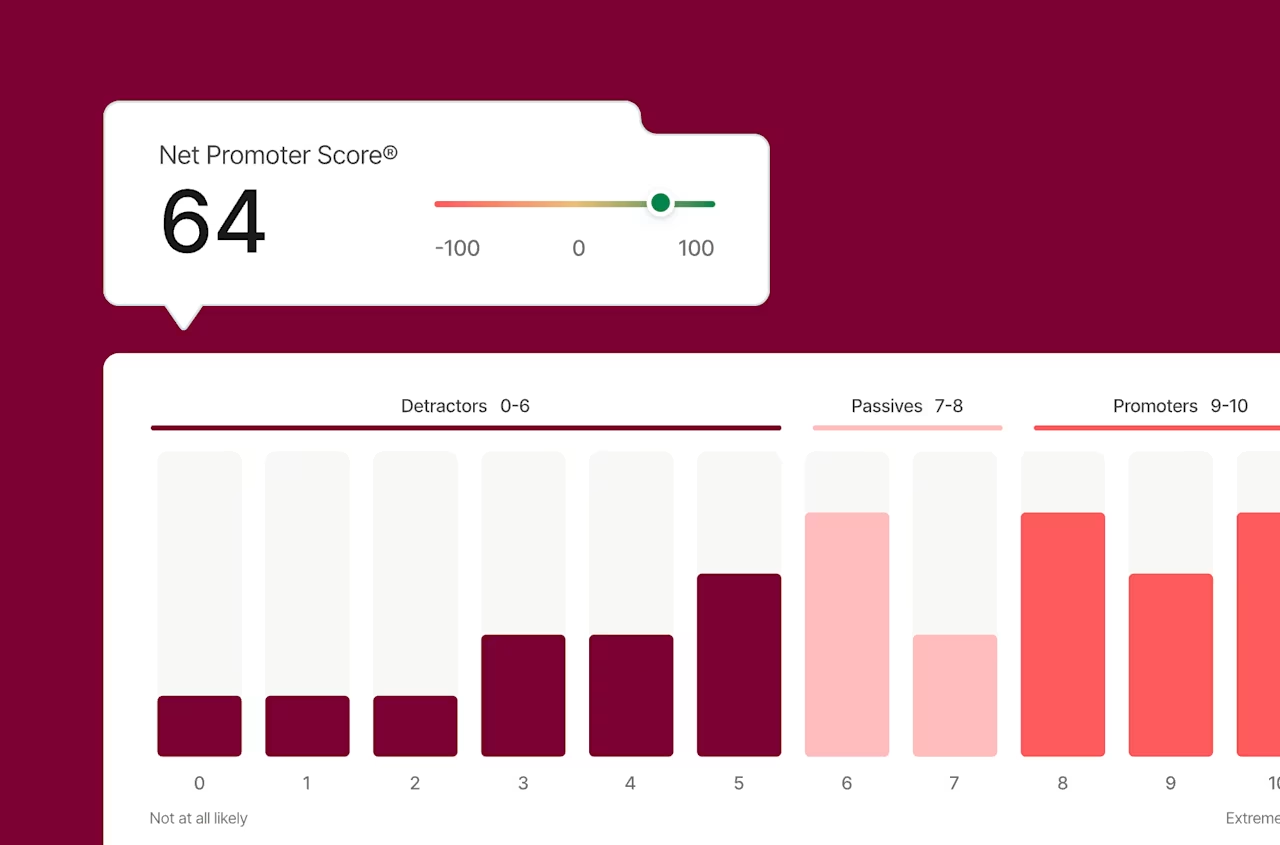
Contentsquare's NPS® dashboard.
Customer Satisfaction (CSAT) questions
CSAT measures how satisfied customers are with a specific interaction, product, or experience. It's typically measured on a scale (1–5 or 1–7) and gives you a snapshot of sentiment at a particular moment.
26. How satisfied are you with our [product/service]?
How happy are customers with your product? Instead of posing this as an open-ended question, you could also ask 'Are you satisfied with our product?' in a pop-up poll to calculate a customer satisfaction score (CSAT). If you want more than just metrics, ask them to explain their answer.
Alternative phrasings to consider:
'How would you rate your overall satisfaction with [specific feature/interaction]?'
'How satisfied were you with the support you received today?'
'Did [product/service] meet your expectations?' (Yes/No with optional follow-up)
Customer Effort Score (CES) questions
CES measures how much effort customers had to expend to complete a task or resolve an issue. Lower effort typically correlates with higher brand loyalty—customers who find things easy are more likely to stick around.
27. How easy did [feature/process] make it for you to solve your issue?
In general, customers want to spend the least amount of effort when completing a task or solving a problem. When you ask them to score how much effort it took to complete a task or solve an issue, you can expose pain points along the customer journey and get a clear picture of where to improve your processes moving forward.
Alternative phrasings to consider:
'On a scale of 1–7, how easy was it to [complete task]?'
'How much effort did you have to put in to get your question answered?'
'[Company] made it easy for me to handle my issue. (Strongly disagree to Strongly agree)'
Customer support feedback questions
Your support team is often the frontline of customer interaction, especially when something goes wrong. Gathering feedback after support interactions helps you identify training opportunities, improve response times, and ensure customers feel heard. These questions work well in post-interaction surveys sent immediately after a support ticket is resolved.
28. How satisfied were you with our support team?
This gives you a baseline measure of support quality. Pair it with a rating scale (1–5) and an optional open-ended follow-up asking what could have been better.
29. Was your issue resolved to your satisfaction?
Sometimes a ticket gets closed, but the customer doesn't feel their problem was truly solved. This question catches those gaps and helps you understand resolution quality, not just resolution speed.
30. How easy was it to get the help you needed?
This is essentially a CES question applied to support. If customers have to jump through hoops—waiting on hold, repeating their issue to multiple agents, navigating a confusing help center—they'll tell you here.
Pro tip: when customers report frustrating support experiences, it helps to see exactly what happened before they reached out. Contentsquare's Session Replay lets you watch back the specific session that led to a support request, so you can understand the full context behind their feedback and identify issues they may not have articulated clearly.
![[Visual] Session Replay](http://images.ctfassets.net/gwbpo1m641r7/430oJrO6BNyEN4lSossUBS/25c3f0e586812ebf94ee6ec10915ae91/Screenshot_2024-11-06_at_12.04.56.png?w=864&q=85&fit=scale&fm=avif)
Contentsquare's Session Replay capability in action.
One final question to always include
At the end of multiple-question surveys, it's a good idea to add one final follow-up question:
31. Is there anything you'd like to add?
Always give your customers a chance to offer feedback at the end of a survey. Many people will leave this section blank, but a surprising number of people will have a burst of insight or a helpful answer to a question you never even thought to ask.
Probably the biggest survey tip is simply to encourage people to be honest. Really emphasize that you want them to be brutally, 100% honest and that all feedback is helpful. This'll free them up to tell you what they really think.
Question Type | Best For | Example | Pros | Cons |
|---|---|---|---|---|
Open-ended | Qualitative insights, discovering unknowns | 'What could we improve?' | Rich, detailed responses; uncovers unexpected issues | Harder to analyze at scale; lower completion rates |
Rating scale | Measuring satisfaction, effort, or likelihood | 'Rate your satisfaction 1–5' | Easy to benchmark and track over time; quick for respondents | Lacks context; doesn't explain the 'why' |
Multiple choice | Understanding preferences, segmenting responses | 'How did you hear about us?' | Easy to analyze; high completion rates | Limited to predefined options; may miss nuances |
Yes/No | Quick validation, screening questions | 'Did you find what you were looking for?' | Fast; high response rates | Binary answers lack depth |
Likert scale | Measuring agreement or sentiment | 'I found the checkout process easy. (Strongly disagree to Strongly agree)' | Captures degrees of opinion; standardized | Can feel repetitive if overused |
Pro tip: combine question types strategically. Start with a rating scale to get a measurable score, then follow up with an open-ended question asking respondents to explain their answer. This gives you both quantitative data to track and qualitative insights to act on.
Tips for getting useful customer feedback
Customer feedback is extremely valuable because it gives your customers an opportunity to share what parts of your business are working, or not working for them. However, to get reliable and useful information, you must ask the right customers the right questions in the right way. Here are five tips for honing your customer feedback strategy:
1. Know what information you want to collect
Before you even start writing any of the questions, pin down exactly what you're hoping to achieve. Do you want to:
Improve your marketing techniques?
Brainstorm new services to offer your existing user base?
Know how people experience a specific web page or customer process?
Your goals will dictate the kind of questions you need to ask customers.
2. Keep your survey short
Filling out a feedback survey can be a big ask for busy customers, so keep yours as brief as possible. You probably won't be able to ask every question you'd like, so prioritize the information that's most useful to you.
3. Pick the right format
There are two major formats of customer surveys: long multiple-question surveys and very short on-page polls.
Longer surveys help you collect more in-depth information, but the more questions you ask, the fewer responses you're likely to receive. As a rule of thumb, ask as few questions as possible to get the information you need.
On-page polls typically consist of only one or two questions and are perfect for collecting a snapshot of information about a specific page or process. Because they take almost no time to complete, survey response rates are usually high.
4. Test the survey before sending it to customers
If you're new to customer surveys, start off with a single-question on-page poll. Then, work your way up to longer multiple-question surveys.
If you're sending out a longer questionnaire, ask coworkers to make sure that it's well worded. The questions should be clear, concise, and free of leading questions so that customers know exactly what kind of information you're looking for.
5. Encourage honest responses
Customers often soften their feedback to be polite, which means you miss the insights that could actually help you improve. Make it clear that you genuinely want honest opinions—even critical ones. Phrases like 'We want to hear what's really working and what isn't' or 'All feedback helps us get better' can give respondents permission to be direct.
When analyzing responses, Contentsquare's AI-powered sentiment analysis can help you identify the emotions and themes behind customer feedback automatically, making it easier to spot patterns even when you're dealing with high response volumes.
Stop guessing. Start asking.
Use the right questions to turn customer feedback into actionable insights and your sharpest competitive advantage.
FAQs about customer feedback questions
Good customer feedback questions are specific, goal-oriented, and easy to answer. Questions like 'What is your main goal for using this product?' or 'What nearly stopped you from buying?' work well because they prompt actionable responses rather than vague opinions.


![[Visual] Person relaxing indoors with plant and laptop](http://images.ctfassets.net/gwbpo1m641r7/5yj0ZBZ1lBOSU8WBILGv0d/f2f5e957bd3a3ae8650cd91c24a1455c/Person_Relaxing_Indoors_with_Plants_and_Laptop.jpeg?w=624&q=85&fit=scale&fm=avif)