![[Visual] AmplitudVsGaVsMixpanel](http://images.ctfassets.net/gwbpo1m641r7/1410T6xKdDwd9vIzKnRj4q/adddf912cfc5534b3ad6f763ad155ac6/AmplitudVsGaVsMixpanel.png?w=1280&q=85&fit=scale&fm=avif)
The information on this page is correct as of 31/08/2026 to the best of Contentsquare's understanding.
If you're deciding between Amplitude, GA4, and Mixpanel, you probably want to know what's bringing people to your site or app, what they do once they're there, and how to stop them from bouncing or churning.
The good news: all three can help you do this. The bad news: they all require significant setup, technical knowledge, and too much emphasis on quantitative metrics over what customers tell you.
Keep reading to see how Amplitude, GA4, and Mixpanel compare across data capture, pricing, features, and ideal use cases, and when it might be better to use Contentsquare instead. 😉
Key takeaways
Amplitude is an AI-powered product analytics platform built for product-led SaaS teams tracking feature usage and running A/B tests. But setup friction limits self-serve, retroactive analytics, and it's rarely the top choice outside product teams
GA4 is Google's free web and app analytics platform, popular with marketing analysts tracking multi-channel ROI and campaign performance. But it needs a lot of technical setup and can't tell you why users behave the way they do
Mixpanel is a popular product analytics platform with PMs optimizing feature adoption and retention. But it requires manual tracking for business-critical events and leaves feedback and customer sentiment out of the analysis
Contentsquare is an experience intelligence platform that automatically captures all customer behavior, feedback, and conversations without manual tagging. AI analyzes every touchpoint and prioritizes by business impact to give all digital teams (including product, marketing, and UX) data-backed next steps to prove their impact and drive growth
That’s why Contentsquare delivers 602% ROI and $3.2M in recovered revenue over three years, according to a Forrester TEI, compared to Amplitude's 217% and Mixpanel’s 354%
Amplitude vs. GA4 vs. Mixpanel compared
With so many overlapping features, it’s tricky to get a quick sense of how different analytics platforms are actually used by teams day-to-day.
Here’s an overview of how Amplitude, GA4, and Mixpanel compare across common product, marketing, and business use cases so you can get a sense of where they perform best and where they fall short.
| Know which channels bring in valuable users | Understand what people do inside your product, and why they struggle | Get quick answers to unplanned questions | Catch technical problems before they cost you conversions | Prioritize what to work on next | Connect what people do with what they say |
|---|---|---|---|---|---|---|
Amplitude | Links acquisition channels to long-term product user habits | Finds dropoffs and friction with funnels and journeys, visualizes behavior with replays and heatmaps | Basic autocapture, manual tracking needed for business-critical events | Finds errors inside replays, no synthetic monitoring | Identifies behaviors that correlate with retention | In-app guides and surveys to help users navigate the product, plus conversation analysis |
GA4 | Best for macro ad attribution and immediate paid channel conversions | Identifies dropoffs but lacks visual and behavior context | Enhanced Measurement tracks basic metrics like pageviews only | Requires custom setup, no synthetic monitoring | Limited to traffic, engagement, and content popularity metrics | Needs third-party integrations to bring in qualitative context |
Mixpanel | Connects channels directly to real-time product funnels | Finds dropoffs and friction with funnels and flows, connected to replays | Autocaptures basic web events only, everything else needs manual setup | Requires custom setup, no synthetic monitoring | Maps features to business goals with Metric Trees | No way to pull feedback or conversations into analysis |
What Amplitude does best
What it is:
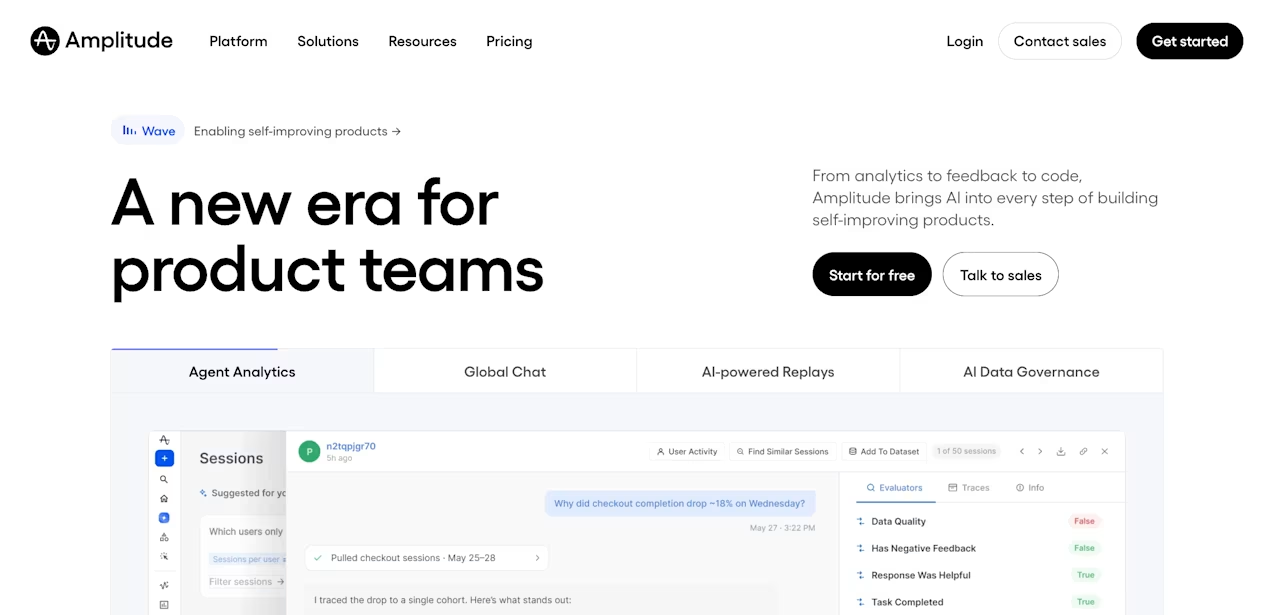
Amplitude is an AI-powered product analytics platform that uses event-based tracking to monitor user interactions (like clicking a sign-up button or exporting a report) and combines analytics with feedback and experiments to optimize retention, conversions, and lifetime value.
Who it’s best for:
Product managers (PMs) at product-led SaaS companies who want to track exact feature usage, find onboarding dropoffs, and run A/B tests to make feature launch decisions based on real user data.
Main features:
Event-based product and app analytics to trace user journeys, track feature adoption, and map friction points
Funnels, charts, and journeys to understand how users navigate
Marketing analytics to tracks web traffic, UTMs, and acquisition journeys
Session replay to recreate individual user sessions
Heatmaps and zoning insights to show how elements perform
Guides and surveys to help users navigate product features and leave feedback
Feedback analysis to link support tickets, surveys, reviews, social media, and call scripts to behavior
Web and feature experimentation to A/B test product and marketing changes
Feature management to control which users see a feature and when
Alerts for automatic, custom, and smart metric changes, sent via email or Slack
Autocapture SDKs and visual labeling for standard web and mobile events like pageviews, element clicks, and applications opens
AI features:
AI agents to analyze product data for you
AI feedback analysis (formerly Kraftful) for sentiment analysis, survey creation, and summarized insights
MCP to query data from AI tools
Amplitude Wave (currently in closed beta) to proactively find insights and take action for you
Pricing, popularity and ROI:
From free for 2M events/month, MTU pricing also available with a guardrail of 1k events/MTU
Used by around 5,000 companies
Forrester found the Total Economic Impact™ (TEI) of Amplitude is 217% ROI over three years (source)
![[Visual] Amplitude-AMPL-NASDAQ-share price](http://images.ctfassets.net/gwbpo1m641r7/1UDeTzvxk07kFOEzTzFl6y/d69ae2a6415aadd3583c8aac761d06bf/Amplitude-AMPL-NASDAQ-share_price.png?w=576&q=85&fit=scale&fm=avif)
Amplitude, Inc. is a publicly traded company listed on the NASDAQ in 2021 under the ticker AMPL
It’s worth noting that Amplitude acquired Statsig (a product development platform for engineers and data scientists) in May 2026. The original team stayed at OpenAI (who acquired Statsig in 2025), with Amplitude now owning the product, brand, and customer base and working toward integrating its features to combine product behavior and code validation.
Amplitude’s limitations
Setup friction limits self-serve, retroactive analytics
Not widely adopted outside product teams
Data governance overhead and unexpected overage fees
No synthetic monitoring to find issues before they impact real users
Amplitude has come a long way since it launched in 2014 when it only offered mobile app analytics. But even with broader tools, it’s still a product-first platform today. It’s rarely the #1 choice for ecommerce, marketing, UX, or CRO teams because, even with some autocaptured and visually labeled data, it still relies on manual precision tracking for business-critical events that adds blockers to non-technical and cross-functional teams.
Product teams also report issues with significant data governance overhead, a steep learning curve, and unexpected overage fees if MTU volume exceeds the contracted tier, which has been reported as 20-50% higher than contracted per-MTU pricing.
What to look for instead:
An analytics platform with broad autocapture across web and mobile, so there’s no missed insight and every team can self-serve the data they need without needing to loop in a developer or wait for reports to be built.
👉See it for yourself: the folks at LendingClub, an online financial community, tested Amplitude, Mixpanel, and Heap (now Contentsquare Product Analytics) to see which worked best for them. Their wishlist was event-based tracking, fast implementation, a complete dataset so they wouldn't have to decide what to tag in advance, and easy access to raw data for A/B testing and modeling. Choosing Heap by Contentsquare meant reallocating 78,400 labor hours and increasing principal loan volume by +$1M by tracing validation errors in loan applications and ranking them for engineering to fix.
[We] simultaneously installed the Mixpanel, Amplitude, and Heap by Contentsquare scripts. Ten minutes later, we’re getting all of this data in Heap by Contentsquare, and nothing in the others. Heap just worked.
What GA4 does best
![[Visual] GA4-vs-Amplitude-vs-Mixpanel](http://images.ctfassets.net/gwbpo1m641r7/5fONVWhwX88Kbv6pAJd412/5c7a4f870b1d416d6d7fd40fa97d1d21/GA4-vs-Amplitude-vs-Mixpanel.png?w=1280&q=85&fit=scale&fm=avif)
What it is:
GA4 (or Google Analytics 4) is the latest version of Google’s free web analytics platform, which tracks and analyzes visitor traffic and behavior across websites and mobile apps.
Who it’s best for:
Marketing analysts reliant on the Google ecosystem who spend heavily on Google ads and want to track multi-channel ROI, traffic attribution, and campaign performance.
Main features:
Event-based website and mobile app tracking that combines cross-device data in one dashboard
Custom funnels, path explorations, and cohort analysis to explore data
Realtime reporting to see what’s happening live
Native Google ecosystem integrations to sync data across Google Ads, Search Console, Looker Studio, BigQuery, and Google 360 marketing tools
AI features:
Behavioral modeling to estimate session data if users decline cookies
User ID stitching to unify user journeys across devices
Anomaly detection to find metric spikes or drops
Predictive metrics like churn or purchase probability based on previous behavior
Pricing and popularity:
Free with limits (50 custom metrics and dimensions, 25 customer parameters, 30 key events, 100 custom audiences, 14 month data retention, 1 million events/day export cap)
Increase limits by paying for Analytics 360
Used on over 13 million live websites
What you can’t do with GA4
No simple plug-and-play dashboards
Needs manual setup to track business actions like form submissions or conversion funnels
No way to visualize what users do or get qualitative insight
No synthetic monitoring to find issues before they impact real users
Universal Analytics (RIP🪦) was hugely popular with marketers because of its intuitive pre-built dashboards. GA4 requires users to manually build reports, exploration funnels, and data visualizations, so it takes more technical competence and time to get things done. As a result, many teams prefer GA4 alternatives with simple interfaces like Fathom or Plausible for basic traffic insights.
Even if you do master its interface, GA4 can’t tell you why users behave like they do. There’s no behavior or feedback context to bring in qualitative data, so you either need to guess or integrate with other tools to fill in the gaps.
What to look for instead:
Platforms that combine the ‘what’ with the ‘why’ in one place, with no technical barriers, so every team can access user data to understand exactly where and why users are getting frustrated, and confidently know what to do next based on the complete picture.
👉See it for yourself: the folks at luxury watchmaker Breitling overcame Google Analytic’s limitations by using GA4 and Contentsquare together to make sense of customer intent across fragmented digital touchpoints. They monitored traffic trends in GA4, then used Contentsquare to dig into what the numbers meant, and what to do next. Teams across the business, including merchandising , UX, and customer care, all worked from a shared view of customer behavior and used Sense to cut down analysis time, contributing to a +17% uplift in sales.
I use Contentsquare a lot, but my day has only so much time in it. With Sense, you have the whole methodology of how to do a Contentsquare analysis, with the prompts ready for you. You don't need to think about what to write—Sense provides the next step in a chat, which is amazing.
What Mixpanel does best
![[Visual] Mixpanel-vs-GA4-vs-Amplitude](http://images.ctfassets.net/gwbpo1m641r7/4TPhHvQgollLLaDOLvPt8/694b810a1a1de36cdec2a2cb168b4135/Mixpanel-vs-GA4-vs-Amplitude.png?w=1280&q=85&fit=scale&fm=avif)
What it is:
Mixpanel is a product analytics platform that tracks and analyzes how users interact with web and mobile applications.
Who it’s best for:
Popular with product managers optimizing feature adoption, reducing onboarding friction, and improving retention.
Main features:
Event-based product, web, and mobile analytics to measure and optimize performance
Funnels and flows to visualize journeys and dropoffs
Session replay to play back individual journeys
Web heatmaps to visualize where people click
Metric trees to map out relationships between metrics
Alerts for metric changes, sent to email, Slack, or webhook
Experiments and feature flags to A/B test product and website changes
Autocapture for basic web events like pageviews, scrolls, and rage clicks
AI features:
Mixpanel Agent to answer questions, run analysis, and build reports and cohorts for you
Mixpanel Headless, an open-source Python SDK that makes Mixpanel programmable
Root cause analysis to analyze why metrics changed
MCP to query data from AI tools
Pricing, popularity and ROI:
Free for up to 1M events/month
Used by over 29,000 companies
Forrester found the Total Economic Impact™ (TEI) of Mixpanel is 354% ROI over three years (source)
The problems with Mixpanel
Complex manual tracking for business-critical events
Steep learning curve for non-technical users
Leaves out feedback and what customers say
No synthetic monitoring to find issues before they impact real users
Despite basic autocapture, Mixpanel still requires manual definition and constant UI maintenance to make sense of business-critical events (like measuring user engagement on a newly launched product feature), making it difficult for wider digital teams to stay agile and self-serve the data they need while it’s still actionable.
Mixpanel users confirm this in practice: a steep learning curve is the most common complaint on G2, particularly for advanced features and non-technical users. And, like GA4, Mixpanel completely leaves customer feedback and sentiment out of their analysis, which means you get a one-sided view of what users do, with no visibility into the emotions, frustrations, and complaints that explain why.
What to look for instead:
An analytics platform that automatically tracks and analyzes quantitative and qualitative data (for example, product usage and customer chats) so decisions are based on the full picture, without technical barriers or delays.
👉See it for yourself: Bill Farrell, Director of Product at HelloSign, an eSignature service now part of Dropbox, had used Mixpanel before joining the company and knew the heavy cost, time spent, and mental overhead of managing custom setups firsthand. He switched to Heap (now Contentsquare Product Analytics) and found a critical issue with gap mobile conversions within days. Creative, product, and engineering teams all used Heap to establish KPIs and score their backlog against real usage, resulting in a more data-driven culture across the business.
Heap [by Contentsquare] allowed us to be diligent in our rollout, and find and fix issues with the most minimal impact. Most importantly, it helped prioritize feature requests when little data was available.
Why teams choose Contentsquare over Amplitude, GA4, and Mixpanel
Amplitude, GA4, and Mixpanel have some overlapping limitations, like complex setup, technical barriers, too much emphasis on quantitative metrics, and a lack of synthetic monitoring.
Here are three reasons why customers choose Contentsquare instead.
Faster time to insight
We use Smart Capture, proven over 10+ years, to automatically collect every interaction from day one, with no tagging plans or missed insights.
![[Visual] Amplitude-GA4-Mixpanel-alternative-with-autocapture](http://images.ctfassets.net/gwbpo1m641r7/77KNHpsxZpbzT0YgQLPRcJ/d34cf029148e18e8b690289be47ff930/Amplitude-GA4-Mixpanel-alternative-with-autocapture.png?w=655&q=85&fit=scale&fm=avif)
Scale insights without scaling effort with Contentsquare Smart Capture
Smart Capture works across the Contentsquare platform, from Product Analytics to Heatmaps and Error Analysis (and, yes, that includes Synthetic Monitoring!), so our customers always get faster insights and spend more time improving their products instead of managing tracking.
Smart Capture is a key feature for us. It saves us considerable time, eliminates tracking errors, and allows us to focus on analyzing the data rather than setting up tracking.
Data that connects the dots
We connect every touchpoint across the customer experience, from first click to support chat, so you always have the complete picture of what’s working well and what to work on next, prioritized by business impact:
Analyze and optimize website, store, app, and product performance with Web Analytics, Product Analytics, Mobile App Analytics, Attribution Analysis, Agent Intelligence, and Merchandising Analytics
Visualize how to build better experiences with Session Replay, Heatmaps and Zoning, Journey Analysis, and Funnels
Find and prioritize errors with Error Analysis, Web Performance, Impact Quantification, Synthetic Monitoring, and Real User Monitoring
Combine behavior with feedback and customer conversations with Surveys and Conversation Intelligence
![[Visual] Amplitude-GA4-Mixpanel-alternative-with-conversation-intelligence](http://images.ctfassets.net/gwbpo1m641r7/1g75enq5kIiwfxcsRLRc6p/9a62facad8926afa89bae56ae0e7c46d/Amplitude-GA4-Mixpanel-alternative-with-conversation-intelligence.png?w=1280&q=85&fit=scale&fm=avif)
Turn tickets into experience insights with Contentsquare Conversation Intelligence
With Contentsquare, you don’t have to guess why their customers churn or stay loyal: every complaint, review, and survey is analyzed at scale and tied to journeys so it’s always clear what you need to optimize next to drive results.
Without Contentsquare, we would still be making decisions based on gut instinct instead of qualitative user feedback.
Self-serve impact across the org
We combine complete, cross-platform data with our AI, Sense so every digital team gets self-serve, expert-level analysis and next steps without waiting for a dev to set things up.
![[Visual] — Sense AI](http://images.ctfassets.net/gwbpo1m641r7/7avKxnpZy5TRdhzLLxRo0H/edc672c073ffdbb4f456f67821d2ea3c/Sense_AI_-_High_Fidelity_nobg.png?w=1280&q=85&fit=scale&fm=avif)
Contentsquare gives every digital team self-serve, expert-level insights
We use AI to summarize and analyze every datapoint for you, removing technical barriers and cutting down analysis time.
![[Visual] Amplitude-GA4-Mixpanel-alternative-for-self-serve-analytics](http://images.ctfassets.net/gwbpo1m641r7/HDJM9poce3zZMmbK7ltXK/6c4cfd10c469840ef2e1c4356b60685b/Amplitude-GA4-Mixpanel-alternative-for-self-serve-analytics.png?w=1280&q=85&fit=scale&fm=avif)
Skip straight to the next steps with Sense
Every team works from the same source of truth and gets insights in their existing workflows (like email, Slack, LLM) instead of having to learn (and re-learn) how to navigate complex dashboards.
Sense Analyst has been instrumental in onboarding new employees and accelerating discovery and learning. It enables stakeholders—especially newer users—to self-serve insights.
Final take: pick an analytics platform that won’t hold you back
Amplitude, GA4, and Mixpanel are popular analytics platforms that are great at tracking where users come from and what they do on your site or app.
But they have limitations, like significant setup, technical barriers, too much focus on quantitative metrics over the full picture, and no synthetic monitoring to find issues before they affect users.
Only Contentsquare automatically connects what users say, do, and feel from day one, giving every digital team fast, data-backed next steps to improve their metrics, prioritized by business impact.
That’s why Contentsquare delivers 602% ROI and $3.2M in recovered revenue over three years, according to a Forrester Total Economic Impact™ study, compared to Amplitude's 217% and Mixpanel’s 354% and why we're trusted by 3,000+ enterprise and mid-market brands and 1.3 million websites.
Ready to see how we do it? Take a product tour or request a demo today.
FAQs about Amplitude vs. GA4 vs. Mixpanel
GA4 focuses on website and app traffic acquisition, making it best for marketing analysts who want to track multi-channel ROI and campaign performance. Amplitude goes deeper into product and user behavior, so it’s best for product managers tracking feature usage and running A/B tests. Mixpanel is known for its funnel and retention insights, making it popular with product managers optimizing onboarding and adoption.
![[Visual] Contentsquare's Content Team](http://images.ctfassets.net/gwbpo1m641r7/3IVEUbRzFIoC9mf5EJ2qHY/f25ccd2131dfd63f5c63b5b92cc4ba20/Copy_of_Copy_of_BLOG-icp-8117438.jpeg?w=946&q=85&fit=scale&fm=avif)
We’re an international team of content experts and writers with a passion for all things customer experience (CX). From best practices to the hottest trends in digital, we’ve got it covered. Explore our guides to learn everything you need to know to create experiences that your customers will love. Happy reading!
![[visual][blog][alternative] GA4](http://images.ctfassets.net/gwbpo1m641r7/0OqauQrKEUgBeoI0URlEN/dc4f907d8b0b1f55c57e0484bc5dd928/Blog-Thumbs-Alternatives__3_.png?w=624&q=85&fit=scale&fm=avif)
![[visual] blog Mixpanel alternatives](http://images.ctfassets.net/gwbpo1m641r7/5alaVbQ7hT1ueeMrBBn7iv/3c49b43f8b51ca6cfd65c19d58d52113/Blog-Thumbs-Alternatives__2_.png?w=624&q=85&fit=scale&fm=avif)