![[Visual] Stock - Happy user with coffee and phone](http://images.ctfassets.net/gwbpo1m641r7/5ubAy1D2BjSqaiT4Lz3sEP/2ea71cab72d252ee96b2d592f7e26ac5/AdobeStock_248831473.png?w=1280&q=85&fit=scale&fm=avif)
Agentic AI goes beyond generating content or answering questions—it takes a goal and completes the work autonomously, connecting insights to actions across your tools without requiring a human to manage every step.
This article explains what agentic AI actually is, how it differs from the generative AI tools most teams already use, and where online businesses can realistically apply it to reduce manual work and respond to customer behavior faster.
Key insights
Agentic AI systems take goals and execute them autonomously across your tools, while generative AI just creates content and waits for you to decide what to do next
The biggest opportunity isn't replacing your team but eliminating the hours they spend manually connecting insights to actions
These AI systems work best when they have access to reliable behavioral data about what customers actually do on your site
Starting with one focused workflow where the rules are clear beats trying to automate everything at once
What is agentic AI?
Agentic AI is artificial intelligence that can perceive its digital environment, make decisions autonomously, and take action to achieve goals, with minimal human involvement. Unlike traditional AI, it doesn't just answer questions or generate content. It completes tasks by working across multiple tools and systems on your behalf.
Think of it this way: if you tell a traditional AI chatbot 'our cart abandonment rate is too high,' it might explain why that's a problem or suggest some solutions. Tell an agentic AI system the same thing, and it analyzes your checkout flow, identifies where users drop off, tests interventions, and implements what works, all without you clicking a button.
A good example is Contentsquare's Sense Analyst, an AI-driven analytics assistant that autonomously creates and executes analysis plans. Give it a goal like 'monitor checkout performance daily,' and it breaks that into specific tasks, pulls insights across modules, spots issues automatically, and delivers recommendations to your inbox, no dashboards or queries required.
![[visual] Run expert analysis on autopilot with Sense Analyst](http://images.ctfassets.net/gwbpo1m641r7/3dop01rRpadtOr6TYuMUhx/1f4534223c56497068536d1384326fcf/Contentsquare-AI-vs-competitors.png?w=1280&q=85&fit=scale&fm=avif)
Contentsquare's Sense Analyst.
Agentic AI vs. generative AI
Generative AI creates outputs in response to prompts, but stops there. You ask ChatGPT to write an email, and it writes one. You ask DALL-E for an image, and it generates one. The human still decides what to do with that output.
Agentic AI doesn't wait to be prompted at every step. It takes the goal and figures out the steps itself, using external tools to execute complex workflows and tasks.
Agentic systems are often built on top of generative AI models. Generative AI is the brain, agentic architecture is what gives it hands. The large language model (LLM) provides reasoning capabilities, while the agentic layer adds the function to perceive, plan, and act.
Why does agentic AI matter for online businesses?
Agentic AI collapses the time between identifying and solving problems. Your business loses money every minute between spotting a problem and fixing it.
Consider what happens today when a payment gateway starts failing. First, someone has to notice the spike in errors through an alert or customer complaints. Then they investigate, pulling data from multiple systems to understand the scope and begin debugging the error. They escalate to the right team, who diagnoses the specific issue. Finally, someone implements a fix or workaround.
An agentic system handles this differently. It
Detects the payment failures in real time as they start happening
Correlates them with specific user segments or payment types to understand the pattern
Switches affected users to a backup payment method automatically
Notifies the technical team with full diagnostic information already assembled
Tracks recovery metrics to confirm the workaround is effective
All of this happens before a human even knows there's a problem.
The real opportunity isn't replacing people. It's eliminating the repetitive work within teams that keeps them from higher-value activities. For example,
Marketing teams spend hours manually adjusting bids and budgets based on performance data.
Support teams copy information between systems to resolve routine requests.
Product teams wait days for analysts to answer questions about user behavior.
This shift matters because online businesses compete on experience as much as price or product. The company that can identify and fix friction points fastest, personalize experiences most effectively, and resolve issues most quickly wins.
How does agentic AI work?
An agentic AI system operates through a continuous loop of perception, reasoning, planning, and action. The agent first gathers context from its environment by pulling data from analytics platforms, monitoring user behavior, checking supply chain or inventory systems, or reading support tickets.
It then reasons through what it needs to do, using its language model and underlying algorithms to understand the situation and determine the best response. Next comes planning—the agent breaks down its goal into specific steps, identifying which tools it needs to use, any existing dependencies, and in what order.
What sets agentic AI apart from standard generative AI is execution. Agents take real-world actions, such as submitting forms, updating records, sending messages, or triggering A/B tests, using APIs to interact with your tools just as a human would, but faster and at scale.
Say you task an agent with recovering abandoned carts. Here's what it does:
Checks the user's session history to understand their browsing pattern
Identifies the exact point where they dropped off in the checkout flow
Cross-references with inventory data to ensure the items are still available
Selects a relevant incentive from your promotion rules based on the cart value
Personalizes the message based on the user's previous interactions with your brand
Triggers the recovery email through your email platform
No human initiates each step. The agent executes the entire workflow autonomously.
The system then updates its understanding and begins to adapt based on what happened. Did the email get opened? Did the user return? Did they complete the purchase? This feedback loops back into the agent's reasoning for next time.
Agents use large language models (LLMs) as their engine for problem-solving. LLMs are trained on vast amounts of text to understand and generate language. But an LLM alone isn't what makes a system agentic. That comes from the ability to take action through tools, maintain context across multiple steps, and work toward goals autonomously.
Where can agentic AI help online businesses?
The most valuable applications of agentic AI is at connecting insight to action in customer journeys. Every time someone has to notice a pattern, decide what to do about it, and then manually implement that decision, there's an opportunity for an agent to streamline and compress that cycle.
This section covers four areas of the digital journey where agentic AI uses are already being deployed. A well-designed agent can operate across multiple stages, following the customer through their entire journey and optimizing each touchpoint based on what it learns.
1. Acquisition and discovery
Acquisition and discovery is the moment a potential customer first arrives on your site or app and begins trying to find what they're looking for. This stage determines whether a visitor becomes a customer or bounces away.
At this stage, agentic AI systems excel by personalizing experiences in real time based on behavioral signals. Instead of showing the same homepage to everyone, an agent can instantly adjust what each visitor sees based on their referral source, device type, geographic location, and real-time browsing patterns.
Dynamic optimization happens continuously, not just during scheduled updates. Say an agent monitoring landing page performance detects visitors from a specific ad campaign are bouncing at twice the normal rate. Within seconds, it identifies these users are looking for a product feature, automatically adjusts the page layout to highlight that feature, and begins tracking whether the change improves engagement.
Understanding what users actually do when they land on a page is the prerequisite for any agent acting on it. Behavior data from tools like Contentsquare's Journey Analysis, which visualizes how visitors move through a site page by page is exactly the kind of information an agent needs to perceive before it can act effectively.
![[Visual] Experience Analytics Journeys](http://images.ctfassets.net/gwbpo1m641r7/76wsXvQyLgeiZJwIzVNWKx/78f0c9fc5dc69f0232a24b65949f2894/Experience-Analytics-Journeys.svg?w=655&q=85&fit=scale)
Contentsquare's Journey Analysis.
2. Conversion and checkout
Conversion and checkout stages are typically the highest-stakes, most friction-prone part of the customer journey, where small issues can mean the difference between a conversion or sale and an abandoned cart.
AI agents help by monitoring these critical flows in real time for both technical and behavioral issues. When an agent detects unusual drop-off patterns, it acts. This might mean triggering a live chat prompt when users hesitate on the shipping costs page, or surfacing a payment alternative when if a card type starts failing.
These interventions are only valuable if they're triggered at the right moment with the right information. An agent that offers a discount to everyone who pauses on the checkout page will erode margins. But an agent that selectively offers free shipping only to high-value customers can save sales while protecting profitability.
Say an agent connected to real-time data and session insights detects mobile users abandoning at the payment step at three times the rate of desktop users. It identifies the issue is a poorly formatted credit card field, automatically deploys a fix to a test segment, measures the impact, and if successful, rolls it out to all users.
Knowing which friction points carry the most revenue impact is what determines where an agent should focus first. Contentsquare's Impact Quantification automatically calculates the conversion and revenue difference between users who encountered a specific issue and those who didn't. This signal helps teams, and the agents they configure, prioritize the right problems rather than chasing every minor issue.
![[Visual] Impact quantification capability](http://images.ctfassets.net/gwbpo1m641r7/2wqPj2QsgvatPeL5QJyB2d/09f69f2146ffe88116c57a04f6449850/Impact_quatification.webp?w=1280&q=85&fit=scale&fm=avif)
Contentsquare lets you compare segments in its Impact Quantification capability.
3. Customer support and self-serve
Customer support for online businesses increasingly means self-serve. Customers expect to resolve issues like tracking an order, updating payment information, or finding return policies without waiting for a human agent.
Agentic AI transforms this expectation into reality by handling complete request workflows end-to-end. When a customer asks about their order status, the agent doesn't just provide tracking information. It checks the shipment status, identifies any delays, proactively offers alternatives if there's a problem, and can even process a replacement order if authorized.
This is the key distinction: a standard chatbot provides information, while an agent completes tasks. The difference matters to a customer who wants their problem solved, not just explained.
The availability advantage compounds these benefits. Agents don't have shift changes, lunch breaks, or capacity limits, offering inherent scalability to your operations. Common issues get resolved at any hour without increasing headcount, which matters especially for businesses in sectors like financial services, healthcare, or cybersecurity serving global markets across time zones.
But autonomy requires boundaries and strict guardrails, like:
Clear escalation paths so the agent knows when to involve a human
Defined limits on what it can do independently, like issuing refunds up to a certain amount
Permission levels that protect sensitive operations, such as updating addresses but not payment methods
Identifying the most common reasons customers contact support before configuring what the agent should handle is essential for success. Teams can use Contentsquare's Surveys to surface what customers are frustrated about and its Conversation Intelligence product to connect those frustrations to actual conversations driving them. This gives teams the input they need to train and scope their support agents effectively.
![[visual] Monitor and optimize customer conversations with Contentsquare Conversation](http://images.ctfassets.net/gwbpo1m641r7/01rhGs5fE9zy1PCmxseSsp/f2d7dedf73d9af2f8a225114cc02c079/Contentsquare-vs-Qualtrics-conversation-intelligence.png?w=1280&q=85&fit=scale&fm=avif)
An example of a summary report in Conversation Intelligence.
4. Retention and lifecycle
For most online businesses, retention is where profitability lives.
Agents excel at monitoring engagement signals across the entire customer lifecycle and acting before disengagement becomes churn. They identify users showing early warning signs like fewer logins, abandoned browsing sessions, or declining purchase frequency, then trigger personalized re-engagement actions while there's still time to make a difference.
The key is timing and relevance. Say an agent detects that users who signed up in the last 30 days haven't returned after their first session. Instead of sending a generic 'we miss you' email, it automatically triggers an onboarding sequence tailored to the features, problems, and the point at which they stopped engaging.
This proactive approach preserves revenue that would otherwise be lost. By the time a customer explicitly cancels or stops purchasing, it's usually too late. Agents that act on behavioral signals earlier in the disengagement curve can intervene while the relationship is still salvageable.
The behavioral data agents need to detect these patterns comes from tracking users across their entire journey, not just individual sessions. Product Analytics automatically captures user behavior across sessions and over time, tracking feature adoption, return visit patterns, and engagement trends without requiring manual event tagging.
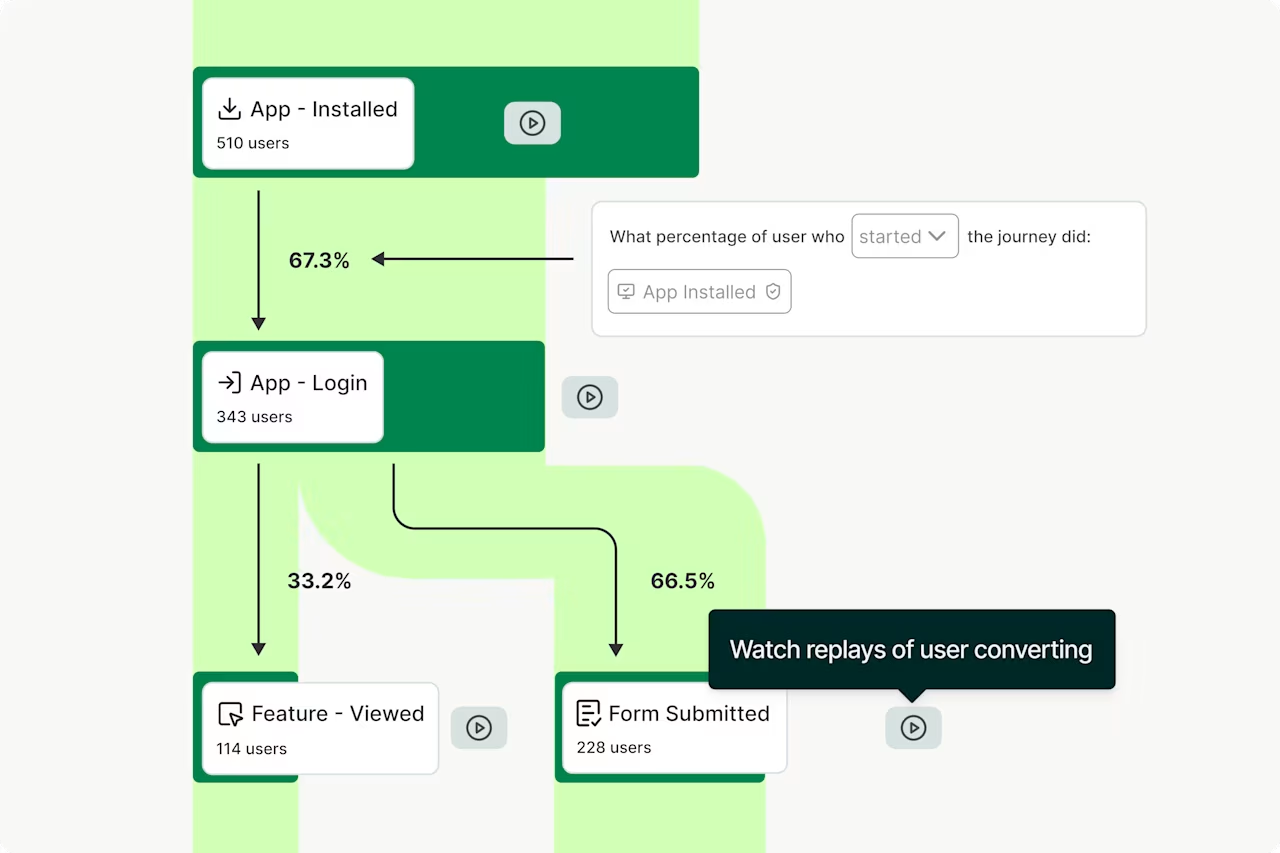
Track user behavior across sessions and time with Contentsquare.
How do you start with agentic AI as an online business?
The most common mistake businesses make is trying to deploy agents across too many workflows or initiatives at once. This scattered approach typically leads to shallow implementations that create more problems than they solve.
The safer and more effective approach is to start with a single, well-scoped use case where the rules are clear and the data is already reliable. Pick a workflow that's currently manual, repetitive, and has clear success metrics.
Cart abandonment recovery, for example, has defined triggers (user adds items but doesn't purchase), clear actions (send recovery message), and measurable outcomes (conversion rate).
This isn't a technology project—it's a workflow design project that happens to involve AI. Success depends more on understanding the process you're automating than on the sophistication of your AI model.
Here are the three steps to follow:
1. Pick the right first workflow: choose something with clear rules, reliable data, and measurable impact. Avoid workflows where human judgment is essential or where the data quality is questionable.
2. Set permissions and approval points: define what the agent can do autonomously and what requires human review. Start conservative—you can always expand permissions later as you build confidence.
3. Run a pilot before scaling: test with a small segment of users or transactions first. Monitor closely for unexpected behaviors, measure the actual impact, and refine before rolling out broadly.
How do you measure ROI from agentic AI?
Measuring return on investment (ROI) from agentic AI is more straightforward than it sounds because agents are deployed to improve specific outcomes that already have metrics attached to them. You're not inventing new ways to measure success—you're tracking whether existing metrics improve.
The challenge isn't finding metrics. It's attributing changes in those metrics to the agent. If conversion rates increase after deploying an agent, you need to determine how much of that improvement came from the agent vs. seasonal trends, marketing campaigns, or other optimizations.
Three categories of metrics matter when evaluating agent performance:
Revenue metrics tell you if the agent is helping the business grow through conversion rate improvements, average order value increases, or customer lifetime value expansion
Efficiency metrics tell you if it's reducing operational cost through support tickets deflected, manual tasks automated, or time to resolution decreased
Trust metrics tell you whether it's achieving these gains without damaging the customer relationship through customer satisfaction scores, error rates, or complaint volumes
All three categories matter because they balance each other. An agent that increases revenue by being overly aggressive with upselling might hurt trust metrics. One that improves efficiency by deflecting all support requests might miss revenue opportunities.
Frequently asked questions about agentic AI for online businesses
Standard ChatGPT is generative AI because it responds to prompts but doesn't take autonomous actions. OpenAI has introduced agent-mode capabilities that allow ChatGPT to use a browser and complete tasks independently, which crosses into agentic behavior, but the distinction depends on how the tool is configured and used.
![[Visual] Contentsquare's Content Team](http://images.ctfassets.net/gwbpo1m641r7/3IVEUbRzFIoC9mf5EJ2qHY/f25ccd2131dfd63f5c63b5b92cc4ba20/Copy_of_Copy_of_BLOG-icp-8117438.jpeg?w=946&q=85&fit=scale&fm=avif)