![[Visual] Stock desktop with graphs](http://images.ctfassets.net/gwbpo1m641r7/4ibTHSyYMP1ULKnZnw1QM9/85f052087a6902cbd526cf634b033572/AdobeStock_542452796.png?w=1280&q=85&fit=scale&fm=avif)
AI is changing how people find your business. AI search engines like ChatGPT, Claude, and Gemini are shifting the discovery phase off-site, giving users key information without requiring them to click through to your website.
This creates a new challenge for marketing teams, who have traditionally invested in top-of-funnel methods like search engine optimization (SEO) and paid social to fuel brand awareness and kickstart the acquisition funnel. But AI search works differently.
Many sites aren’t fully visible to the crawlers that inform AI search engines, leading LLMs to misrepresent—or completely miss—your brand or products.
To maintain control of your brand in the age of AI-driven discovery, you need to ensure LLMs have accurate, up-to-date information. But how can you tell what AI crawlers actually see and what they miss?
In this article, you’ll learn:
Why optimizing your site for AI crawlers is so important
How to see what they miss in just one click
And what to do now to improve visibility—so you can maximize your reach in AI-powered search
Key insights
Designing for humans and designing for AI require different approaches. According to our analysis, 90% of bots can’t execute JavaScript, meaning they’re unable to load dynamic content. As a result, the rich experiences that engage human users may render content inaccessible to most AI crawlers.
SEO helps LLMs find you, but AI accessibility helps them understand you. Today, you need both to ensure your brand, positioning, and content are accurately represented in search results.
Analyze key pages through AI’s eyes. Start with conversion-focused pages, like product pages, to ensure AI accurately represents your features, prices, and availability—so you don’t lose potential customers due to misinformation.
What are AI crawlers and why do they matter?
AI crawlers are automated bots that scan and index your content for AI search results. When a user asks an LLM about a product, brand, or service, the model draws on what its crawlers were able to ingest to answer.
As AI search becomes an increasingly important acquisition channel, making your site accessible to AI crawlers is critical to drive top-of-funnel traffic and brand recognition. This process is known as generative engine optimization (GEO).
What’s the difference between AI crawlers and AI agents?
There are two main ways AI interacts with your site:
AI crawlers scan and index your content for AI search results
AI agents act on behalf of users and can browse, compare, and complete transactions
Both are important, but they serve different functions—and require different optimization approaches.
The problem: AI crawlers don’t see what humans see
Most AI crawlers don’t ‘see’ your website the way a human does. They work by fetching raw HTML, and most can’t execute JavaScript, the technology behind most dynamic and interactive website features.
As a result, AI crawlers may completely miss
Content that only appears after a page is fully loaded, like prices and product descriptions that load dynamically
Content that appears after a user input or interaction, like hotel availability that only shows up once you’ve selected specific dates
Information in tabs, expandable sections, or tooltips, like product explanations that appear on mouseover or FAQs that expand when clicked
Infinite scroll feeds, like product catalogs that load items progressively as you scroll
This visibility gap impacts how AI talks about your brand in ChatGPT, Gemini, or Claude results. Without clear, crawler-friendly information, AI search engines may omit your brand or share incorrect information, limiting your website’s discoverability and negatively impacting conversions and revenue.
The stakes: how poor AI crawler visibility negatively impacts your business
According to Contentsquare’s 2026 Digital Experience Benchmarks Report, AI-referred traffic spiked +632% year-over-year. While it may only account for less than 0.2% of total traffic right now, its influence is already being felt in other areas:
Organic search fell –9%
Paid search dropped –7%
59% of websites saw traffic decline in 2025
As more of the search and discovery phase happens off-site, visitors from LLMs are often further along in their journey and arrive with stronger intent. Semrush reports that visitors from LLMs are 4.4 times as valuable as the average visit from traditional organic search, based on conversion rate.
Currently, however, AI-referred traffic has one of the highest bounce rates among channels (53.6%) according to our benchmarks report. This may suggest a disconnect between what users expect based on AI-generated answers and what they actually find on your site, causing them to bounce when they don’t see what they’re looking for.
This makes it even more crucial for AI search engines to accurately describe your website to prospective customers. Otherwise, businesses risk frustrating users when they can’t find what they were promised—damaging trust and reputation, creating poor user experiences, and reducing conversion rates.
The solution: identify and fix AI visibility gaps
To close these visibility gaps, you need to see your website exactly the way AI crawlers do. Only then can you understand precisely what’s missing, what it could be costing you, and how to fix it.
With Contentsquare’s CS Live, you can do this right in your browser. Toggle between Human View and Bot View in just one click to surface what AI crawlers miss on key pages, like JavaScript-rendered prices, dynamic product descriptions, and interactive CTAs. Then, quickly prioritize the most important fixes based on business impact.
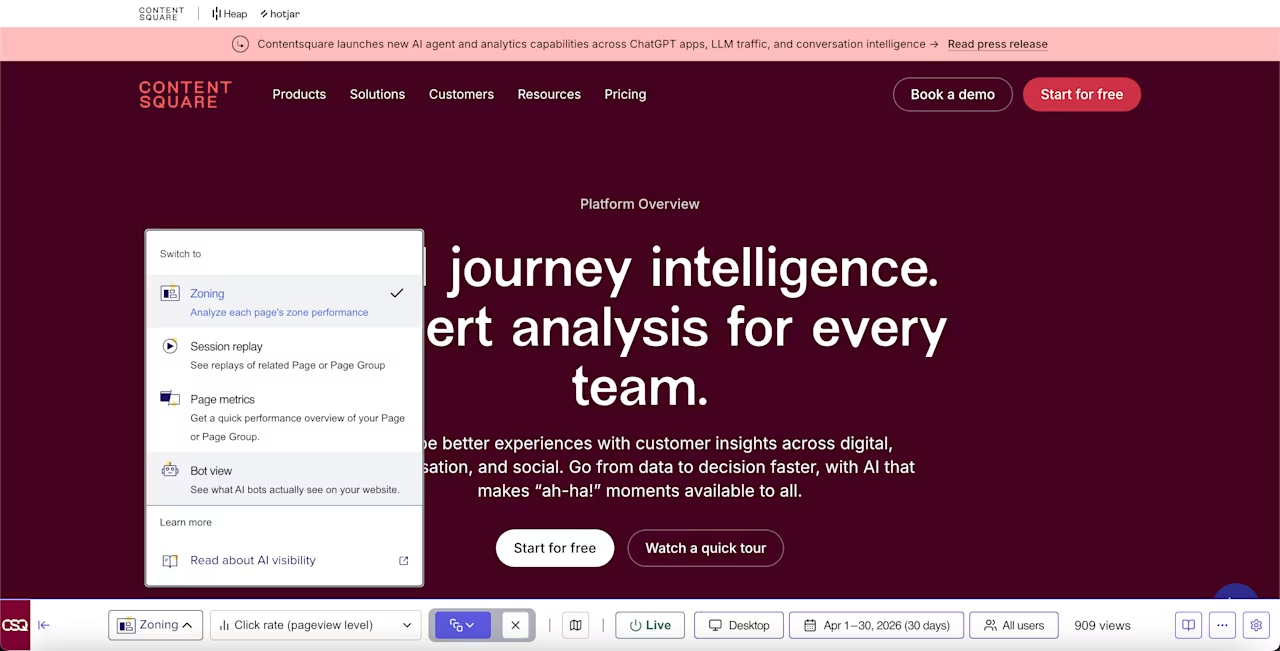
What Contentsquare’s Bot View in CS Live looks like in action
4 quick wins to improve AI crawler visibility
Once you’ve identified what’s missing, use these tips to quickly take action.
1. Load critical content upfront
Use server-side rendering to make sure your product’s most important information (like prices, descriptions, and availability) renders immediately so AI crawlers can accurately report on it.
2. Use structured data
Label your content to tell AI exactly what things are (like product names and categories), so it describes them correctly in search results.
3. Give AI clear guidance
Include an llms.txt file on your site to actively steer how AI represents your brand in conversations.
4. Ensure key information is visible
Design your page so the most important content isn’t gated behind JavaScript that requires clicks or interactions AI crawlers can’t execute.
💡 Pro tip: use Acquisition Analysis in Contentsquare to monitor AI-driven traffic as you close visibility gaps. Acquisition Analysis shows you
Which LLMs drive the most traffic
How visitors from each source convert
Engagement metrics like bounce rate, time on page, and pages consumed
Where your highest-value sessions come from
Start by identifying opportunities using Bot View in CS Live, then measure the impact of your improvements on engagement, conversions, and revenue.
Not sure where to start? Ask Contentsquare’s AI agent, Sense Analyst, to analyze AI-driven traffic and make recommendations for which source to optimize first.
![[Asset] Acquisition Analysis Sense chat](http://images.ctfassets.net/gwbpo1m641r7/3iBpj2t7vtllAnkGfwUQrC/95f412256fb0ea4b8903ff8e5ec8dc9b/image2.png?w=1280&q=85&fit=scale&fm=avif)
Futureproof your website for AI-driven search
As the way consumers discover and evaluate brands evolves, the sites that are AI-ready will have a distinct advantage. Optimizing for AI crawlers ensures you stay visible, maintain relevance, and control your brand’s narrative—so you can drive traffic, conversions, and revenue through an increasingly essential channel.
FAQs about AI crawlers
AI crawlers interact with your site by fetching raw HTML, which they scan and index for use by LLMs and AI search engines. Most AI crawlers struggle to execute JavaScript, which means they frequently miss
Content that only appears after a page is fully loaded (like prices)
Content that appears after a user input or interaction (like filter results)
Information in tabs, expandable sections, or tooltips (like FAQs)
Infinite scroll feeds (like product catalogs)
As a result, AI crawlers often lack key information that may skew how LLMs represent your brand in AI search results.

Anna is a freelance content writer and strategist specializing in B2B SaaS. She's written for industry-leading companies like Contentsquare, Hotjar, Intercom, DocuSign, HubSpot, and more. When she's not writing, she spends her time reading, drawing, and hanging out with her cat.