
User segmentation is one of the most powerful ways to understand your customers—and improve your relationship with them. By analyzing different user segments, empathizing with their behavior, and adjusting the digital experience to meet their unique preferences, you increase conversions, boost customer loyalty, and drive real business growth.
Not sure where to start with your customer segmentation strategy? Here are 5 real-world user segmentation examples to borrow for your next product analysis session, experimentation sprint, or marketing campaign.
1. How Rakuten used heatmaps to improve their checkout process
When online vouchers and cashback company Rakuten’s shopping cart page didn’t deliver the expected conversion rate, the team turned to user segmentation to discover why.
Using the zoning feature in Contentsquare’s Heatmaps, which overlays user experience (UX) metrics onto your site to reveal which page elements users interact with, the company compared the behavior of first-time visitors with current customers. Based on this data, the team hypothesized that new visitors found the cart page confusing.
They also spotted that the segment that didn’t convert was spending longer on the page than the converting segment.
They deduced that having one long checkout page was producing a negative effect, so they split it into a more user-friendly 4-step process—and increased the conversion rate between initiating and completing the checkout process by +10%.
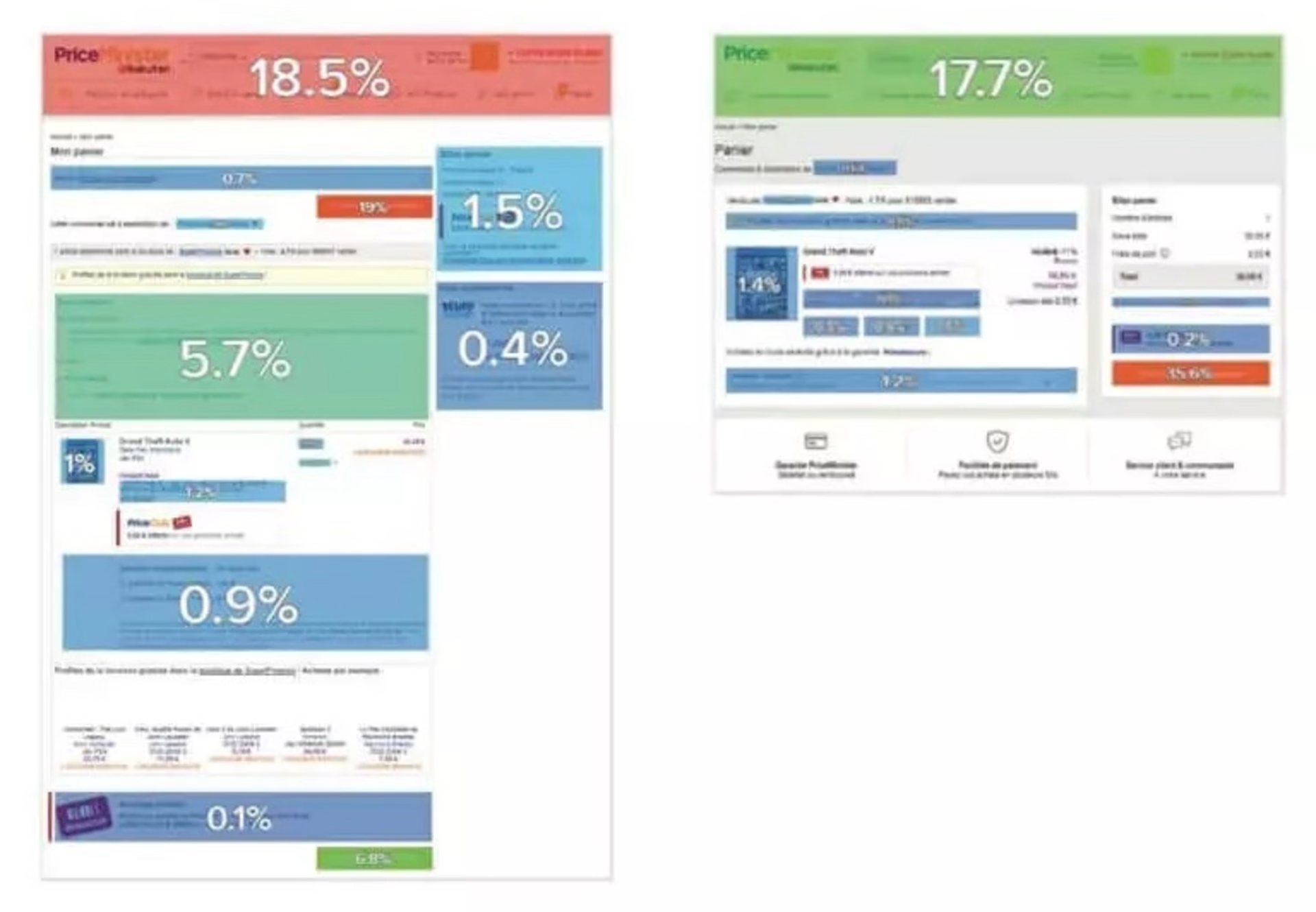
Using insights from Contentsquare, Rakuten improved its shopping cart page
Contentsquare is the perfect ally for working on UX. It not only allows us to better understand areas of our site that are confusing users but also to study the right way to address problems.
2. How Co-op Food found and fixed errors with session replays
User frustration can tank your digital experiences and cause potential customers to choose your competitors instead. To minimize the impact on your conversions and revenue, you need to quickly spot issues and empathize with your users.
When the team at food retail business Co-op Food noticed some customers were dropping off at the payment stage, they used Contentsquare’s Journey Analysis to learn more.
They soon realized these customers weren’t bouncing; they were getting sent back to their baskets. They then jumped to the relevant session replays for that specific segment to do a deeper dive.
![[Visual] Configure session replay](http://images.ctfassets.net/gwbpo1m641r7/79BbshL9ArlzcriOvdsoON/525c776cf057e163575dbd200e8898b4/Screenshot_2024-11-06_at_11.44.49.png?w=1920&q=100&fit=fill&fm=avif)
Use Contentsquare’s Session Replay capability to watch how individual users from specific segments navigate your site or app
By watching replays of customers stuck in this loop, the engineering team quickly identified what caused the error, making it easier and faster for them to roll out a fix.

Contentsquare has helped us develop our understanding of online shopper behavior, putting insights into the hands of the people who can take action.

3. How John Lewis & Partners used analytics to analyze marketing campaigns
To win new customers and hit your business goals, you need to know which of your customer engagement and marketing efforts are actually producing results.
Understanding which marketing messages and in-app ads resonate with your target audience helps your marketing team effectively allocate budget and resources, streamlining decision-making and improving your ROI.
After British department store chain John Lewis & Partners launched a big campaign, the UX team wanted to measure the impact of one particular element—campaign banners—across the website.
To do this, they used behavioral user segmentation to compare 2 segments: customers who interacted with the campaign banners and made a purchase in the same session, and customers who didn’t interact with the banners.
This customer segment analysis revealed the campaign banners had an impressive effect: they drove up to 4x higher engagement than the team had initially targeted, and resulted in a significantly higher average order value (AOV).
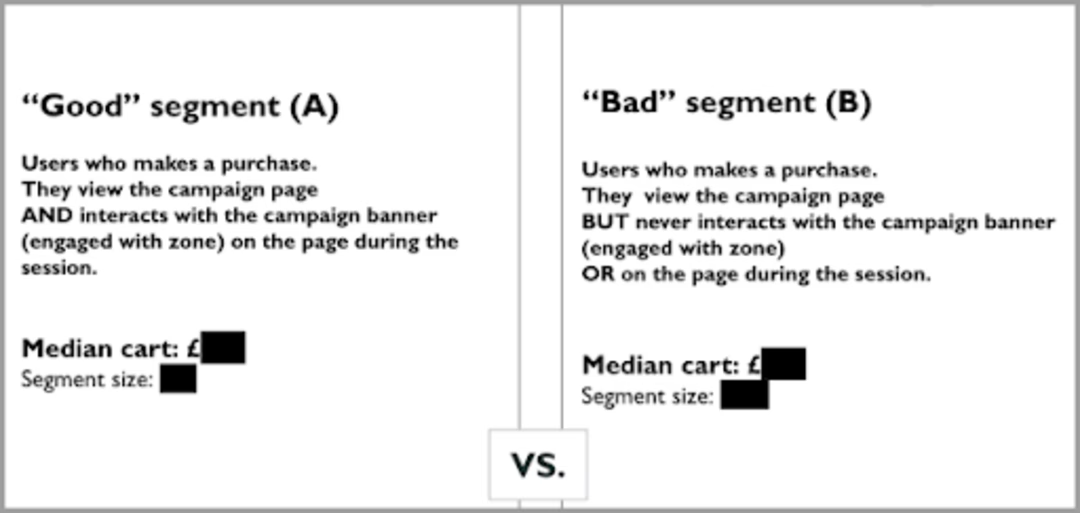
The team at John Lewis & Partners used customer segmentation to see how much money they would miss out on if campaign banners weren’t shown to users
Using Contentsquare’s Impact Quantification capability on these segments, the team was able to identify how much revenue the business could lose by not showing these banners to users.
By connecting the marketing campaign directly to a bottom-line figure, the team could clearly communicate the impact of their marketing efforts to key stakeholders—and make data-driven decisions for their next campaign.

“The main difference that Contentsquare brings is how easy it is to access insights and get people to the point where they're actually unlocking a lot of insights very, very quickly. That speed to insight comes easily as you upskill.”
4. How the Cotton On Group used personalization to increase acquisition
One of the biggest benefits of customer segmentation is how it enables you to use customer data to build stronger relationships. With the wealth of information in your product analytics tool, you can hone your marketing strategy to create personalized journeys for different segments.
For example, when Australian retail company Cotton On Group struggled with ineffective acquisition strategies that led to increased churn, they decided to do a deep dive into each acquisition channel’s performance.
Matt Spowart, Head of Digital Enablement and Brand Optimization at the company, used data analysis to find which channels led to the best long-term results.
Equipped with this knowledge, the Cotton On Group focused its acquisition efforts on channels linked to high-value, loyal customers. Using segmentation, they were not only able to understand the behaviors of customers from different channels but also tailor their marketing messaging to specific segments depending on which channel they came from.
This allowed them to connect with more right-fit customers from the start, enabling them to improve retention and customer satisfaction.

Our merchandising team uses Contentsquare to look at the customer’s experience on the site and test, learn, and play around with what could be the optimal model to improve conversion and acquisition.

🔎 More ways to use user segmentation for personalization
User segmentation is helpful at every stage of the customer journey, from acquisition to retention. Whether you’re in ecommerce or SaaS, here are other more customer segmentation ideas to help you use personalization to build better customer relationships.
Use demographic or behavioral segmentation to analyze which items are popular with customers who have shared behaviors or common characteristics (such as similar shopping history or age group) and highlight these items to other users in this segment
Identify users with the highest customer lifetime value (CLV) and reward this segment’s loyalty with exclusive offers or perks
Re-engage segments at risk of churning with in-app notifications or email marketing campaigns designed to bring them back to your site or product and help them get more value from it
Analyze your highly engaged segment to find behaviors linked with adoption, then build these behaviors into your onboarding flow. For example, if you find that users with high engagement levels use a certain feature X times in their first month, teach new users how to use it too and highlight the benefits of regular usage.
If your data shows that users from one particular channel (like social media) care more about pricing compared to other channels, offer them a special discount for their first order or highlight sale items on your landing page
Use geographical segmentation to automatically take users to the localized version of your site in their preferred language
![[Visual] User segments - analysis setup](http://images.ctfassets.net/gwbpo1m641r7/477HHUHJYrGlEEXLjdrwog/8b2b1b1294c7578b624ae095f2ea58e7/User_segments.svg?w=1920&q=100&fit=fill)
User Segmentation in Contentsquare gives you granular insights into different groups of customers you can leverage in your marketing campaigns and product roadmap
5. How ASICS segmented A/B test results for more effective experimentation
When you want to improve the user experience, running experiments is just the first step: what really matters is what you do with the data afterward.
By breaking data down by segments, Andrey Prokhorov, Ecommerce Team Lead at footwear and sports apparel company ASICS, was able to better understand and action the results of his team’s A/B experiments. They used Heatmaps and zoning analysis to quickly find users who took a certain action within their A/B test.
That was the data they really wanted. By creating a segment of those users for further analysis, Andrey and his team got more insights into the behavior and next steps of the specific cohort they cared about.
This doesn’t just save you valuable analysis time. The richer your insights are, the more empowered your team is to make data-driven decisions and turn your experiments into serious results.
🤝 Combine Contentsquare with A/B Tasty for faster experimentation
Integrating your product analytics tool with your A/B testing platform adds a layer of additional insight to your experiments.
Use the Contentsquare and A/B Tasty integration to streamline your workflow and get digital experience insights that explain why users preferred the winning variation, so you can iterate on your successes.
Customer segmentation analysis gives you deeper insights
User segmentation and analysis gives you unparalleled insights into your visitors and customers—and helps you understand what turns the former into the latter.
Start exploring key user segments to surface important trends, uncover pain points and opportunities, and prioritize your product and marketing resources to have the greatest impact.
FAQs about user segmentation
User segmentation is the process of grouping users by the characteristics they share, including traits and actions (like behavioral segmentation). This allows product and marketing teams to design features and strategies that meet each group’s specific needs, improving engagement and achieving better business outcomes.