![[Visual] Survey retention - stock image](http://images.ctfassets.net/gwbpo1m641r7/3xD9ghYf8jbPKMEwGAJVpi/2c197fc402ee4aec10737501dd1b9291/Indoor_Workspace_with_Women_Using_Laptops_and_Plants.jpg?w=3840&q=100&fit=fill&fm=avif)
With even the most incremental website changes capable of generating return-on-investment (ROI) gains over time, it’s no wonder the most innovative and successful companies (think Amazon, Google, and Netflix) have an experimentation mindset.
However, deciding what to experiment with is easier said than done. In this article, you’ll find 5 digital experimentation ideas your business can try to drive more revenue. Plus, discover how Contentsquare helps you get the most accurate and actionable results from these experiments.
1. Make product and gift recommendations
Thinking of gift ideas can be challenging—especially when you have a big family or group of friends to shop for.
To help consumers pick and add more products to their carts without having to browse various pages, present them with curated lists of quality gift recommendations.
Use A/B testing to experiment with different formats, whether that’s frequently bought items, staff-created lists, occasions, price points, or user reviews.
This way, customers have a much smaller list to browse and feel more confident about buying from you.
💡 Pro tip: add a product carousel to your landing pages to provide the perfect experience for last-minute shoppers who don’t have time to search through a suggested items grid.
You can then A/B test the impact of including different items in the carousel. That’s what global fashion retailer New Look did, using Contentsquare to A/B test carousels with and without user-generated content (UGC) in the first-image position.
As a result, New Look saw product conversion increase by +19% and a topline incremental uplift on revenue of +5.5% over the testing week.
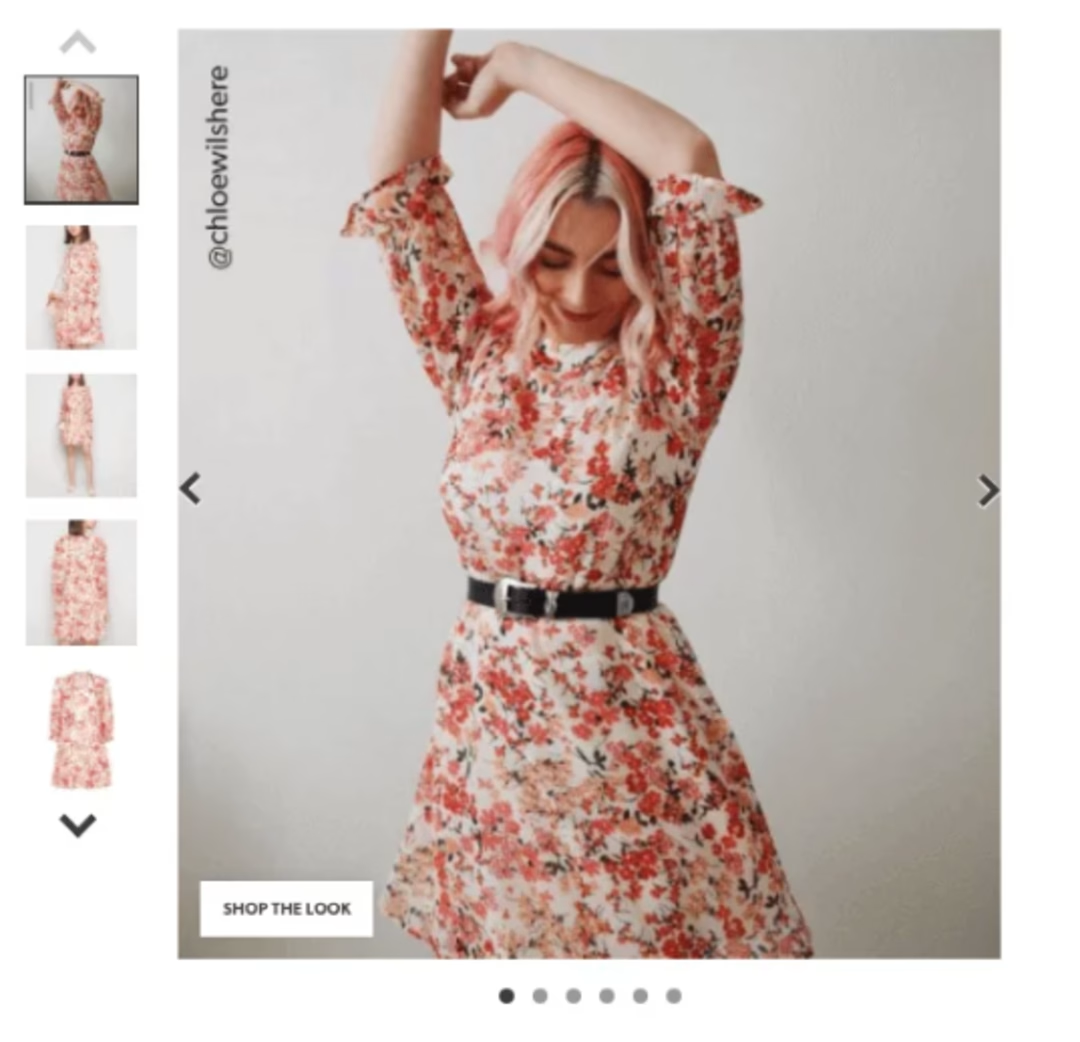
Screenshot showing New Look’s user generated content on its site
Read the full New Look customer story.
2. Add a countdown timer
If you’ve ever been in a time-sensitive situation, you’re likely familiar with the impact of a ticking clock.
Having limited time to make a decision or finish a task can force us to take action. Simply put, such situations make us feel that if we don’t act, we’ll miss out.
Many ecommerce companies leverage this technique to improve their conversions. See if you’re able to get similar results by A/B testing countdown timers.
For example, you can remind consumers that your holiday sale only lasts for a limited time by showing the number of days remaining or adding a live countdown timer to your site.
This will drive them to click the ‘Buy Now’ button sooner rather than later.
Experiment with different variants of the timer (for example, by the minute, by the hour) to see what works best in your particular case.
3. Put up a ‘days left to order’ banner
In the lead-up to any major holiday, there’ll be many shoppers in a frenzy about getting gifts in time.
By displaying the number of days left to order for items to arrive before a specific date in a banner, you encourage customers to convert while helping them avoid ordering too late.
You can also use banners to display the shipping methods that guarantee on-time delivery.
💡 Pro tip: use heatmaps to test out different banner placements and sizes. These could impact not just the number of customers who see and interact with it, but also how other page elements perform.
Using Contentsquare’s Heatmaps, beauty brand AVON discovered customers were viewing a banner at the top of a page and not scrolling down to view a product carousel beneath it—causing the product carousel to have a lower exposure rate.
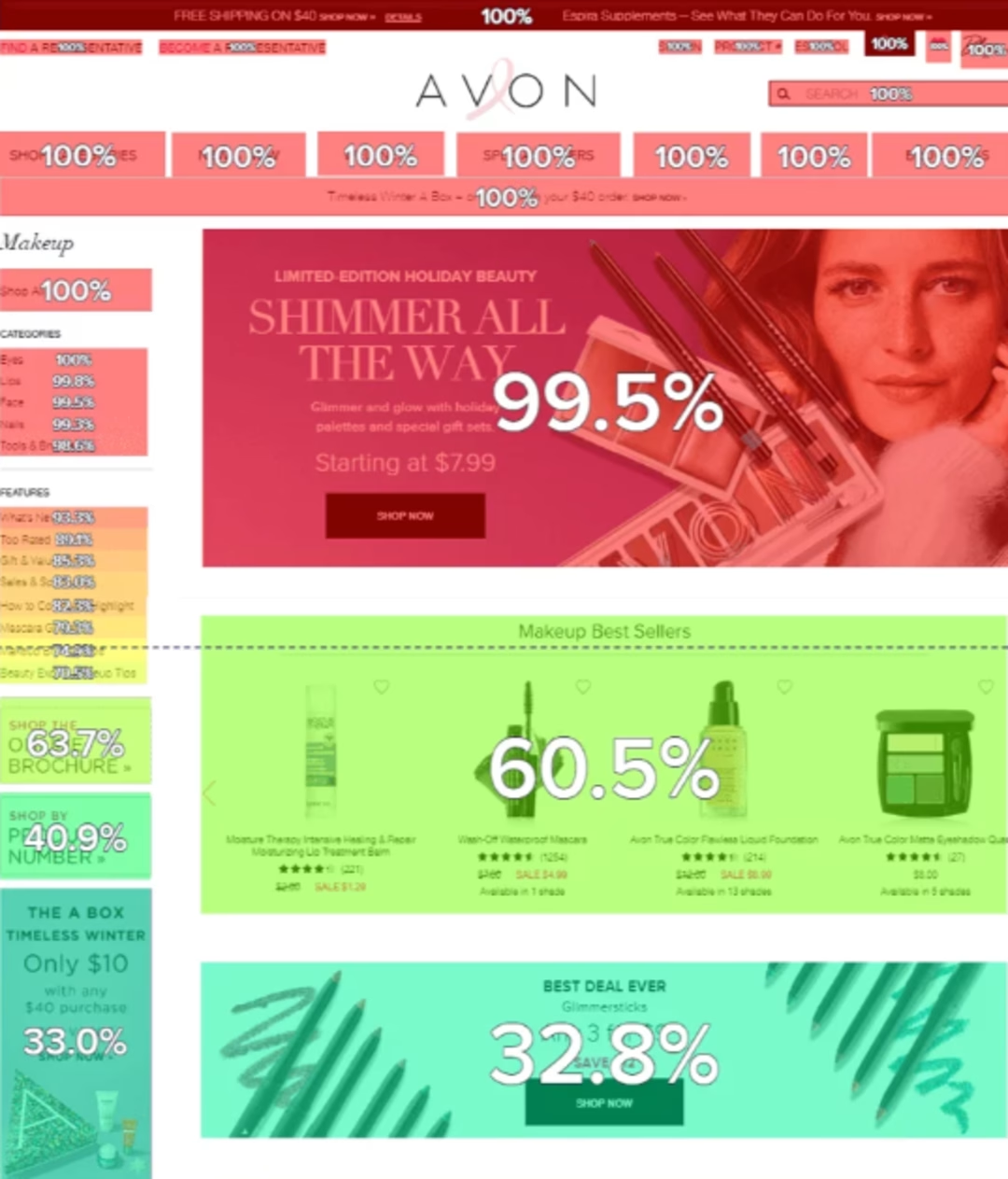
Zone-Based Heatmaps show the low exposure rate of AVON’s product carousel
AVON’s team ran an A/B test on the page to see if reducing the banner size would impact the performance of the carousel. It did, in a major way. You can read the full AVON customer story here.
Some retailers go with the typical hero image, while others integrate such banners into their email campaigns. You can also A/B test it in the sidebar or on specific product pages.
4. Provide fast shipping for specific items
If you’re planning to offer express shipping but don’t necessarily want to associate it with every order, you can split-test it as an option for specific categories and items.
For example, try offering next-day shipping for more lucrative goods—either those that demand continual repurchases or those with higher price tags.
If your operations team doesn’t have the resources for next-day shipping for highly in-demand items, consider other ways to A/B test.
For example, you can limit express shipping to a specific payment option. This includes completing the transaction with a brand-specific credit card or offering it to only half of your customers.
Another A/B testing option is making express shipping available for an additional charge and seeing who bites on its availability.
5. Try out a site-wide ‘benefits bar’
Why should a consumer buy from your business? What makes you stand out from the competition?
These are questions that anyone in the ecommerce industry should be able to answer and clearly communicate to their customers.
While many online businesses do a great job of explaining their brand’s unique benefits, they often inadvertently bury these value propositions in their website’s footer or on sub-level pages.
A much better way to make your value proposition apparent is to experiment with a ‘benefits bar’ on your site, above the fold, right below the navigation menu.
The importance of spelling things out (where appropriate) for your site visitors is illustrated by activewear brand Rhone, who used Contentsquare to test and prove a hypothesis that their male customers would benefit from a buyer’s guide being added to male collection pages.
You can read more about that in this Rhone customer story.
How to turn digital experimentation ideas into wins with Contentsquare
Hopefully, this article has given you some great ideas for experiments to run on your own site. (And there’s more where that came from—see this blog for 7 more great examples of A/B tests.)
However, before you don a lab coat, remember: your tests are only as good as your data.
If you only have contextless data to work with, you might be able to see, for example, that a page variant has a higher conversion rate—but you won’t know exactly
How are the users who land on the variant behaving compared to those on the control page?
How are the visitors who convert on the variant page behaving differently from those who don’t?
How do the pre-conversion journeys of those visitors who hit the variant differ from those who landed (and failed to convert) on the control?
And why are all of these behaviors happening?
To answer nuanced questions like these, you need digital experience analytics.
Contentsquare’s experience intelligence platform gives you the full picture of your A/B tests by providing you with rich, contextual user behavior data through capabilities such as Heatmaps, Journey Analysis, and Session Replay—all of which help you gain deeper insights.
![[Visual] ab test heatmaps](http://images.ctfassets.net/gwbpo1m641r7/71Feljv3nwR0ng3PEiPGEG/c5c4f991ef679e660e08970edb2a894a/ab_test_heatmaps.png?w=3840&q=100&fit=fill&fm=avif)
Example of a Contentsquare A/B test
Contentsquare is integrated with top testing solutions such as AB Tasty and Optimizely, making it easy to feed data from the platform into your experiments, and vice versa.
It also provides
Experience Monitoring for surfacing and fixing user friction
Product Analytics for multi-session behavior analysis and retention optimization
Voice-of-Customer (VoC) to capture customer feedback and tie it to behavior
And you’ve barely scratched the surface. Why not see the platform for yourself?
![[Visual] Jack Law](http://images.ctfassets.net/gwbpo1m641r7/6K99ulcVqLqKGyNZUaPiF8/145af0b27131005d862c790ddcafb3c5/Jack_Law.jpg?w=3840&q=100&fit=fill&fm=avif)