
Understanding your customers' journey isn't just helpful—it's essential. Every click, scroll, and drop-off across every touchpoint tells you something. But without the right tool to decode that data, you're making decisions in the dark. That's where conversion funnel analysis comes in.
This guide breaks down the top customer funnel analysis tools for 2026. We'll cover what makes each one stand out, who it's best suited for, and how to pick the right fit for your team and goals.
Key takeaways
Funnel analysis shows you exactly where users drop off in your conversion funnel—and gives you the data to fix it
Every tool serves a different need: GA4 for breadth, Contentsquare for depth, Mixpanel and Amplitude for product analytics, FullStory for UX diagnosis, and Plerdy for budget-friendly CRO
Quantitative data tells you what's happening. Session replays and heatmaps tell you why. The best results come from using both
Integration with your existing stack—HubSpot, Salesforce, ad platforms—is just as important as the tool's features
AI agents are changing how teams work: surfacing bottlenecks and anomalies automatically, at every funnel stage
Funnel optimization isn't a one-off project. The teams that win treat it as a continuous workflow—test, measure, and repeat
Why customer funnel analysis matters
A funnel isn't just a diagram. It's a map of your customer's journey—from first visit to final conversion.
Funnel analysis shows you exactly where users get stuck, quit, or convert. Once you can see those patterns, you can fix them. And when you fix them, you grow.
Here's what it helps you do.
Map user journeys: See the exact sequence of pages and actions users take across every touchpoint. Understand the most common paths, and identify where users take unexpected detours at each funnel stage.
![[Visual] Journey analysis on reference mapping](http://images.ctfassets.net/gwbpo1m641r7/30V6WdNQ7xg3mlOFV7DkmY/0e2235977563e2c759fdbd873d51ae59/01-Masthead__1_.png?w=3840&q=100&fit=fill&fm=avif)
Spot drop-offs and bottlenecks: Pinpoint every funnel stage where users abandon the journey—whether that's a landing page, a checkout form, or a signup flow. Identify bottlenecks quickly, quantify how many users are dropping off, and start forming hypotheses about why.
Optimize your marketing spend: Link conversions to the channels driving them. Understand which campaigns—whether paid ads, email messaging, or organic search—are bringing in users who actually convert. Then invest accordingly.
Support forecasting and planning: Over time, funnel data gives you a reliable baseline for forecasting conversion rates, projecting revenue impact, and setting realistic growth targets.
Without funnel visibility, you're guessing. And guessing is expensive.
6 things we looked for
Not all funnel tools are built the same. Here's the framework we used to evaluate each platform.
1. Ease of use: A powerful tool is only useful if your team can use it. We prioritized clear interfaces, quick setup, pre-built templates, and dashboards that don't require deep technical expertise to interpret.
2. Integration capabilities: Your funnel tool needs to work alongside the rest of your stack—your CRM (whether that's HubSpot, Salesforce, or another platform), messaging and marketing automation tools, ad channels, and data warehouse. We looked for strong native integrations and flexible APIs that slot into your existing workflows without friction.
3. Reporting and visualization: Can you access real-time data? Customize dashboards to your KPIs? Drill into specific segments or time periods? Good visualization turns raw data into actionable insights at every funnel stage.
4. Advanced features: The best tools go beyond the basics. We looked for A/B testing support, segmentation depth, predictive analytics, ai-driven anomaly detection, session replay, and forecasting capabilities.
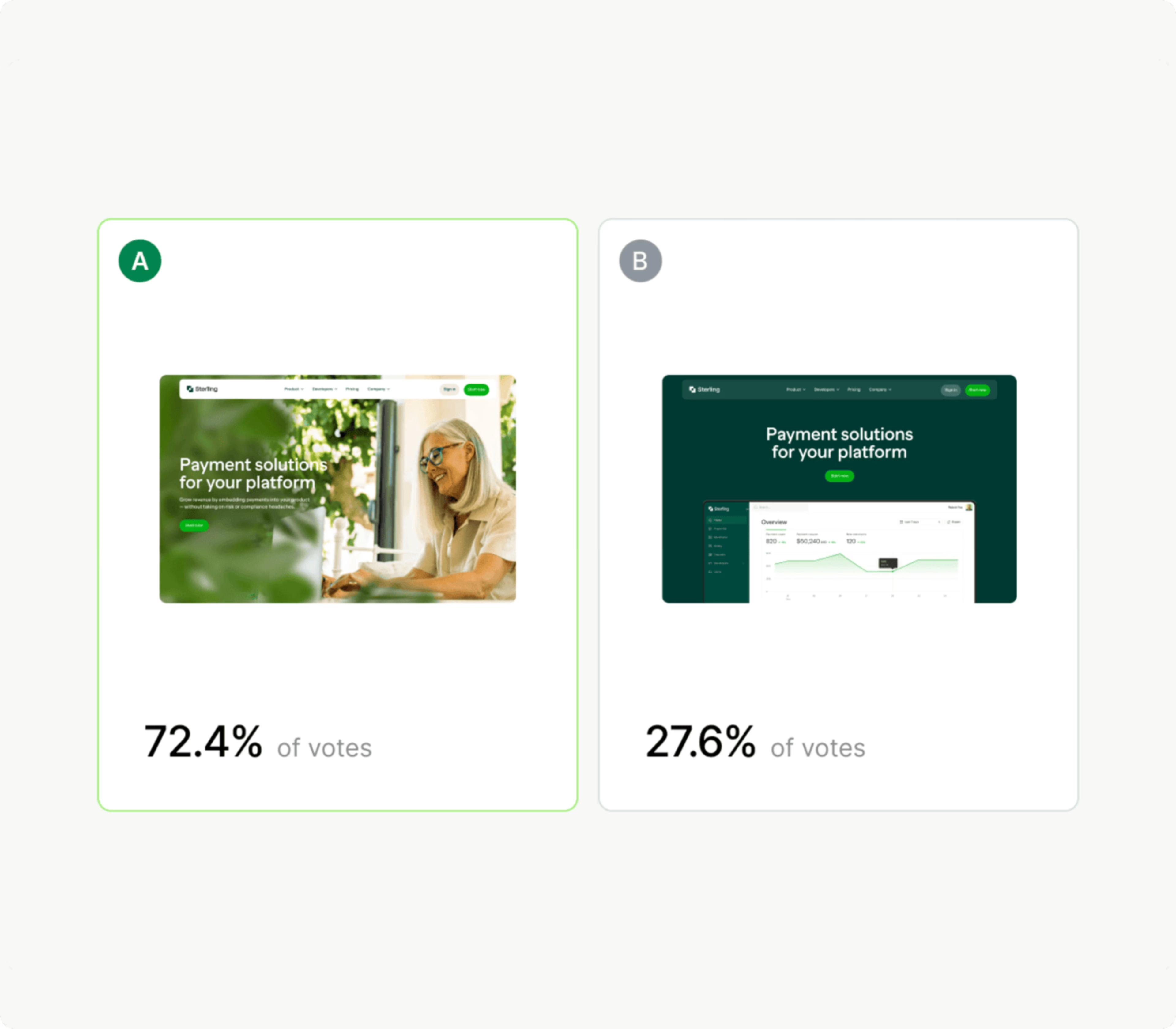
5. Pricing and scalability: We considered transparency, flexibility, and value across business sizes—from lean startups to enterprise teams managing complex multi-product conversion funnels.
6. Support and resources: Documentation, onboarding, community forums, and responsive support all affect how quickly your team gets value from a new tool.
The 6 best customer funnel analysis tools for 2026
1. Google Analytics 4 (GA4)
Best for: teams already using the Google ecosystem
GA4 is Google's rebuilt analytics platform—and a significant step forward from Universal Analytics. At its core is an event-driven data model: every user interaction is tracked as an event, making it well-suited for cross-platform analysis across both web and app.
Key features:
Funnel Exploration reports showing conversion rates and drop-offs at every funnel stage
Path Exploration to visualize the routes users actually take through your site or app
Segment overlays for comparing user groups within a single funnel
Real-time reporting to monitor active user behavior as it happens
Pre-built templates for Funnel and Path Exploration to speed up setup
Custom event tracking for virtually any user interaction—including landing page views, form starts, and button clicks
Predictive metrics powered by machine learning, including purchase probability, churn probability, and revenue forecasting
Pros: Free and feature-rich; deep integration with Google Ads, GTM, and BigQuery; strong cross-platform tracking for web and mobile; real-time dashboards built in; connects with HubSpot and other CRMs via GTM or data layer.
Cons: Steep learning curve from Universal Analytics; complex event setup requires careful planning; default reporting interface can feel intimidating without custom configuration.
Best for: Businesses already using Google Ads or GTM, teams that need free and powerful analytics, and organizations willing to invest time in configuration to unlock its full potential.
2. Contentsquare
Best for: teams who need to understand the why behind the numbers
Contentsquare (hello 👋🏼) is a Digital Experience Analytics platform that goes beyond tracking what users do—it shows you why they do it. It combines Behavioral Analytics, Heatmaps, Session Replay, and AI-driven insights to bridge the gap between raw funnel data and real user understanding.
Where most tools stop at the numbers, Contentsquare starts there. Every drop-off in your funnel becomes a starting point for investigation—not just a metric to report. That shift from observation to understanding is what makes the difference between knowing you have a problem and knowing how to fix it.

Key features:
Visual conversion funnel analysis enriched with heatmaps and zone-based analytics at every touchpoint—see not just where users drop off, but what they were doing right before they left
Session replay linked directly to funnel drop-offs—watch exactly what users experience on a landing page, checkout step, or onboarding flow before they abandon it
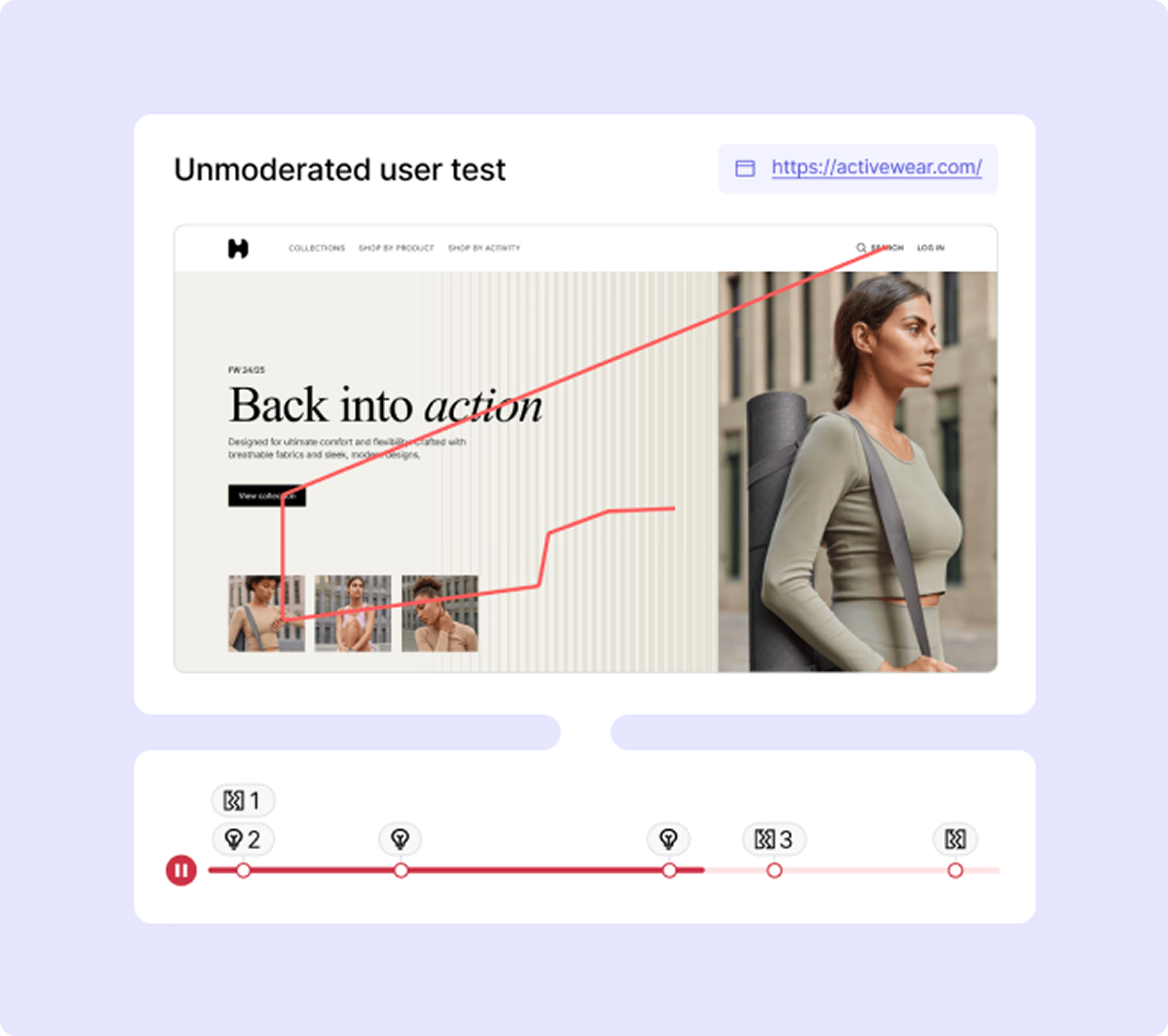
Zone-based analysis to evaluate how specific content blocks contribute to engagement or friction at each funnel stage
AI agents that surface real-time alerts, anomalies, and user struggle points automatically—without waiting for someone to go looking
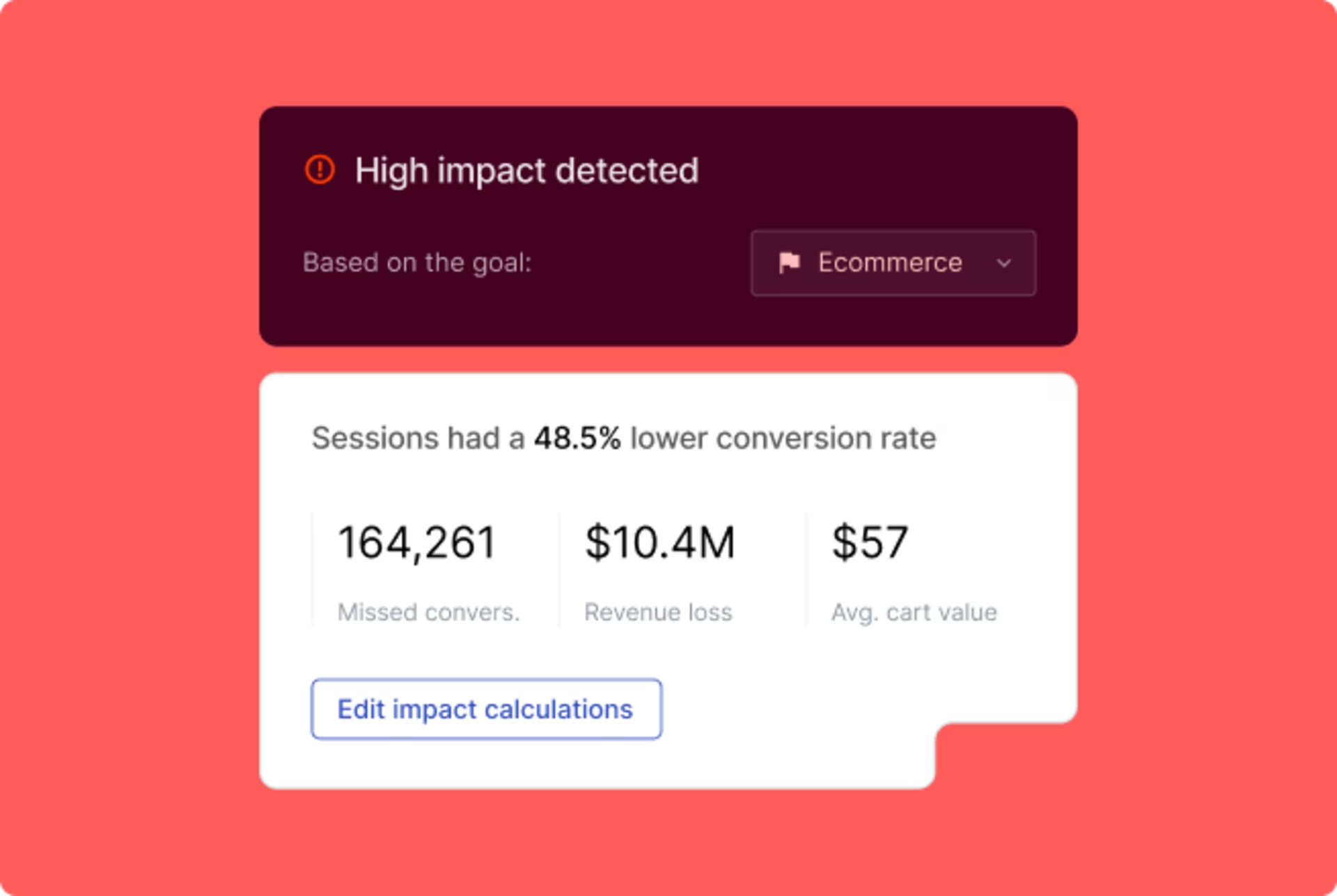
Revenue impact scoring to quantify the business impact of each issue, so your team focuses on what moves the needle first
Frustration signal detection—rage clicks, dead clicks, and error interactions—mapped directly onto funnel steps
Customer journey analysis to understand the full paths users take across your site, beyond a single predefined funnel
Integrations with HubSpot, Salesforce, and other platforms to connect experience data to your wider workflows
Pros: Unmatched qualitative depth; intuitive, visual dashboards; AI agents surface actionable insights proactively; built for enterprise scale; strong UX and CRO focus.
Cons: Premium pricing means it's not suited to small budgets; implementation across complex sites takes time; less focused on marketing attribution than pure analytics tools.
Best for: Mid-market and enterprise teams with dedicated UX, CRO, or product functions who want to understand—and act on—the full customer experience, not just the numbers. Particularly powerful for teams that are already measuring conversion rates but struggling to explain them.
3. Mixpanel
Best for: product-led growth teams
Mixpanel is purpose-built for product analytics. Everything centers on events and the users who trigger them, making it a natural fit for SaaS companies, mobile apps, and teams focused on user activation and in-product behavior.
Key features:
Flexible funnel builder based on any sequence of events, reordered on the fly
Conversion rate and drop-off visualization across every funnel stage
Powerful segmentation to analyze specific cohorts within a funnel—acquisition channel, device type, feature usage, and activation milestone
Time-to-convert analysis to identify where users stall
Retroactive funnel building from historical data—no pre-configuration needed
Messaging campaign integration to connect in-app or email communications to funnel performance
HubSpot integration to sync product behavior data directly into your CRM
Historical trend tracking to measure the impact of product changes over time
Pros: Highly granular event tracking; intuitive funnel builder; excellent segmentation; retroactive analysis saves setup time; fits naturally into product team workflows.
Cons: Pricing scales with event volume and can get expensive for high-traffic products; requires a thoughtful event tracking plan to get the most out of it; not a primary tool for marketing attribution.
Best for: Product managers and growth teams at SaaS companies or mobile app businesses who need precise visibility into user engagement, activation, and in-product funnels.
4. Amplitude
Best for: data-driven product and growth teams at scale
Amplitude is an enterprise-grade product analytics platform, built to help teams understand the full customer lifecycle—from acquisition through activation to retention. It excels at identifying not just where users drop off, but what's driving it.
Key features:
Advanced funnel reports with multi-step event sequences and instant segmentation
Conversion Drivers to identify which behaviors and user properties influence funnel outcomes
Impact Analysis to understand the causal relationship between user actions and conversion
AI agents to surface anomalies, flag unexpected drops in conversion, and recommend areas for investigation
Behavioral cohorting to create and apply sophisticated user segments
Pathfinder and Journeys to explore what users do before and after each funnel stage
Salesforce and HubSpot integrations to connect product data to sales and marketing workflows
Real-time data syncs and forecasting models to support planning at scale
Pros: Enterprise-scale performance; deep segmentation and cohort capabilities; strong collaboration features for product, engineering, and marketing teams; AI agents go beyond surfacing data to recommending action.
Cons: Higher price point; complex event taxonomy requires careful planning; steeper learning curve; likely more than most small teams need.
Best for: Large SaaS companies, mobile app teams, and data science or growth functions focused on the full customer lifecycle—with the resources to implement it properly.
5. FullStory
Best for: UX teams and anyone diagnosing experience issues
FullStory leads with digital experience intelligence. Its funnel analysis is made powerful by letting you literally watch what users do at every step—turning drop-off data into visual, human stories.
Key features:
Visual funnels with conversion rates and direct links to session replays for every drop-off
Automatic frustration signal detection: rage clicks, dead clicks, and error clicks flagged without configuration
Multiple heatmap types (click, scroll, rage, error) overlaid directly on funnel pages—including landing pages and key conversion steps
Omnisearch and flexible filters for targeted session analysis by user attribute, event, or error message
Developer tools integration to connect console errors to specific funnel abandonment points
Follow-up session tagging to revisit and share specific user struggles with your team
HubSpot integration to connect session insights to contact records in your CRM
Pros: Best-in-class qualitative insights; automatic session capture without event pre-configuration; accessible for non-analysts; rapid identification of bottlenecks; complements quantitative tools well.
Cons: Premium pricing based on session volume; privacy considerations require active management and clear communication; not designed for complex marketing attribution or statistical modeling.
Best for: UX and UI designers, product managers, and CRO specialists who need to visually diagnose why users drop off—especially on complex interfaces or multi-step flows.
6. Plerdy
Best for: small to mid-sized businesses focused on CRO
Plerdy brings funnel analysis, heatmaps, session recordings, pop-up forms, and NPS surveys together in a single platform. It's an all-in-one CRO tool that doesn't just show you where users drop off—it gives you ways to act on it immediately.
Key features:
Custom conversion funnel analysis based on URL sequences or specific events, with ready-to-use templates to get started quickly
Multiple heatmap types (click, scroll, segment, attention) overlaid on funnel pages and landing pages
Session recordings for users who convert or drop off at any funnel stage
Pop-up smart forms triggered by funnel behavior—including exit-intent pop-ups for abandoning users, with pre-built templates for common messaging scenarios
Follow-up NPS and feedback forms to collect direct qualitative input at key funnel moments
Native HubSpot and Google Analytics integration to slot into your existing workflows
Pros: Affordable all-in-one platform; combines quantitative and qualitative data; built-in tools to act on insights without switching platforms; user-friendly for marketing teams.
Cons: Lacks the advanced segmentation, predictive features, or product analytics depth of Mixpanel or Amplitude; less suited to enterprise-scale traffic; the breadth of features can feel overwhelming initially.
Best for: Small to medium-sized businesses, e-commerce stores, and marketing agencies looking for a budget-friendly CRO platform that combines analysis and action in one place.
How to choose the right funnel analysis tool
There's no one-size-fits-all answer here. The right tool depends on your goals, your team, and your budget. Here's a simple framework.
Define your goals and KPIs first: Are you trying to increase e-commerce sales? Improve user activation? Reduce churn? Your objectives determine which touchpoints and funnel stages matter most—and which metrics you need to track. Start here before you look at any tool.
Be honest about your team's technical skills: Tools like GA4, Mixpanel, and Amplitude reward investment in event tracking and data modeling. FullStory and Plerdy are more accessible for teams without deep analytics expertise. Assess your team's current skill set and bandwidth before committing.
Factor in the full cost: Subscription pricing is just the starting point. Consider implementation time, developer resources, training, and how well the tool integrates into existing workflows. The cheapest option isn't always the most cost-effective if it's too difficult to use or lacks the features you need.
Check your integration needs: Does it connect with HubSpot, Salesforce, your ad platforms, and your data warehouse? Strong integrations prevent data silos and make every tool in your stack work harder.
Trial before you commit: Most platforms offer free trials. Use them. Set up a real conversion funnel with actual data, involve stakeholders from different teams, and make a list of follow-up questions to address before signing a contract.
Best practices for getting the most from funnel analysis
A great tool is only half of it. Here's how to put it to work.
Start with a hypothesis: Don't open a dashboard without a question in mind. "I think users are dropping off on the landing page because the CTA isn't prominent enough" is a more useful starting point than "let me see what the data says."
Segment everything: Aggregate data hides the patterns that matter. Break your funnels down by traffic source, device type, user type, geography, and behavior. The insight is almost always in the segment, not the overall average.
Combine quantitative and qualitative data: Numbers tell you what's happening. Session replays and heatmaps tell you why. The most actionable funnel improvements come from triangulating both—and using real-time data and AI agents to catch bottlenecks early.
Test, measure, and repeat: Optimization isn't a one-off project—it's a continuous cycle. Form a hypothesis, run an experiment, measure the result, and use follow-up tests to build on what you learn.
Review your funnels on a regular cadence: Your product, messaging, and users are always changing. Set a review schedule—weekly, monthly, or quarterly—and update your funnels to reflect new product launches, site changes, and shifts in user behavior. Use forecasting data to set benchmarks and make review cycles more meaningful.
Choose your tool. Start closing those gaps.
Funnel analysis gives you the map. The right tool gives you the detail to act on it.
Whether you need the free breadth of GA4, the qualitative depth of Contentsquare or FullStory, the product precision of Mixpanel or Amplitude, or the all-in-one affordability of Plerdy—there's a match for your team and goals.
Pick one, get set up, and start turning drop-offs into conversions.
Funnel analysis is the process of tracking how users move through a defined sequence of steps—such as a checkout flow or sign-up process—and identifying where they drop off. It helps teams spot bottlenecks, understand user behavior, and make targeted improvements to increase conversion rates.
![[Visual] Contentsquare's Content Team](http://images.ctfassets.net/gwbpo1m641r7/3IVEUbRzFIoC9mf5EJ2qHY/f25ccd2131dfd63f5c63b5b92cc4ba20/Copy_of_Copy_of_BLOG-icp-8117438.jpeg?w=1920&q=100&fit=fill&fm=avif)
We’re an international team of content experts and writers with a passion for all things customer experience (CX). From best practices to the hottest trends in digital, we’ve got it covered. Explore our guides to learn everything you need to know to create experiences that your customers will love. Happy reading!