
To create digital experiences your users love, you need to know what drives their actions, how they navigate your site or product, and what keeps them loyal. Understanding customer acquisition is a critical piece of this puzzle. And if you want to identify—and replicate—what brings high-value customers to your business, you need robust acquisition analytics.
Read on to learn how you can use customer acquisition analytics to uncover in-depth insights about new customers, optimize your conversion rates, enhance your marketing campaigns, and elevate your customer acquisition strategy.
What is customer acquisition analytics?
Customer acquisition analytics is the process of collecting and analyzing data about how your business attracts and converts users. It looks at where new customers come from, the journeys they take after landing on your site, and how they behave on key pages, like your sign-up, pricing, or checkout pages.
The goal is to understand which acquisition channels and marketing efforts are most successful and assess how each one is performing across various metrics, so you can use this data to optimize your strategies and get the greatest return on investment (ROI) for your acquisition efforts.
3 benefits of customer acquisition analytics
A great customer acquisition analytics tool gives you granular insights about your users pre- and post-acquisition, enabling you to streamline your product and marketing strategies and hone in on the most impactful optimizations.
Here are 3 benefits of using customer acquisition analytics.
1. Improve your marketing
Once you understand which marketing channels are working—and which ones aren’t—you can reallocate your budget to the sources that actually drive results.
For example, does your customer data reveal prospects from social media have a much lower conversion rate than those you nurture with email marketing? Save your ad spend and invest in launching more targeted email campaigns with tried-and-tested messaging.
Or, examine how both user segments behave on your site after landing to find potential blockers that may be preventing the lower-performing group from converting.
2. Get more from your resources
Without clear attribution data, you’re left in the dark about which channels your customers come from and what they want from you—leaving you at risk of spending your marketing budget on the wrong things or prioritizing product improvements that don’t meet the needs of your target customer base.
Customer acquisition analytics lets you make data-driven business decisions about where to use your resources to have the greatest impact.
3. Increase customer retention
With the right platform, you can work backwards to reconstruct the entire customer journey. Understand the behavior of your long-term, high-value customers—including where they came from, what triggered them to convert, and what keeps them around—to get valuable insights about how to attract more right-fit customers from the start, and create new customer acquisition flows modeled after your most successful pathways.
How to use customer acquisition analytics to uncover insights and optimize conversions
It’s not enough to know which channels are performing well and which ones aren’t—if you want to make meaningful improvements, you need to know why.
The best customer acquisition analytics tools combine qualitative and quantitative data to give you comprehensive insights about the acquisition journey from beginning to end. By enriching your numerical data with empathy-boosting customer behavior insights, you can make optimizations based on real customer needs, connect more deeply with your target audience, and create smoother, more engaging customer experiences that lead to greater acquisition.
Here’s how.
1. Create segments based on acquisition channels
First, use customer segmentation to create cohorts based on the acquisition channels (like social media) or campaigns (like your Black Friday ads) you want to analyze.
You can get quantitative data about traffic sources and campaign UTMs with Google Analytics, or use a platform like Contentsquare to implement more complex behavioral segmentation.
Once you have these acquisition segments in place, you can easily combine them with other analytics features to jump straight to the insights you need.
2. Analyze your quantitative acquisition data
Next, start looking for trends and patterns in your quantitative acquisition data. Explore questions like:
Which campaigns are bringing in the most new users?
Which channel has the highest conversion rate?
How is our latest landing page performing with each acquisition segment?
Make a note of anything interesting—like particularly high- or low-converting channels, or any sudden changes—so you can dig deeper.
💡 Pro tip: get at-a-glance insights and quickly spot trends with custom acquisition dashboards. An intuitive dashboard lets you effortlessly track metrics for each channel in real time, with widgets that surface data like bounce rates, conversion rates, number of visits, and views per visit, as well as a comparison mode to visualize performance over time.
![[Visual] Acquisition channel dashboard](http://images.ctfassets.net/gwbpo1m641r7/5GlYmKhst0VZWybMgxFxJC/1dba09982bcffd8837cd86b6ff5007a0/Screenshot_2024-11-12_at_15.47.35.png?w=3840&q=100&fit=fill&fm=avif)
Use a customer acquisition analytics dashboard—like this Acquisition Dashboard from Contentsquare—to stay on top of your acquisition data and KPIs
3. Watch how users from different channels behave
Spotted something that warrants further analysis? Use session replays to follow individual journeys through your users’ eyes.
Contentsquare’s Session Replay enables you to watch how people from various user segments navigate your site or product. Compare how users from different acquisition channels behave to identify pain points that negatively impact the user experience (UX) and discover new opportunities to engage them.
For example, if your workspace reveals a sudden increase in bounce rate for users from organic search, watch session replays from this cohort to find out why.
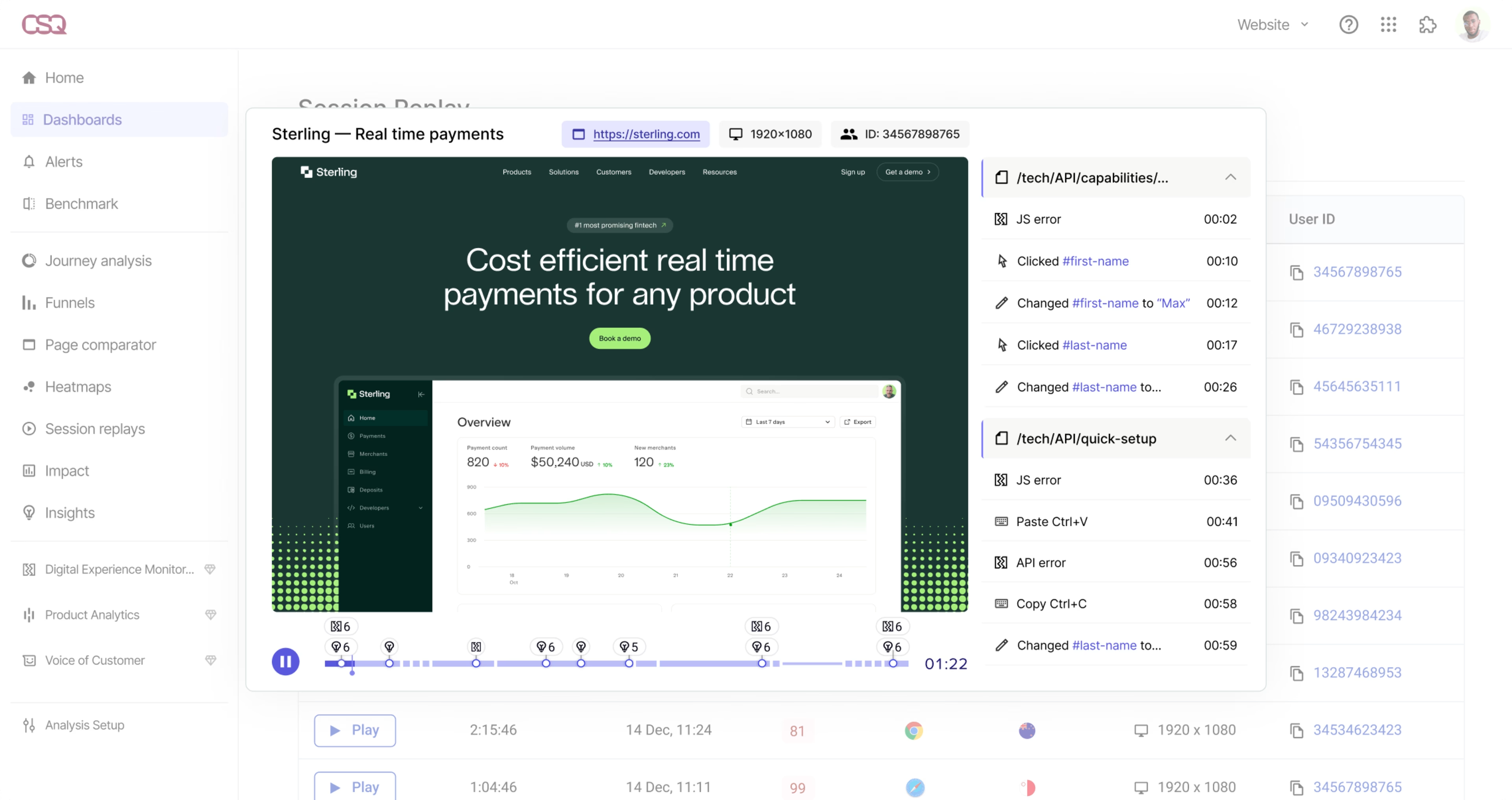
Watch session replays to discover how people explore your site and compare how users from different acquisition channels behave
4. Compare user journeys—and recreate the best ones
Don’t just see where users come from: watch where they go next. Contentsquare’s Journey analysis capability is a vital part of any customer acquisition analytics strategy, revealing the exact pages and touchpoints your users visit before they convert (or bounce).
What pages are they landing on first? What’s the sequence of their clicks? What actions are they taking? Are they filling out forms, making purchases, or abandoning carts?
Understanding this helps you correlate different actions with the ultimate conversion rate. For instance, does a visit to a particular blog post or product page usually lead to higher conversion? This is invaluable information you can use to refine your customer acquisition efforts, for example by leveraging it across other channels or bringing the same messaging into your landing pages.

Use Contentsquare’s Journey Analysis to see the full user path from acquisition to conversion and identify which touchpoints influence the outcome
5. Find and fix UX issues that affect acquisition
Poor user experience—like broken buttons, incorrect links, and confusing layouts—can quickly thwart your acquisition efforts. Use Contentsquare’s Heatmaps capability to get a visual aggregation of where users click, tap, scroll, and move on key pages, enabling you to spot frustration signals (like rage clicks) and quickly address the underlying issues.
Understand which design elements and content users engage with and identify which parts of your page get ignored, like crucial signup forms they don’t scroll down far enough to see. Then, use these customer behavior insights to make data-driven optimizations, fix errors, tweak layouts and calls-to-action (CTAs), and boost your conversion rates.
![[Visual] Heatmaps types](http://images.ctfassets.net/gwbpo1m641r7/44qPX6Nyu2v2i9pGM8JdIE/e1ccfd573959295483bb4b867ca7e57f/Heatmaps___Engagements__3_.png?w=2048&q=100&fit=fill&fm=avif)
Heatmaps to get a visual representation of where users click, tap, and scroll on your page, highlighting which elements catch their attention and which ones get overlooked
💡 Pro tip: use Sense, Contentsquare’s AI, to automatically surface the worst areas of friction and understand what to prioritize based on their impact on user experience. Let your analytics platform bring customer behavior insights to you with AI-powered alerts that keep you one step ahead.
![[Blog] Predictive personalization - Sense frustration IMAGE](http://images.ctfassets.net/gwbpo1m641r7/7CJd1Lbsu5D6mU1Eeyv9TH/f1127c713c342865da1d0ca606b620d9/Session_replays_event_stream.png?w=3840&q=100&fit=fill&fm=avif)
Sense identifies issues, provides insights, and offers related session replays to watch back the moments in real time.
How to measure acquisition performance: key metrics to track
As you implement the above strategies, there are a few different ways to measure the performance of your customer acquisition efforts. Here are some core metrics and KPIs to watch.
Customer acquisition cost
Customer acquisition cost (CAC) is the average cost of acquiring new customers in a given time period. To calculate CAC, use the formula:
CAC = cost of acquiring customers in a given period / number of new customers in the same period
CAC is a useful indicator of the effectiveness of your marketing and sales efforts, but it’s most helpful when combined with other metrics, such as customer lifetime value.
Customer lifetime value
Customer lifetime value (LTV or CLV) is the amount of revenue a user is predicted to bring in over the entire course of your business relationship. There are a few ways to calculate this based on whether you want to use historical or predictive data, but a very simple formula is:
LTV = customer value x average customer lifespan
Compare this to your customer acquisition cost using the LTV:CAC ratio to get a fuller picture of your acquisition performance. For many businesses, the sweet spot is an LTV:CAC ratio of 3:1, which indicates that acquisition is keeping a healthy pace with business growth.
Conversion rate
Your conversion rate is the number of potential customers (such as site visitors) that convert in a given time period expressed as a percentage. The ‘conversion’ event may be making a purchase, signing up for a free trial, or becoming a paid subscriber, depending on your business type and goals. To calculate, use the formula:
Conversion rate = [number of people who converted / number of potential customers] x 100
Customer churn and retention rate
Customer churn and customer retention aren’t technically related to acquisition—but if you want to measure the ultimate efficacy of your customer acquisition strategy, you need to monitor how many of those new users are sticking around. Otherwise, you’re just pouring money into a leaky marketing funnel.
To measure your customer churn rate, use the formula:
Churn rate = [number of customers lost in a given period / total number of customers at the start of the period] x 100
To measure your customer retention rate (CRR), use the formula:
Customer retention rate = [number of active customers at the end of the period / total number of active customers at the beginning of that period] × 100
Tracking both these metrics as part of your acquisition analytics strategy helps you keep a pulse on not just how many new customers you’re generating, but whether they’re the right kind of customers for your business. If not (for example, if new users are churning almost as fast as you’re acquiring them), you’ll know it’s time to dig into your acquisition analytics tool to investigate further.
Understand what drives conversion with Contentsquare
With the right customer acquisition analytics tool, you can identify the factors that cause—and prevent—conversions, enabling you to create more effective customer experiences that boost acquisition.
Contentsquare gives you all the customer behavior insights you need to follow the customer journey from first touch to conversion, so you can attract more right-fit customers and turn them into long-term advocates.
FAQs about customer acquisition analytics
Customer acquisition analytics is the process of collecting, analyzing, and interpreting data related to how your business attracts and converts customers.