
When budgets are tight and competition is high (let’s be real: when aren’t they?), product teams need to get strategic.
Instead of relying on guesswork and assumptions, forward-thinking teams use lean experimentation to get valuable data without burning through their resources, or budgets.
Lean experimentation differs from traditional experimentation because it doesn’t require expensive tools or extensive work. Instead, it’s all about being agile, flexible, and efficient, enabling teams to validate assumptions quickly, optimize user experiences, and drive growth.
So whether you want to improve user onboarding, better engage your prospects, or enhance monetization, read on for 3 quick and lean experiments you can set up today—to start making improvements tomorrow.
Experiment 1: watch session replays to improve user onboarding
Effective user onboarding is crucial to user engagement and retention. Helping users get value from your product doesn’t just set them up for success—it sets your product up for success too. It becomes an integral part of their workflow and turns users into loyal, long-term customers.
To improve user onboarding, you need to listen to your users and understand their pain points.
Start by watching how different users navigate your product or website using Contentsquare’s Session Replay. These replays give you a first-person view of the user experience, revealing where people click, hover, scroll, and get frustrated.
With these insights in mind, identify potential improvements to the onboarding user experience, then start A/B testing to put your hypotheses into action. Fine-tune elements like messaging, calls-to-action (CTAs), and explanatory pop-ups to create a more intuitive, user-friendly onboarding flow.
For example, if you discover users frequently rage click on a certain part of your signup flow, it might suggest they’re looking for more information. Try adding a helpful tooltip when they hover over that area, and monitor the rage clicks to see if they decrease.
Once you have enough user behavior data from your experiments to draw conclusions, implement your new and improved onboarding flow across your product and monitor the results.
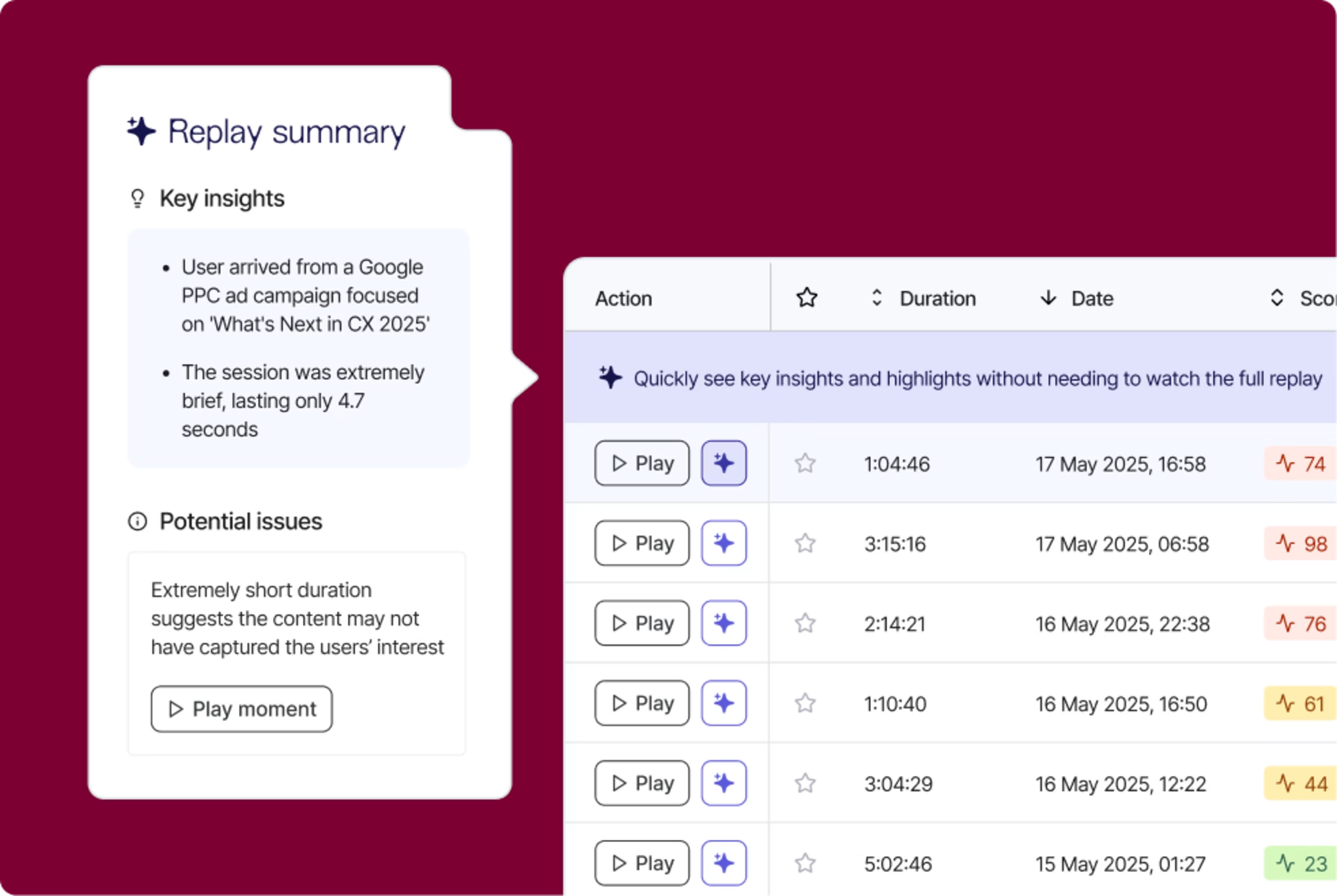
Use Session Replay as part of your lean experiments to quickly understand how users navigate your site or app
Experiment 2: use journey analysis to increase conversions
Exploring the path users take before converting can be enlightening. For example, you might find visitors from different acquisition channels, like social media vs. organic search, take different customer journeys before signing up for a demo—or certain user segments are more likely to bounce.
Using Contentsquare’s Journey Analysis, work backward from the most valuable journeys (that is, those that lead to the most conversions) and see the exact path those users took. Segment the journeys by channel, campaign, or user behavior, and zoom into related session replays to get even more granular insights about each user cohort.
Once you’ve mapped out the optimal path (remember, there may be different ‘optimal’ paths for different types of users), create a lean experiment to guide more site visitors in that direction. This could include
Showing different content or landing pages to different user segments
Adding more CTAs, changing their placement on the page, or testing different ones with new text or imagery
Including additional information on key pages, like product specifications or FAQs
Incorporating social proof like customer logos, testimonials, or reviews
Track the results of your experiment—for example, use Contentsquare’s Heatmaps to measure engagement with new site elements—and compare the signup rates from the ‘new’ path with the previous user journey to understand how it affected conversion rate.
![[Customer Story] [Clarins] Journey Analysis](http://images.ctfassets.net/gwbpo1m641r7/4nozxbnvlcRqDnxYjbPNnm/707c4b2a2c0c36077eb336538bb1098c/Complex.svg?w=1920&q=100&fit=fill)
Experiment 3: boost monetization down funnel
Many SaaS tools have multiple pricing tiers, and the best way to determine the gap between different tiers is through the data you collect on your site. But for many product teams, paywalling customers when they move between different tiers can be a huge pain.
This is where lean experimentation really shines. Start by segmenting users based on usage limits to determine where they should sit across your tiers.
Or, you can use segmentation to work backward from your highly engaged and highest-paying users to discover the premium features integral to their workflow. With this data, you can target similar users on lower tiers—for example, users in the same industry or with the same use case—and offer them free trials of those features so they can experience the value for themselves.
Then, sync these user groups across tools like Appcues and Marketo, where you can coordinate messaging and block users from certain features. This allows you to experiment with personalized user flows and access, so you can find the right combination to boost monetization.
![[Blog] Predictive personalization - Segments - IMAGE](http://images.ctfassets.net/gwbpo1m641r7/2T3dC4D7croDfiAhedFBET/17278fea0d0739886569174f26f57e63/Understand_user_journeys_towards_key_conversions.png?w=1920&q=100&fit=fill&fm=avif)
Segment your users to find new opportunities to increase monetization
Key principles for success in lean experimentation
For your lean experiments to be successful, you need to follow 3 fundamental principles. These principles empower product teams to make data-driven decisions, streamline processes, and achieve positive outcomes in a short space of time.
1. Leverage both qualitative and quantitative data. Data is crucial, but don’t rely on numerical inputs only. Product teams should combine quantitative data (like conversion rates and bounce rates) with qualitative data (like user feedback and survey responses) to form hypotheses and win stakeholder buy-in.
2. Use the right tools to work quickly and efficiently. Using an all-in-one digital experience platform with powerful product analytics capabilities, product teams can track and monitor user data in real time. This enables quick and efficient data-driven experiments and measurable impact. Integrate a product analytics tool with A/B testing platforms like AB Tasty to streamline the workflow, making it even easier to run and analyze lean experiments.
3. Iterate rapidly based on experiment results. The biggest benefit of lean experimentation is how quickly you can put your findings into action. Rapid iteration and a culture of continuous improvement allows your product teams to fine-tune their strategies, optimize user experiences, and drive product growth.
Small experiments, big results
Lean experimentation lets you capture valuable data with minimal resources, empowering even the most time-strapped teams to get customer insights that inspire user-centric updates. Using a product analytics platform makes your lean experimentation strategy even more powerful, enabling you to quickly run and analyze experiments and providing real-time data that enhances decision-making.

Anna is a freelance content writer and strategist specializing in B2B SaaS. She's written for industry-leading companies like Contentsquare, Hotjar, Intercom, DocuSign, HubSpot, and more. When she's not writing, she spends her time reading, drawing, and hanging out with her cat.