![[Visual] Content feedback - stock image](http://images.ctfassets.net/gwbpo1m641r7/3VIxae9gYdfHTaMYr25eph/96af0a02a3248b25f83d10b360591acc/Magic_Oil_-_Photo_4.jpg?w=3840&q=100&fit=fill&fm=avif)
As clean, reliable data becomes integral to everything from exec-level business decisions to ongoing marketing campaigns, it’s never been more important to have the right data management tools in place.
No longer just for analysts and business intelligence specialists, today’s data management tools bridge the gap between data teams and key end-users like marketers and product managers, providing real-time data to support evidence-based, customer-centric decisions at every level.
But with so many data management solutions on the market, how do you know which ones are right for your company? Read on to learn the 6 top data management tools to meet a range of customer needs and business processes, and transform raw data into actionable insights.
Key insights
Data management tools are software designed to help businesses capture, organize, and analyze data efficiently. They improve data governance, reduce redundancies and errors, and break down data silos across customer touchpoints to provide a full picture of user needs.
There are several types of data management tools, including data warehouses, database management systems (DBMS), data integration tools, data analytics platforms, behavioral data management tools, master data management (MDM) solutions, and data modeling and visualization software.
To choose the right data management software for your team or business, consider factors such as your current data maturity, business requirements and goals, scalability, integration with your existing tech stack and data architecture, and budget (both initial pricing and long-term cost of ownership).
1. Behavioral data management: Contentsquare
One of the most powerful data sources at your disposal is real customer behavior. How users act on your site or product throughout the customer lifecycle reveals essential information about their preferences, needs, and frustrations that you can use to improve the customer experience (CX), optimize journeys, and ultimately increase satisfaction—and revenue.
Contentsquare captures clean, reliable user behavior data across key touchpoints, then organizes and analyzes it. You can export these analyzed datasets and insights to your warehouse and combine them with data from other sources (like CRM and business intelligence tools) for more effective data modeling and management. Here’s how:
Collect essential behavioral and experience data from tools like Journeys, Heatmaps, Session Replay, and the AI-based Frustration Score. Contentsquare’s unified platform reduces data silos, connecting the dots between tools and systems to transform raw data into trusted, accessible insights that your team can instantly action for maximum results.
Smart Capture automatically captures every interaction from day one, without requiring a complex tagging setup, providing a complete, retroactive dataset.
Then, use Data Connect to export this experience and behavioral data into your warehouse of choice, enabling it to be part of the broader data ecosystem and ensuring you never lose sight of the human end-user at the heart of all the numbers.
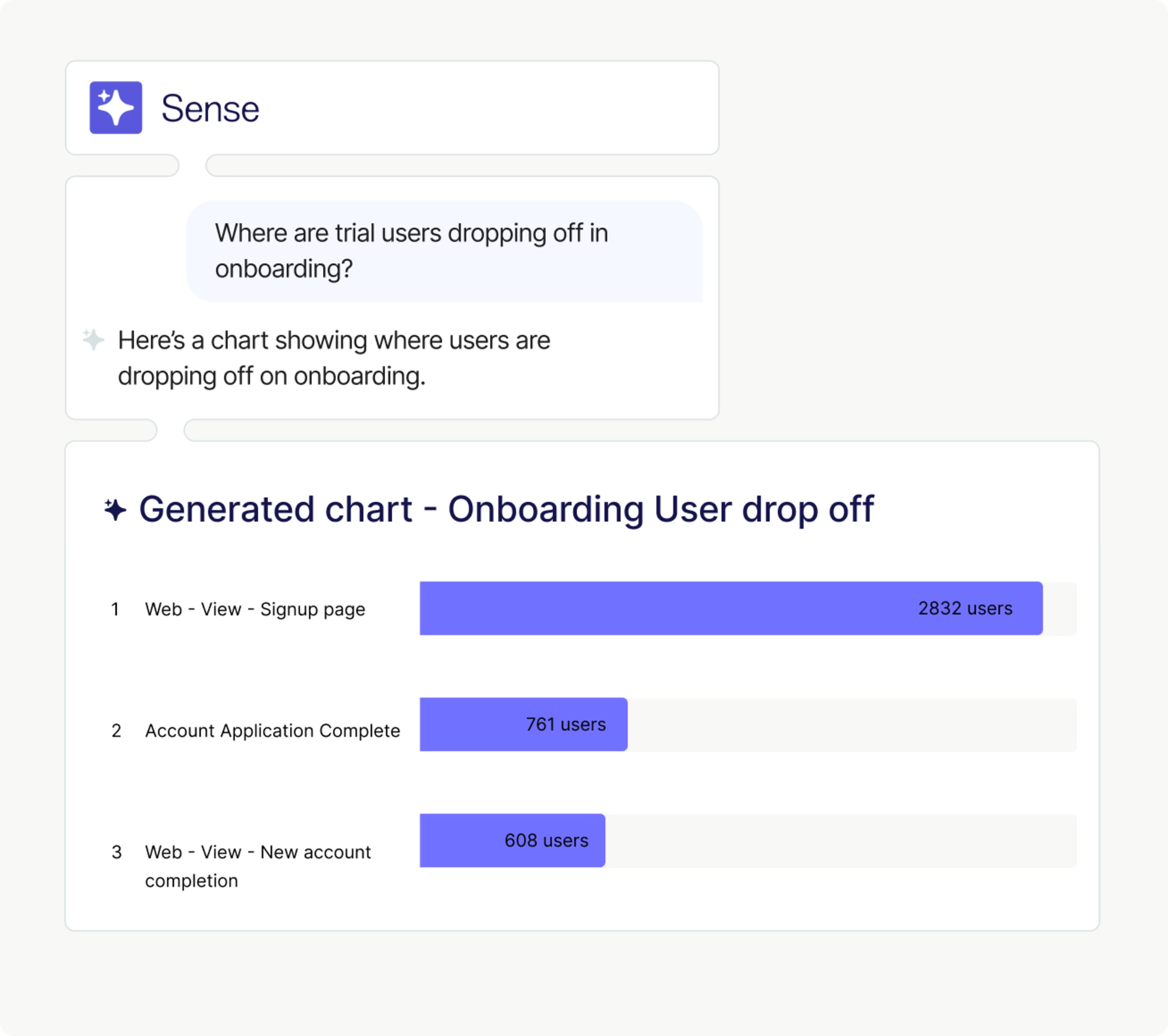
💡 Pro tip: empower every user with Contentsquare's AI agent, Sense Analyst. Sense automates every stage of the data analysis process to simplify workflows, improving data management and breaking down usage barriers to help teams find patterns, proactively predict problems, and make data-driven, agile decisions that optimize the digital experience.
2. Data warehousing: Snowflake
Snowflake is a cloud-native data warehouse used to store business data from multiple sources.
Data warehouses are a fundamental part of any data strategy. By consolidating all business data into one place, warehouses create a single source of truth for data engineering and analysis, break down silos between tools and platforms, and help reduce data quality issues like inconsistencies and replication. This ensures everyone has up-to-date, accurate, and high-quality data to fuel complex analysis, strategy, and decision-making.
Snowflake’s multi-cloud architecture runs on Amazon Web Services (AWS), Microsoft Azure, and Google Cloud Platform (GCP) to provide additional flexibility and service resilience, streamlining workloads across regions and cloud providers and enabling teams to store all data types.
In addition to data storage, Snowflake has built-in security and governance features, support for AI and machine learning (ML) capabilities, and an AI agent to help teams analyze their data. It separates the compute, storage, and service layers to improve data protection and optimize costs based on your business’s actual usage, helping teams to manage their resources more effectively.
Alternatives: Amazon Redshift, Oracle Database, Peliqan
💡 Pro tip: integrate Contentsquare with Snowflake to democratize data across your organization and unlock unprecedented insights. Use Data Connect to provide Snowflake’s AI agent, Snowflake Intelligence, with behavioral data from Contentsquare and empower everyone—from business analysts to marketers, product managers, and support specialists—to get instant answers to their questions, like
How does the frustration score affect renewal rates?
How did users engage with our recent marketing campaign, and what was the impact on revenue?
Which in-app user journeys commonly lead to support tickets?
![[Visual] Data Connect](http://images.ctfassets.net/gwbpo1m641r7/78lJG8kGk6ifl1DusTJnoS/97013645900ae9f27c85f5aacba535d6/Contentsquare-Data-Connect.svg?w=1920&q=100&fit=fill)
3. Data integration and transformation: Qlik Talend Cloud
Qlik Talend Cloud is an end-to-end data management platform that provides integration and transformation functions to combine data from multiple sources and deliver it, ready to use, to your warehouse or data lake.
Its data integration capabilities ingest and integrate data from a range of sources, including SaaS tools (like your CRM and digital experience platform) and proprietary databases, including sensitive data behind firewalls or on-premises. It automatically syncs data and keeps it up to date and accurate.
Talend’s transformation tools let you perform basic transformations—like standardizing metadata and adjusting missing or incorrect values—and advanced ones, like customizing data marts and automating warehouse creation, with a built-in AI assistant that accelerates workflows. Talend supports both ETL (extract, transform, load) and ELT (extract, load, transform) data processing, helping data teams maintain consistency and quality, quickly identify issues, and prevent untrustworthy, bad data before it becomes embedded in your warehouse.
Alternatives: Oracle Data Integrator, IBM DataStage
💡 Pro tip: a robust data integration strategy ensures that you’re working from a complete and reliable dataset. Look for solutions (like Contentsquare) that integrate effortlessly with the other tools you use every day—like your communication, experimentation, and CRM software—to keep your data and workflows connected.
![[Visual] Share in real time via Slack](http://images.ctfassets.net/gwbpo1m641r7/NrQzonnNWGmn6RAF33WFI/ea4eb10640a11305675b4c4df6b0b0e1/Real_time_dashboards__1_.png?w=3840&q=100&fit=fill&fm=avif)
Integrate Contentsquare with the other software you use, like Slack, to keep your data connected
4. Master data management: Informatica MDM
Informatica MDM is an enterprise-grade suite of tools for master data management (MDM) across cloud-based and on-premises systems.
It uses data integration, reconciliation, enrichment, quality, and governance capabilities to create a single master record for each piece of information—such as customers, products, and suppliers—to consolidate business-critical data into one unified, comprehensive view.
Its AI and ML functions, like AI agents and AI-driven match and merge, streamline workflows, enhance data quality, and enable users to self-serve to improve productivity.
Alternatives: SAP, Profisee, Oracle Enterprise Data Management
5. Data governance: Collibra
Collibra is a data governance tool that enables teams to enforce their governance standards and policies across all data assets and systems to ensure full visibility and control.
It lets you implement guardrails to build compliance into your organization’s processes across the entire data lifecycle. Define and automate key data governance processes, automatically enforce data privacy policies, and assign role-based access to data assets to reduce risk and protect against compliance failures.
Data governance is a vital part of any data management strategy, ensuring your organization’s data is reliable, accessible, and secure. This is essential as new data use cases and opportunities evolve. A strong data governance foundation enables businesses to scale their processes safely and responsibly, allowing you to quickly adopt emerging technologies like AI—and gain competitive advantages.
Alternatives: Atlan, Alation, Informatica Cloud Data Governance and Catalog
💡 Pro tip: well-managed data is essential to meeting your compliance and regulatory requirements. Download our Privacy-Conscious Analytics Guide to learn how Contentsquare protects your—and your customers’ data—to ensure compliance with industry-leading standards and deliver peace of mind.
6. Real-time data streaming: Apache Kafka
Apache Kafka is an open-source distributed event streaming platform that moves real-time event data between systems reliably, at enormous volumes, and with low latency. This is used to build data pipelines and streaming applications that respond instantly to events, such as customer sign-ups or transactions.
Bringing real-time data streaming into your data management tech stack enables you to automatically assess and act on opportunities as they happen. For example, use real-time event streams to personalize customer experiences, trigger advertising based on user preferences, or identify and intercept fraud attempts.
Alternatives: Amazon Kinesis, RabbitMQ
Enrich your data management strategy with user behavior data
Improved data management benefits every team, leading to better customer experiences, fewer silos, faster insights—and more immediate impact. Solid, reliable, and accessible data powers everything from personalization campaigns and digital experience optimizations to fraud protection and regulatory compliance.
Use data management tools to fuel both technical and non-technical teams alike and turn data chaos into clarity, enabling everyone to access and analyze trusted, well-governed data to make data-driven decisions.
FAQs about data management tools
Data management tools are software used to collect, store, organize, analyze, and govern data throughout the data lifecycle. They’re used to improve data quality, create a reliable and consistent dataset that functions as a single source of truth for decision-making, and support analysis throughout the organization.
![[Visual] Contentsquare's Content Team](http://images.ctfassets.net/gwbpo1m641r7/3IVEUbRzFIoC9mf5EJ2qHY/f25ccd2131dfd63f5c63b5b92cc4ba20/Copy_of_Copy_of_BLOG-icp-8117438.jpeg?w=1920&q=100&fit=fill&fm=avif)