
The company
Olaplex is a haircare brand rooted in science, with a mission to empower individuals to achieve healthier hair from the inside out. The company has become a leader in its scientifically-backed, bond-building solutions that actively repair and protect hair health.
Olaplex is trusted by professionals and consumers alike for creating treatments and maintenance products that help reduce breakage and restore hair strength.
The challenge
Alexandra Alessi, VP of Brand.com at Olaplex, oversees the company’s site experience, as well as retention marketing and customer service. She says the website—which operates across multiple markets and languages—was in need of a “facelift.”
“We wanted to really make sure the website was functioning from a back-end perspective and a technical perspective,” Alexandra says.
Kim Efonye, Senior Analyst and Ecommerce Optimization Specialist at Olaplex, says the company embarked on a full website redesign while maintaining a seamless customer journey experience for individual markets and languages.
“This meant the redesign had to be backed up by real data, not guesswork, and we also had to minimize disruptions to existing users,” Kim says.
Olaplex faced several key challenges:
Unclear customer journeys: the team lacked visibility into how users moved through the site, especially from the homepage to checkout
Underused on-site content: educational content, such as quizzes and blogs, wasn’t being leveraged effectively
Need for a data-driven redesign: the redesign process had to be informed by real user behavior data, ensuring decisions were backed by insight, not best guess

At every phase of the website design, Contentsquare was a key strategic partner.

The solution
Kim says the digital team tackled the redesign across 3 key stages, using a combination of tools—including Contentsquare, Optimizely, Google Analytics, and Shopify—to validate every decision.
Pre-launch
To start, the team needed an overarching view of every high- and low-performing element across their key pages. They also wanted to identify errors or pain points during this pre-work phase to keep the customer experience front-of-mind right from the start.
Kim says Contentsquare’s Zone-based Heatmaps was the “most impactful” pre-launch feature because it gave a visual representation of what users were engaging with most (and least) on certain pages.
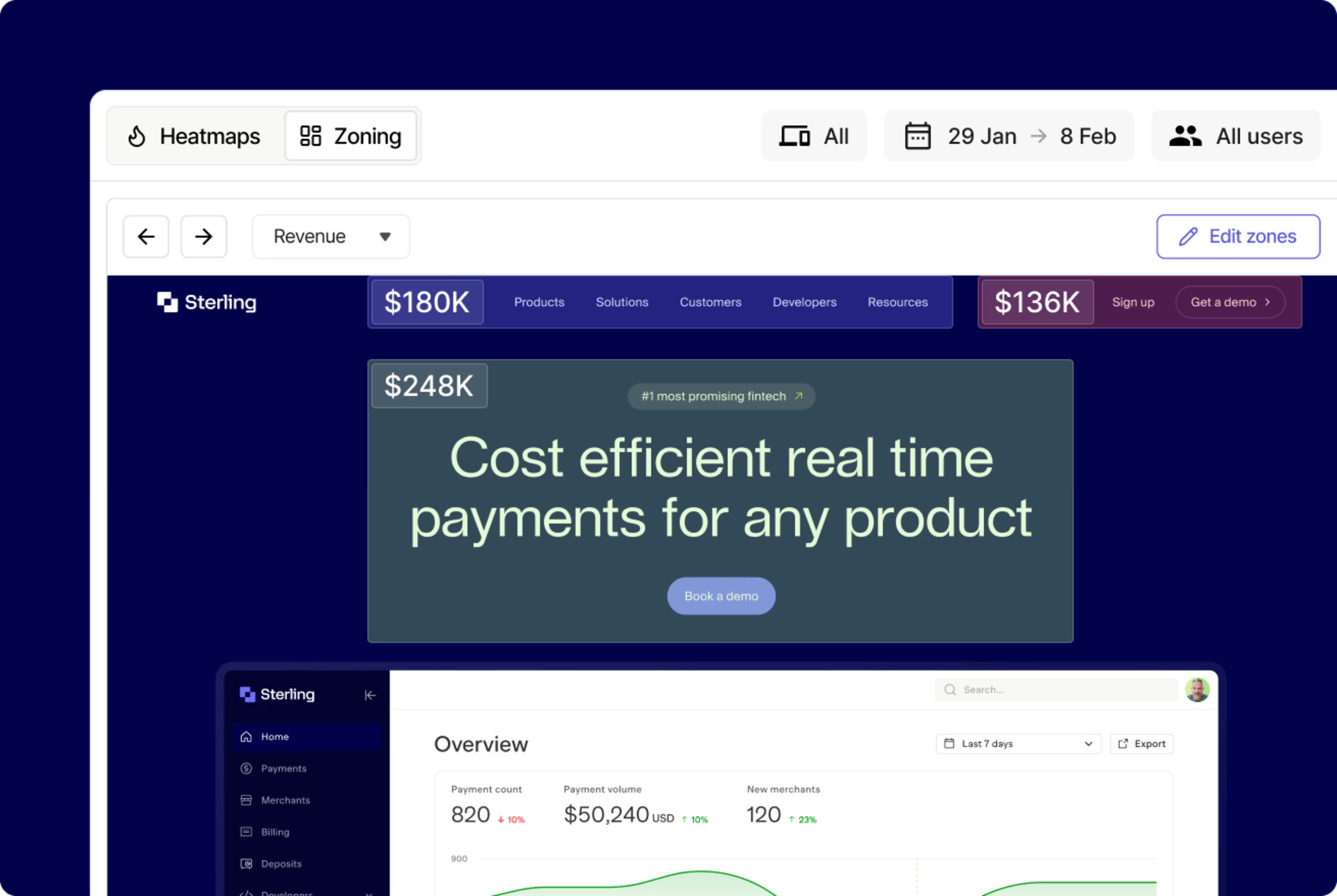
“By looking at it with certain metrics, such as click rate, sales, exposure rate, or attractiveness rate, it really told us a story of what modules probably need to be changed,” Kim says.
“That way, we’d make changes based on user behavior instead of guesswork. If we didn’t have Contentsquare, it would have been a more subjective redesign.”
Everyone has an ideal opinion of what a homepage or a specific page should look like but with Contentsquare, we had real user data, which became our source of truth vs. guesswork.

During the launch
The team continued to use Contentsquare during the launch phase to monitor user reactions in real time so they could spot issues and early signs of success.
Using Contentsquare’s integration with Optimizely, they could A/B test designs and layouts to find, and more importantly, understand, winning variants.
Alexandra says being able to make agile, data-backed changes was pivotal during the launch phase.
“We were able to identify where we should run A/B tests and how we should work with our user experience (UX) and user interface (UI) designers to change some of the designs,” says Alexandra.

Post launch
After launch, Kim says the team used Contentsquare’s Error Analysis capability to see where frustrations were coming from across the site. They drew insights from Error Analysis reports and made quick, business-driven changes to select pages and journeys within weeks of launch.
With Contentsquare’s Journey Analysis and Zone-based Heatmaps, the team was able to validate the launch’s impact and continue identifying further optimizations in the customer journey—something they still do now.
![[Customer Story] [Clarins] Journey Analysis](http://images.ctfassets.net/gwbpo1m641r7/4nozxbnvlcRqDnxYjbPNnm/707c4b2a2c0c36077eb336538bb1098c/Complex.svg?w=1920&q=100&fit=fill)
“Journey Analysis gives you a quick, visual representation of where users are landing on your page, where they’re dropping off, but also the recipe to success,” says Kim.
“Overall, [it] really helps you identify frustrations, and optimize the customer journey end-to-end.”
Kim says while the look and feel of the customer journey needed to be seamless, the site’s usability was just as important. That’s why monitoring user behavior data and web performance data, including Core Web Vitals, was critical.
“Our account manager set up a dashboard to monitor site performance metrics because, yes, while we were focusing on the redesign of the website to look good, we also needed to make sure the back end of the site was loading as intended,” says Kim.
“[This helped] increase SEO and loading speed too.”

Alexandra says there’s always more work to be done, refining journeys and removing friction points.
“Post launch, we use Contentsquare to identify where people are dropping off, where there might be friction, where there are things we didn't think about that maybe we now need to continue to evolve,” she says.
Contentsquare now provides added context to what the team is seeing across its other analytics platforms.
“A lot of the time, I’ll start with a KPI we’re seeing within our Shopify Analytics dashboard or Google Analytics and we’ll need to go deeper to better understand why we’re seeing this,” Alexandra says.
“Are people bouncing from the site? Why is there no engagement rate on this page? Whatever we’re trying to figure out, Contentsquare enables us to dive deeper and to really understand what might be the root cause. Then, we use the platform to identify a solution and resolve it as quickly as possible.
“Being able to visually express what’s happening on the website means you can not only leverage those quantitative KPIs but also that qualitative user experience.”
We use Contentsquare daily; it’s one of our key ecommerce and analytics tools.
The results
Alexandra says the redesign was more than a facelift: it was a global transformation for their business that
+51% improvement in Largest Contentful Paint (LCP)
+18% increase in checkout funnel conversions
20-second reduction in checkout journey time
+31% improvement in conversion rates
–2% drop in bounce rates
Improved user frustration levels, significantly across JavaScript and API errors
One of the biggest wins was internal. We set a new standard for how decisions are made: data over opinion. This shift toward a more evidence-based approach not only saved time but also improved cross-functional alignment. Teams moved faster, with fewer rounds of debate, and with more confidence in the outcomes.
What’s next
Alexandra says one of the biggest things Olaplex is looking into next is AI.
“Not just across the ecommerce team and not even just with Contentsquare, but how do we harness the power of a lot of data and use AI to help do analysis quicker, to find the right things to focus on,” Alexandra says.
In fact, the team is already using Contentsquare’s AI, Sense, to analyze user sessions with Session Replay Summaries, a report that summarizes user behavior and key friction points, and provides links to examples of those friction points.
![[Asset] Session replay summaries](http://images.ctfassets.net/gwbpo1m641r7/37Slb23dAdFsAgNItuUNPc/5ad533ecdc801e082aeef8bfaca324ce/sessionreplaysummary.webp?w=3840&q=100&fit=fill&fm=avif)
“[Contentsquare’s Sense] has been helpful for us to communicate to other teams that are maybe not as deep into the ecommerce world to help make changes or recommendations on the website,” Alexandra says. “We’re really trying to focus more on personal user journeys and melding that with quantitative data.”
Alexandra says the combination of Contentquare’s Session Replay capability and the AI-powered summaries has helped them “build a narrative or persona around what’s happening on the website.”
The platform’s visual elements and cross-team sharing capabilities have helped democratize data throughout the company.
“The hair and beauty space can be a very emotional category, and it can be very subjective when people are talking about visuals or things they want to see,” Alexandra says.
“Contentsquare really enables us to make as many data-backed decisions as we can and to really share that information with the wider organization. That’s helped not only upskill our team, but upskill a lot of other teams as well…to make sure we’re putting the user experience at the core of everything we’re creating.”


![[Customer story] [Diptyque] Logo](http://images.ctfassets.net/gwbpo1m641r7/3IuHSnkSSR1lOHsbpn0pCb/f02e9fa8d8b9e66f58696205652ebe4a/image.png?w=3840&q=100&fit=fill&fm=avif)