
A website tracking tool will track, measure, and report on website activity and user behavior including traffic, user clicks, and performance (for example, conversion rate).
Tracking tools show you what's happening on your website so you can learn what is (and isn’'t) working, make data-driven decisions, and optimize for improved UX and business goals.
Whether you're new to website tracking or looking to get in-depth insights beyond the usual traffic stats, you'll find the best tools below.
Key takeaways
Website tracking tools fall into three categories: traffic analytics, behavior tracking, and performance monitoring. Most teams need at least one from each to get a complete picture of their site.
Free tools like Google Analytics and Contentsquare provide robust tracking for most use cases, with paid upgrades for enterprise needs.
Choose tools based on your primary goal—often validated by industry case studies: traffic growth, conversion optimization, or technical performance.
Understand your users with Contentsquare
Use Contentsquare to safely track user behavior and understand how people experience and interact with your website or app.
Website tracking tools comparison chart
Tool | Category | Best for | Pricing | Standout feature |
|---|---|---|---|---|
Google Analytics | Traffic | Overall traffic analysis | Free (paid upgrade available) | Industry-standard metrics |
Adobe Analytics | Traffic | Enterprise multichannel | On request | Advanced segmentation |
Matomo | Traffic | Privacy-conscious teams | From $26/month | Open-source, self-hosted option |
Fathom | Traffic | Simple, privacy-first tracking | From $15/month | Lightweight, GDPR-compliant |
Contentsquare | Behavior | Understanding the "why" behind user actions | Free tier available | AI-powered frustration detection |
Optimizely | Behavior | A/B testing and experimentation | On request | Statistical rigor |
VWO | Behavior | Conversion optimization | From $173/month | Visual editor for tests |
UserTesting | Behavior | Qualitative user research | On request | Real user feedback |
Mixpanel | Performance | Product analytics | Free up to 20M events | Event-based tracking |
Google Search Console | Performance/SEO | SEO monitoring | Free | Direct Google search data |
Ahrefs | SEO | Keyword and backlink tracking | From $129/month | Comprehensive SEO suite |
Semrush | SEO | Competitive SEO analysis | From $139/month | Competitor research |
Website traffic tracking tools
Traffic is usually the first thing that gets tracked on a website or app. Traffic metrics can tell you how many users you have, how they found you (such as via social media or Google Ads), how long they spend browsing different pages, and how frequently they're converting into customers.
Key traffic metrics you can track include bounce rate, pageviews, user source and medium, session duration, user location, device type, new vs. returning users, event tracking, and conversions.
1. Google Analytics
Google Analytics is the veteran of the list and the most popular website analytics tool, offering extensive tracking functionality. GA4, now fully mature, puts more emphasis on how users use your site, not just traffic volume.
What you can track: new and returning users, engagement, revenue, retention, demographics, conversions, and events.
Best for: teams that need a free, comprehensive traffic analytics foundation.
Pricing: free (with limits); upgrade to the paid version (Google 360) for more features and unlimited traffic.
Pro tip: complement Google Analytics' quantitative user data with Contentsquare's qualitative intelligence to gather even more valuable insights through the Contentsquare and GA integration.
2. Adobe Analytics
Adobe Analytics is a real-time traffic analytics and multichannel data collection tool providing real-time data, designed for advanced users and enterprise companies.
What you can track: business intelligence (BI) and traffic data from websites, emails, and apps, including pageviews, unique users, purchases, order attribution, segmentation, and customer journey analytics.
Best for: enterprise teams needing advanced segmentation and cross-channel attribution.
Pricing: on request.
3. Matomo (formerly Piwik)
Matomo is an open-source web traffic analytics tool.
What you can track: unsampled traffic metrics, ecommerce and event tracking, custom reports, custom dimensions, goals, and segments.
Best for: teams that want full data ownership with a self-hosted option.
Pricing: try the free plan, or from $26/month for Business plan.
4. Fathom
Fathom is a simple, privacy-focused analytics tool.
What you can track: site views, unique views, average time on site, bounce rate, goal completions, referrers, country, user device, and browser type.
Best for: teams prioritizing simplicity and GDPR compliance without cookie banners.
Pricing: 30-day free trial, from $15/month for 100,000 pageviews.
Pro tip: website tracking isn’t limited to websites you own, you can also track traffic on competitor websites with tools like SimilarWeb, Ahrefs, and Semrush. The data isn't 100% accurate but should give you a relative understanding of how your website traffic compares to other sites.
Website behavior tracking tools
By tracking traffic, you'll get a good idea of what's happening on your website: the most popular pages, where people leave from, and where they spend time browsing. But to understand why users behave the way they do, you need behavior tracking.
Behavior tracking shows you where your users click and how they scroll or navigate between different web pages. The main goal is to measure user experience, find actionable insights to improve UX, and as a result, increase conversions and revenue. Common behavior tracking methods include:
Heatmaps: see an overview of where users click, tap, and scroll on a page
Session recordings: view how each user browses across multiple pages
A/B testing: create page design variations and test which performs better
Surveys and feedback widgets: get direct feedback from users and track sentiment and satisfaction over time
User testing: interview users as they navigate your site
5. Contentsquare
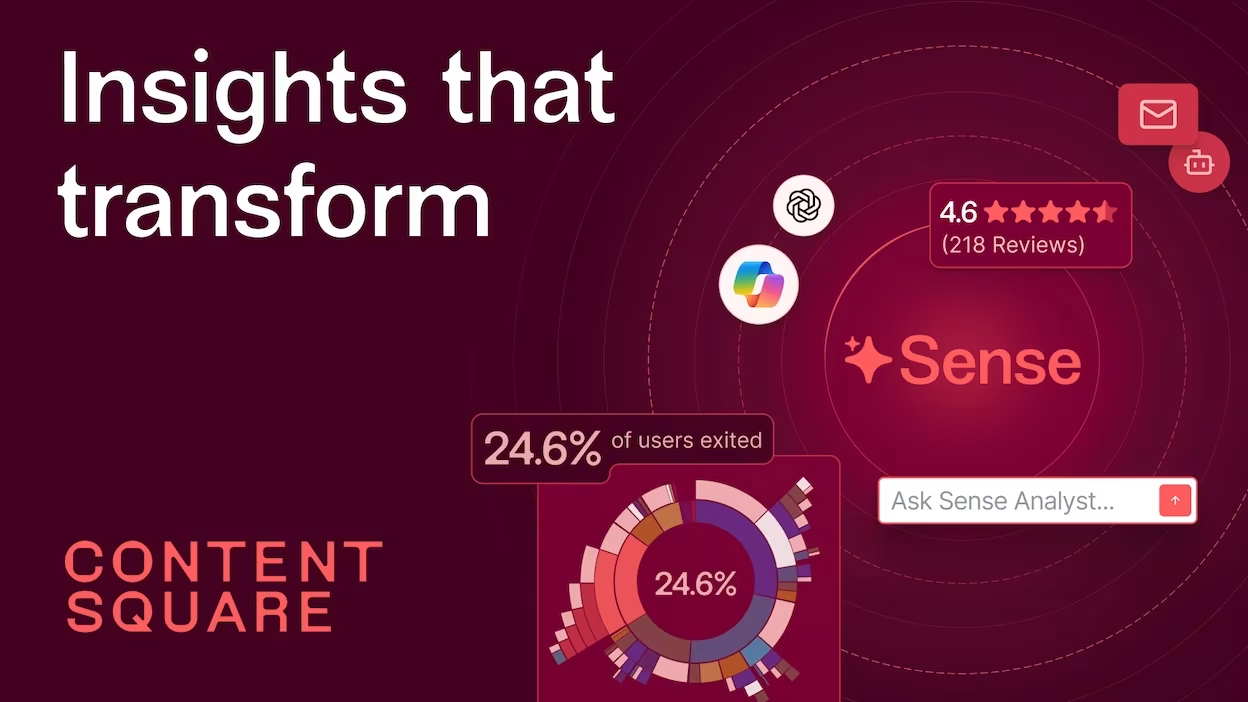
Contentsquare provides visual behavior insights and in-the-moment feedback, all in one place
Contentsquare is an AI-powered customer experience intelligence that helps you connect the dots between what your users do and why, all in one place, so you can confidently create and optimize user experiences that convert.
What you can track: product experience insights like aggregated user clicks, scrolls, and mouse movement with heatmaps; individual user browsing behavior with session recordings; and user feedback with on-site surveys and feedback widgets, conversation Insights, quality assurance, and AI agent analytics.
Best for: teams that want to understand the 'why' behind user behavior with AI-powered insights. The frustration score feature automatically surfaces sessions where users struggled, so you can prioritize fixes that matter most.
Pricing: Contentsquare offers three separately purchasable products, each with their own plan tiers, including free options and paid plans (Growth, Pro, Enterprise).
Pro tip: Contentsquare isn’t technically a single website visitor tracking software, it’s many tools in one platform, including Journey Analysis and Funnel Analysis to identify where users drop off in multi-step processes, then watch recordings to understand why. The platform integrates with popular tools like HubSpot, Slack, Microsoft Teams, Mixpanel, Unbounce, and more.
6. Optimizely
Optimizely is a website optimization tool that allows you to run website experiments.
What you can track: A/B, MVT, and split testing results to test variations of different landing pages and optimize performance.
Best for: teams running rigorous experiments who need statistical confidence in their results.
Pricing: on request.
Pro tip: Contentsquare integrates with Optimizely so you can filter session replays and trigger surveys by page variant, giving you more data to understand why some pages outperform others.
7. VWO
VWO (Visual Website Optimizer) is a conversion optimization platform that combines A/B testing with behavior analytics.
What you can track: A/B and multivariate test results, heatmaps, session recordings, and form analytics.
Best for: marketing teams who want a visual editor for creating test variations without developer support.
Pricing: from $173/month for the Testing plan.
8. UserTesting
UserTesting is a usability testing platform that recruits people to test your website.
What you can track: measure qualitative user experience by watching test participants use your app, product, or website and answer questions.
Best for: teams that need direct user feedback and want to watch real people interact with their product.
Pricing: on request.
Website performance tracking tools
Once you're tracking website traffic and user behavior, the only thing left to measure is how your website is performing in relation to your business goals.
Tracking website performance is about measuring the metrics that matter most to your business. For a product team, that might be customer churn or retention. For an ecommerce team, it's likely sales and conversion rate. Whatever metrics matter to your business, there's a tool to track them.
9. Mixpanel
Mixpanel is a product analytics tool that tracks performance on mobile and web applications.
What you can track: product metrics like activation, retention, and churn.
Best for: product teams focused on user engagement and retention metrics.
Pricing: free for up to 20 million monthly events.
Pro tip: connect the what to the why with the Contentsquare and Mixpanel integration: filter recordings, heatmaps, trends, funnels, and dashboard data by specific Mixpanel events, or trigger surveys when they happen.
10. Google Search Console
Search Console is a free search optimization tool from Google.
What you can track: measure SEO performance, view keyword impressions and clicks, see your backlinks, and check for crawling and speed errors.
Price: free.
SEO and keyword tracking tools
If growing organic traffic is a priority, dedicated SEO tools help you track keyword rankings, monitor backlinks, and identify opportunities to improve your search visibility.
11. Ahrefs
Ahrefs is a suite of SEO tools to monitor and grow website traffic from search engines.
What you can track: keyword rankings, backlinks, website speed, and broken links for your own and competitor websites.
Best for: SEO teams that need comprehensive keyword research and backlink analysis.
Pricing: from $129/month.
12. Semrush
Semrush is an all-in-one SEO and competitive research platform.
What you can track: keyword rankings, organic traffic estimates, backlink profiles, site audits, and competitor analysis.
Best for: teams that want to combine SEO tracking with competitive intelligence to see what's working for competitors.
Pricing: from $139/month.
How to choose the right website tracking tool
With so many options available, picking the right website tracking tools comes down to matching tools to your specific goals and constraints.
Match tools to your tracking goals
Start by identifying your primary objective:
Traffic growth: if you need to understand where users come from and which pages perform best, start with traffic analytics tools like Google Analytics or Matomo
Conversion optimization: if you know you have traffic but users aren't converting, behavior tracking tools like Contentsquare help you see exactly where users struggle
Technical performance: if site speed or SEO rankings are your focus, tools like Google Search Console and Ahrefs give you the data you need
Most teams benefit from using at least one tool from each category. For example, pairing Google Analytics (traffic) with Contentsquare (behavior) gives you both the 'what' and the 'why' behind your website performance.
Evaluate integration and ease of use
Consider these practical factors before committing:
Existing tech stack: does the tool integrate with your CMS, CRM, or other analytics platforms? Seamless data flow saves time and reduces errors.
Team technical skill: some tools require developer support for implementation, while others offer no-code setup.
Implementation time: free trials help you test whether a tool fits your workflow before committing.
Understand your users with Contentsquare
Use Contentsquare to safely track user behavior and understand how people experience and interact with your website or app.
FAQs about website tracking tools
Website tracking tools are software that monitors, records, and analyzes how users interact with your website, including their traffic sources, visitor behavior patterns, and conversion actions. They range from basic traffic analytics to advanced behavior tracking that shows exactly how users navigate your pages.
![[Visual] Contentsquare's Content Team](http://images.ctfassets.net/gwbpo1m641r7/3IVEUbRzFIoC9mf5EJ2qHY/f25ccd2131dfd63f5c63b5b92cc4ba20/Copy_of_Copy_of_BLOG-icp-8117438.jpeg?w=946&q=85&fit=scale&fm=avif)
![[Guide] [Behavior analytics] Strategy - Cover image](http://images.ctfassets.net/gwbpo1m641r7/2mYjwn6o7Ifwx2h19dmA9V/fcb2b0375023eb3072e886ce0605d7fb/5744496.jpg?w=624&q=85&fit=scale&fm=avif)
![[Visual] Group or team](http://images.ctfassets.net/gwbpo1m641r7/32JzPMpv2HCcGRrdmakrvx/c7467f340be42d9d1fdc2d0fcf79d2d6/Neurodiversity__4___1_.png?w=624&q=85&fit=scale&fm=avif)